

She storms in with fury, fires off accusations, and walks out drenched—literally. In the hit period drama The First Jasmine (莫离), Ye Ying’s (叶莹) every confrontation with her rival Ye Li (叶璃) ends not in victory but in farce. Viewers have laughed at her clumsy schemes, yet beneath the comedy lies a sharper question: why does this young woman fail so spectacularly every single time? The answer isn’t simply that Ye Li is too clever. It runs deeper, into the very soul of the man Ye Ying married—and the brutal political chessboard she never knew she stepped onto. This is not a story of good versus evil, but of innocence colliding with a world that eats it for breakfast. And at its heart, one uncomfortable truth emerges: some people are not made for the game they are forced to play.
The Comedy of Misplaced Rage
Ye Ying’s opening move is always the same—righteous indignation. In the latest episode, she corners Ye Li at the palace garden, demanding, “Didn’t your Lishan Academy (离山书院) teach you shame? You keep pestering my husband even after the engagement was broken.” Her voice trembles with what she believes is moral authority. But Ye Li, calm as still water, replies with three quiet questions that expose Ye Ying’s own hired assassination attempt. Within sixty seconds, the accuser becomes the accused. Ye Ying’s face freezes, her mouth opens and closes like a beached fish—and the audience knows another beatdown is complete.
What makes these scenes hilarious is not cruelty but absurdity. Ye Ying never learns. She brings a knife to a gunfight, then complains the other side fights dirty. When Ye Li casually deflects her shove, Ye Ying tumbles into a pond—splash, gasp, and soggy silk. She sputters accusations while floating like a drenched cat. The show’s director frames these moments with slapstick timing: Ye Ying’s elaborate entrance, her towering anger, then the deflation. It is pure physical comedy, but it also reveals her tragic flaw—she mistakes passion for strategy, and loudness for strength.
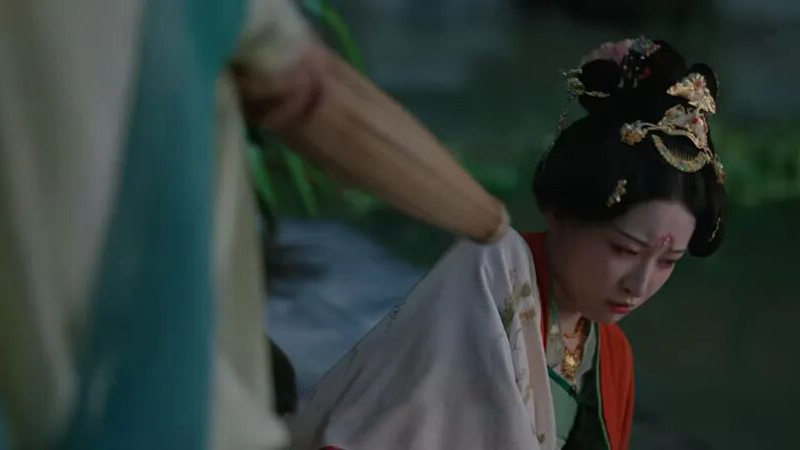
Yet here is the odd sympathy: Ye Ying is not malicious. After her failed attempt to learn flute-playing to impress her husband—she hired a master, practiced for weeks, and when she blew the first note, the peacocks fled, the servants ran, and even the garden lizards scattered. She stomped her foot, yelled once, then dismissed the tutor without punishment. No one got beaten, no one lost their job. Her rage evaporates like morning mist. She is petty but not cruel, impulsive but not calculating. In any normal household, she would be the annoying but harmless sister-in-law. But she married into a viper’s nest.
The Prince Who Plays Dead
Now meet Mo Jingli, her husband. On the surface, he is a poetic dandy—strumming his qin all day, hosting wine parties, sighing over lost love. He weeps dramatically when Ye Li rejects him, even threatening to jump into a lake. Ye Ying watches this performance and burns with jealousy, believing he still loves his ex-fiancée. But the show’s clever writing peels back the mask. Every tear Mo Jingli (墨景黎) sheds is calculated. Every melancholic tune he plays covers the sound of secret couriers arriving with military reports. He is not a heartbroken artist; he is a hibernating wolf.
As the imperial grandson, Mo Jingli lives under the ever-watchful eye of the Dowager Empress. She destroyed his father, sidelined his branch of the family, and now monitors his every move. His public persona—the useless, lovesick fool—is his shield. He broke off the engagement with Ye Li not because he stopped loving her, but because her powerful family would have alarmed the throne. He married Ye Ying precisely because her father’s household was influential yet politically neutral—a perfect bridge to build his secret network. She was never a wife; she was a diplomatic hostage in his bedroom.
This is the man Ye Ying shares a pillow with. While she frets over his cold glances and his lingering gaze on Ye Li, he is drafting troop movements and bribing generals. He speaks to her in hollow endearments while his mind maps the palace’s escape routes. She thinks their marital problem is another woman; he thinks their marital problem is that she exists as a liability. The gap between her domestic worries and his national conspiracy is a canyon. She cannot see it because she never looks beyond the courtyard wall. He ensures she never does.

When a Sparrow Marries a Hawk
Consider the assassination subplot—pure dark comedy. Ye Ying, fuming after Mo Jingli’s fake suicide attempt, decides to kill Ye Li. She hires a killer with all the subtlety of a toddler hiding a cookie. They agree not to look at each other’s faces, not to speak the target’s name, only to write it on paper. But after exchanging notes, she adds nervously, “Actually… don’t kill her. Just capture her and bring her to me.” The killer nods, they part, run in panic, circle the same tree, and crash face-first into each other. They see everything. The scene is so absurdly inept that viewers laugh out loud—but it also proves Ye Ying cannot even orchestrate a crime properly.
Contrast this with Mo Jingli’s quiet efficiency. He never raises his voice, never threatens openly. He lets his enemies overreach, then crushes them with evidence he’s collected for years. He waits. He endures. He smiles at the Dowager Empress while poisoning her trusted eunuch’s tea. Ye Ying, by contrast, cannot wait through a single flute lesson. She acts on every impulse, speaks every thought, wears her heart on her embroidered sleeve. In his world, that is not honesty—it is suicide. She is not his partner; she is his weakest seam, the one spot where an enemy’s knife might slip through.
So the real tragedy of Ye Ying is not that she loses to Ye Li—it is that she married the wrong man for the wrong reasons. Mo Jingli needed a chess piece; she wanted a romance novel. He needed silence and patience; she offers noise and tantrums. If she had wed a minor official, a scholar, or even a merchant who valued her clumsy warmth, she might have lived a contented life—bickering, laughing, growing old with someone who found her antics endearing rather than dangerous. But the royal court does not forgive innocence. It exploits it, then discards it. Her failures are not her stupidity; they are her humanity screaming inside a machine built for wolves. And that, perhaps, is the show’s quietest lesson: in the game of power, the kindest heart is often the first to drown—not because it is weak, but because it refuses to believe the water is poison.