

Does Ye Li’s Chest-Tied Dress in The First Jasmine (莫离) Really Stay Up Without Falling? Ancient weavers and painters left us the answer—and it has nothing to do with body shape.
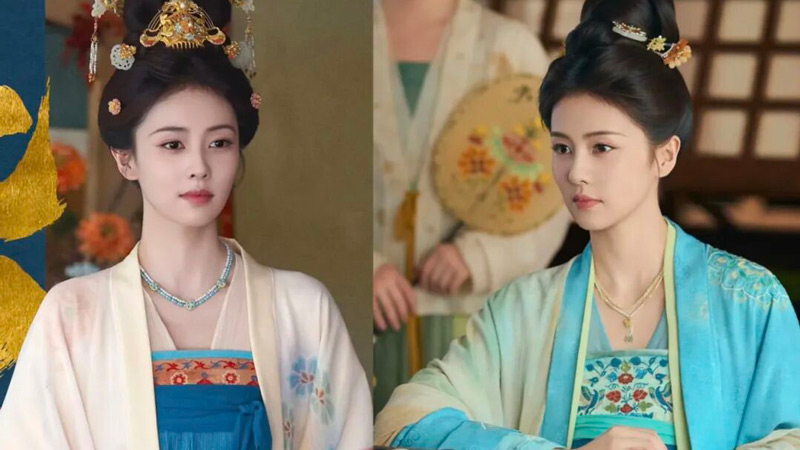
When viewers watch the historical drama The First Jasmine, many fixate on a single question: how does Ye Li (叶璃), played by Bai Lu (白鹿), keep that chest-bound skirt from sliding down? The garment hugs the ribcage without elastic, straps, or modern stretch fabric. Online chatter often claims it “relies entirely on the bust to hold it up.”
But that take is a major misunderstanding of Tang-style jacket-and-skirt construction. Based on surviving murals, excavated tomb figures, and traditional textile crafts, the so-called Qixiong skirt (齐胸裙) stays secure through a complete dressing system—fit, fabric choice, and tying technique. It has no absolute link to body size or shape.
The Grip Logic
Modern people habitually tie belts at the waist, a natural curve that acts like a locking notch. A wrapped skirt stays put as long as the cords are tight. The Tang-era Qixiong skirt simply moves that anchoring point from waist to chest, following the same mechanical principle. It is not loosely draped over the breasts. The skirt’s headband is wide enough to wrap fully around the torso. By winding and tightening the ties in multiple layers, the band presses against the ribcage to form a closed-loop grip.
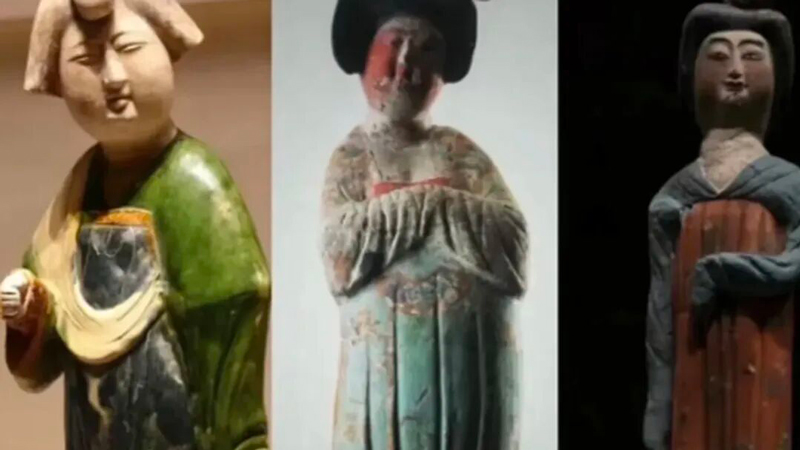
When the fabric fully contacts the body and the circumferential pull is evenly distributed, a stable “clasp structure” emerges. Even during daily actions—walking, raising arms, or light movement—the skirt rarely slides down as a whole. Ancient people lived active lives: feasting, dancing, and traveling all happened while wearing Qixiong skirts. If the garment depended solely on bust support, it could never meet normal living demands.
The key is that the skirt does not rely on a single point of friction. Instead, it creates a continuous band of pressure around the chest area. This is similar to how a well-fitted barrel hoop stays on a barrel: even pressure, not a protruding shape, prevents slipping. The design respects the body’s geometry without expecting any particular curve.
Fabric Secrets
Tang-dynasty dyeing and weaving had reached a high level of maturity. Craftsmen never used slick, lightweight materials for the skirt’s headband. The main fabric was coarse-patterned silk brocade, thick hemp cloth, or cross-weave fine twill silk — all with rough surfaces and high friction. Some deluxe skirts added an inner lining of the same rough textile against the skin.
In contrast, many modern reproductions use chiffon or imitation silk for a flowing, pretty look. The headband and ties become glass-smooth. This low-friction material lets knots loosen gradually even when tied tightly. That is why many Hanfu enthusiasts complain that modern Qixiong skirts slip down. The original Tang ties were thick cotton-linen or woven ribbons—stiff, resilient, and resistant to slipping or loosening.
Also, the skirt’s inner design often included a separate lining layer that added weight and cling. The combination of rough outer fabric and slightly heavier lining created a sandwich effect. When tied, the two layers moved as one unit, increasing the surface friction against the body. This is a forgotten but brilliant piece of pre-modern engineering.
Ancient Solutions
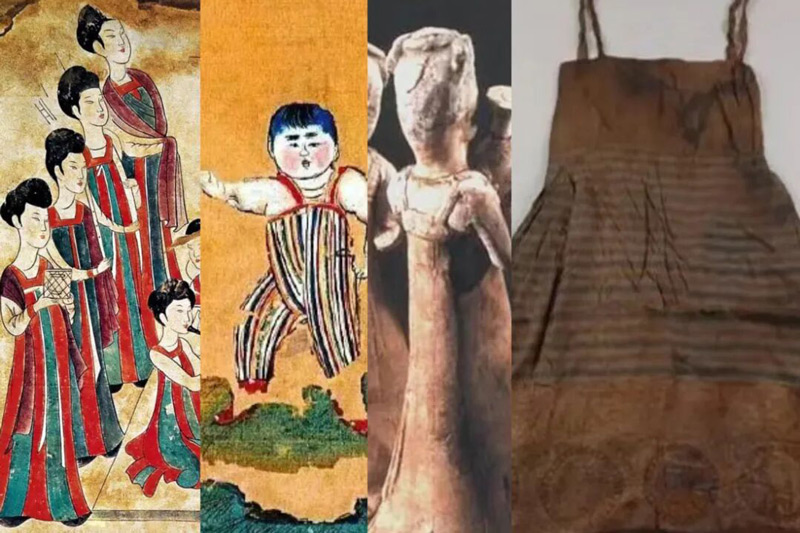
Flat-chested wearers often wonder: without a visible curve at the ribcage, wouldn’t the skirt fall more easily? The answer is no. Looking through Dunhuang murals, Tang-dynasty tomb pottery figures, and court lady paintings, one finds two major versions of the Qixiong skirt: strapless and strapped. Shoulder straps or suspenders are not rare in surviving Tang depictions. The straps share the downward pull of the skirt, adapting to any body type and fundamentally solving the slipping problem.
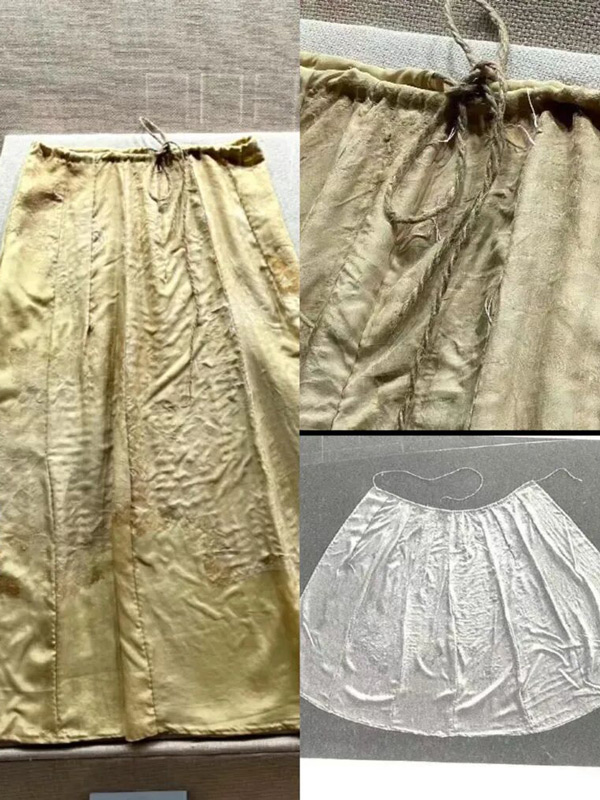
Beyond straps, the Tang period also produced skirts with built-in drawstrings or hidden cinch bands. These used localized tightening to assist fixation. Such variants never became as famous as the classic strapless style, so few people know about them today. The lesson is that ancient designers already considered different body shapes and different usage scenarios. They did not force one single cut onto everyone.
Of course, a Tang-style Qixiong skirt is not “absolutely impossible to drop.” Wrong winding of the ties, loose knots, or an overly soft and thin headband fabric can still cause slipping. That is no different from any modern skirt whose waistband comes undone. No garment works without correct wearing method. Stability always begins with proper dressing technique.
For today’s Hanfu wearers, we can borrow ancient wisdom. If you buy a Qixiong skirt with slippery fabric, try adding a non-slip inner lining, invisible silicone grip strips, or clear thin straps for extra support. And if the chest-high style never feels right, don’t force it. The natural-waist jacket-and-skirt was also a mainstream choice through many dynasties. As long as the cut is correct and you feel comfortable, it remains a classic option passed down for millennia.
In the end, the stability of the Tang Qixiong skirt comes from structure, material, and craftsmanship working together. Reducing it to “body support” underestimates ancient makers’ ingenuity and misreads the brilliant design of traditional Chinese clothing. Only by noticing these details can we truly appreciate the blend of function and beauty behind classical garments.