

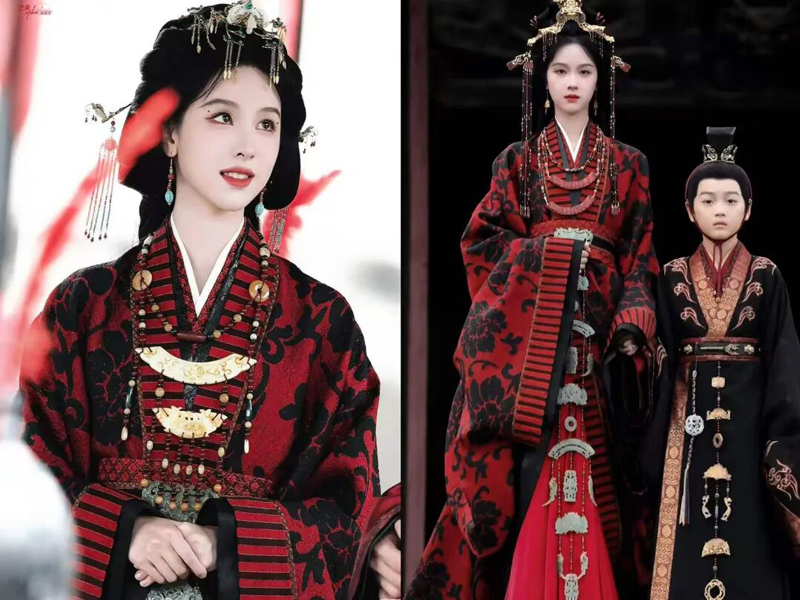
Chen Duling (陈都灵) wears a striking red-and-black striped gown in the period drama Ashes to Crown (翘楚). Viewers instantly cry, “Those look like modern knitwear stripes!” But were ancient Chinese really using such clean, linear patterns two thousand years ago? The answer lies in a single tomb from the Warring States period (c. 475–221 BCE). And what it reveals might just flip your idea of “ancient fashion” upside down.
Stripes in a Silk Tomb
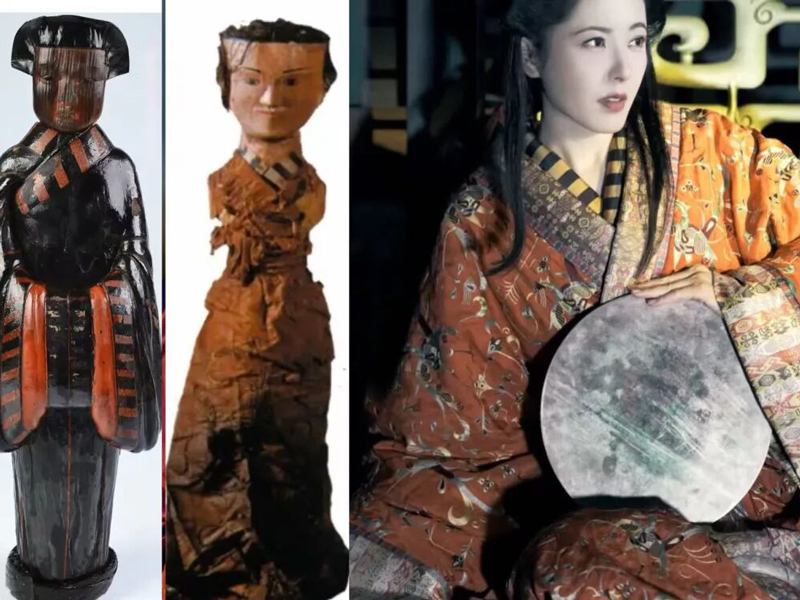
In 1982, archaeologists opened the Mashan No.1 Chu Tomb (马山一号楚墓) in Hubei province. Inside, they found over thirty preserved silk garments—robes, jackets, and sheer single-layer gowns. These are the most complete set of Chu (楚) textiles ever unearthed. To their surprise, many robes featured neat, multi-colored striped bands at the collar, cuffs, hem, and waist. The stripes were not printed on the main fabric but woven as narrow brocade-like ribbon and sewn onto the edges. That is exactly the technique seen on Chen Duling’s costume in Ashes to Crown. The drama’s designers did not invent a modern look; they copied a 2,400-year-old tailor’s manual.
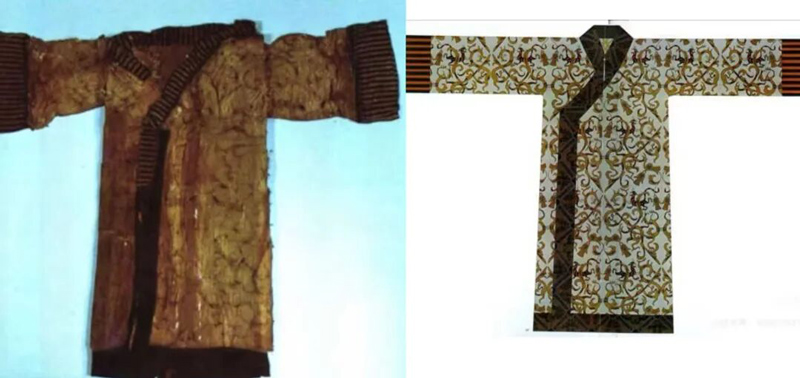
Take one unlined robe from the tomb: its body is densely embroidered with dragons and phoenixes facing each other. But the collar and cuffs are finished with a rhythmic pattern of alternating red, black, and yellow stripes. The contrast is deliberate. The busy central design draws the eye, while the simple linear border gives the eye a resting point. It is the same logic a contemporary fashion editor would use—loud print, quiet trim. Only here, the “editor” was a weaver from the Chu state who never heard of Milan or Paris.
Why did the Chu people love stripes on their clothes? The practical reason is simple: edges of a robe wear out first. Arm movement, friction, and sweat destroy complex embroidery quickly. A tightly woven striped band is tougher. It protects the more delicate fabric of the robe body. But there was also a visual trick at work. Chu robes were famously wide-sleeved and full-skirted. Large floral or animal motifs can make a person look bulky. Vertical stripes along the hem and horizontal ones on the cuffs create an optical illusion—they slim the silhouette and add structure. Sound familiar? That is exactly how a 2024 designer uses stripe trim on a puffer jacket.
Red, Black, and a Lost Palette
The colors are no accident either. Chu culture worshipped red and black. From lacquerware to bronze vessels, from painted coffins to silk banners, these two colors dominate every surviving Chu artifact. Red symbolized life, fire, and the south; black represented water, the north, and the unknown. Together they formed a cosmic balance. When Chen Duling’s character appears in a black robe with red floral vines and blood-red stripes, she is not just looking dramatic. She is wearing the spiritual DNA of an entire kingdom. The drama’s costume team, however, modernized the main body pattern—using scrolling vines instead of exact phoenix motifs. Yet they kept the red-and-black stripe trim intact. That choice tells us something important: the creators knew that the stripe, not the flower, was the authentic Chu signature.
Here is where many viewers get tripped up. We are trained to think “ancient Chinese clothes” mean gold dragons, peonies, and clouds packed onto every inch of silk. That is actually a later imperial aesthetic from the Ming and Qing dynasties (14th–20th centuries). The Warring States Chu people had a completely different sensibility. They loved bold geometry, high-contrast color blocking, and what we would now call minimalism. The stripes on those tomb robes are not rustic or primitive. They are crisp, almost brutalist in their repetition. If you saw a Chu noblewoman walking down the street, you might think she stepped out of a Bauhaus exhibition. That timeless quality is exactly why modern eyes mistake ancient stripes for a contemporary knit.
One more detail: the stripes on the Mashan robes vary in width. Some bands have thick black lines next to thin red lines, then a yellow pinstripe. This is not random. Chu weavers calculated visual rhythm. They alternated widths to avoid monotony, just as a modern graphic designer kerning a typeface. The striped edges on Chen’s costume follow the same principle. The drama’s artisans did not just copy a pattern; they reconstructed an ancient sense of proportion. That is rare in period dramas, which often slap random “traditional” motifs onto costumes without understanding why they worked.
Why Your Brain Says “Modern”
So if the stripes are truly ancient, why do so many online comments call them “modern-looking”? The answer is not about the costume. It is about our own limited mental image of history. We unconsciously believe that older equals more ornate, more chaotic, more “folk art.” When we encounter clean geometry from before the Common Era, our brain misfires and tags it as contemporary. But the truth is that basic linear patterns—stripes, checks, herringbone—are among the oldest decorative systems in human textiles. Neolithic weavers in China made striped fabrics 5,000 years ago. The Chu people did not invent stripes. They perfected a language that every era would reuse because the human eye finds order pleasing.
Consider your own wardrobe. You probably own a striped shirt, a pair of ribbed socks, or a jacket with contrast trim. That design choice did not come from a 20th-century art movement alone. It came from thousands of years of trial and error across cultures. The difference is that the Chu tailor framed his stripes with silk embroidery of phoenixes and dragons. Your T-shirt frames them with cotton and polyester. The grammar of stripes is identical. So when you watch Ashes to Crown and feel a jolt of recognition, do not call it an anachronism. Call it a 2,400-year-old handshake between your taste and a Warring States weaver’s taste.

Would you wear a robe with striped edges today? The Chu noble would have laughed at the question. For her, stripes were not a statement. They were simply good craft—durable, slimming, and beautiful. Modern period dramas have spent years piling on wrong details: plastic armor, polyester embroidery, and invented “ancient” patterns. Seeing a show get something as small as a stripe right is actually a milestone. It means costume designers are finally reading archaeological reports. And it means that the next time you spot a “modern” detail in a period piece, you might pause before judging. That stripe on Chen Duling’s collar? It survived the fall of dynasties, the rise of factories, and the blindness of our own assumptions. And it still looks fresh.