

For months, fans of Soul Land 2: The Peerless Tang Clan (斗罗大陆: 绝世唐门) have admired the icy beauty of Snow Empress. She rules the Extreme North, commands seventy thousand years of cultivation, and looks like a goddess carved from frost and moonlight. But a recent online discovery has shattered the assumption that her face came purely from an artist’s imagination.
Sharp-eyed viewers compared multiple screenshots of her expressions—calm, cold, slightly smiling—with photos of an ordinary young woman from real life. The result? Nearly identical bone structure, eye shape, lip line, and even that distant, untouchable gaze. The internet exploded with one question: Did the animation team scan a real person into the show?
Shocking Parallel
When the comparison images first appeared on social media, disbelief spread fast. One fan posted a side-by-side of Snow Empress’s three-quarter profile and the real woman’s same angle. The brow height, the curve of the nasal bridge, the subtle dip of the chin—each feature matched like a mirror. Another user layered a transparent grid over both faces and found the alignment almost perfect. “This isn’t just similar,” one comment read. “It’s a 3D print of a human.” Within days, the hashtag trended across major platforms, pulling in viewers who had never noticed before.
What makes this discovery so striking is that The Peerless Tang Clan is known for high-quality character modeling. Xuanji Technology (玄机科技), the studio behind the series, has built a reputation for avoiding the generic “web celebrity face” that plagues many Chinese animated shows. Yet even their best work usually stays within the realm of artistic invention. Here, the resemblance goes beyond inspiration. It feels like a direct transcription of a living person’s features—right down to the faint tension in her eyelids when she looks downward.

Fans began digging through earlier episodes, pulling frames from Snow Empress’s first appearance in the Extreme North ice plains to her later moments as a soul spirit beside Huo Yuhao (霍雨浩). Every shot seemed to reinforce the match. The real woman, who remains unidentified and may not even know she became a model, has a face that perfectly aligns with the animators’ output. Some joked that the studio should hire her as a brand ambassador. Others wondered if she had secretly posed for a full 3D scan without public knowledge.
Design or Copy?
The debate quickly split into two camps. One side argues that basing a 3D character so heavily on a real person is a form of creative laziness. “Why trace a real face when you can invent something new?” asked a critic on a fan forum. They worry that if every studio adopts this approach, animated characters will lose their fantastic, otherworldly quality. After all, Snow Empress is a seventy-thousand-year-old being from a frozen wasteland. Shouldn’t she look less like a woman you might pass on a city street and more like a creature from myth?
But the opposing view is louder and more passionate. Supporters say that using real human references is exactly what gives Snow Empress her power. Many animated female characters suffer from “same-face syndrome”—smooth, flawless, but completely forgettable. By anchoring her appearance in actual facial anatomy, the modelers created something rare: a beautiful face that also feels authentic. The slight asymmetry in her eyelids, the natural width of her philtrum, the way her lower lip catches light—these tiny details make her feel present, not just drawn. “She breathes,” one fan wrote. “That’s why we love her.”
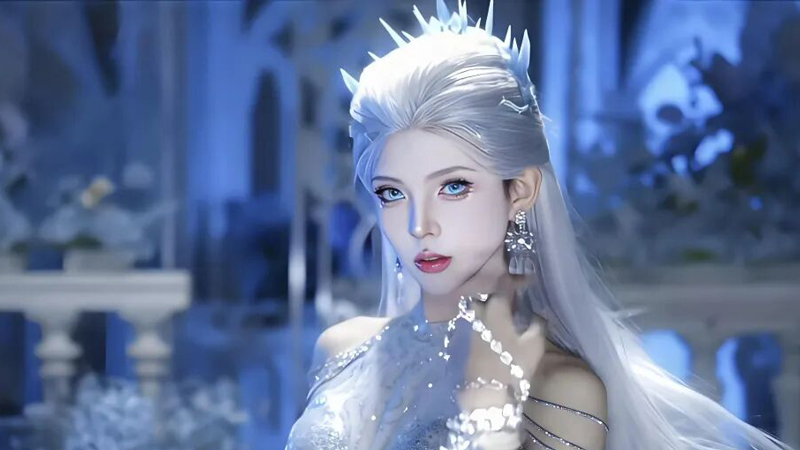
Moreover, this practice is not new in global animation. Major film studios have long used reference models for key characters. The difference here is the degree of precision. Most reference work leaves room for stylization. But Snow Empress’s model appears to have been built almost as a photogrammetric reconstruction of a specific person. Whether that was intentional or a coincidence of design remains unknown. Xuanji Technology has not issued any statement confirming or denying a real-life source. Still, the silence only fuels more speculation—and more admiration for the craftsmanship involved.
A New Standard
Regardless of where one stands on the ethics of facial replication, the Snow Empress incident has changed how viewers watch Soul Land 2: The Peerless Tang Clan. Now, every close-up of her face invites a second glance. Audiences are no longer just admiring her beauty; they are analyzing her bone structure, comparing her to people they know, and asking themselves what makes a digital face feel “alive.” This meta-awareness has actually deepened engagement with the series. Fan art has exploded, with many illustrators now trying to capture not just her fantasy elements but her uncanny human resemblance.
For the industry, this case offers a clear lesson. Viewers crave originality, but they also crave authenticity. A face that looks too perfect feels plastic. A face that looks too strange feels alien. But a face that looks like someone real—someone you might have met—creates an emotional shortcut. It tricks the brain into caring faster. That is why Snow Empress became a fan favorite long before anyone knew about her real-world double. Her design already worked on a subconscious level. The discovery just made that subconscious reaction visible.

Moving forward, more Chinese animation studios may adopt this approach deliberately. Instead of hiding their human references, they might celebrate them—credit the models, release comparison videos, and turn the process into part of the marketing. That would avoid any potential legal issues around unauthorized likeness use. It would also satisfy audience curiosity. Snow Empress has proven that a character can be both a digital goddess and a familiar face. She is the ice queen who lives next door. And thanks to this accidental reveal, she will remain one of the most talked-about figures in Soul Land 2: The Peerless Tang Clan for a long time to come.