

Recently, a behind-the-scenes image of actress Li Yitong (李一桐) on the set of the period drama Golden Branch sparked a wave of nostalgia online. She wore a towering phoenix hairpin, a type of ornate headpiece that instantly reminded viewers of the TV shows they grew up watching. Back then, such grand golden ornaments seemed to crown every noblewoman on screen. Today, they have become a rare sight. What happened?
The answer lies not just in shifting fashion tastes, but in a deeper truth about costume design: it always serves the actor and the character first, never a fixed mold. The old-style phoenix hairpin matched the rounder, fuller faces of past leading ladies. Today’s beauty ideals favor a smaller, paler, more delicate look. And that tiny face simply cannot carry the weight of a giant, glittering phoenix.
Modern Beauty Standards
Let’s talk about face shapes. In the 1980s and 1990s, Chinese television celebrated actresses with square or oval faces—think of the classic Dream of the Red Chamber (红楼梦) cast. Their broader cheeks and balanced jawlines provided a perfect canvas for large, dramatic hair ornaments. A massive phoenix hairpin did not overwhelm them; it anchored their entire appearance, adding authority and elegance. The gold and pearl details framed their features like a halo. It was a harmonious relationship between the woman and her crown.
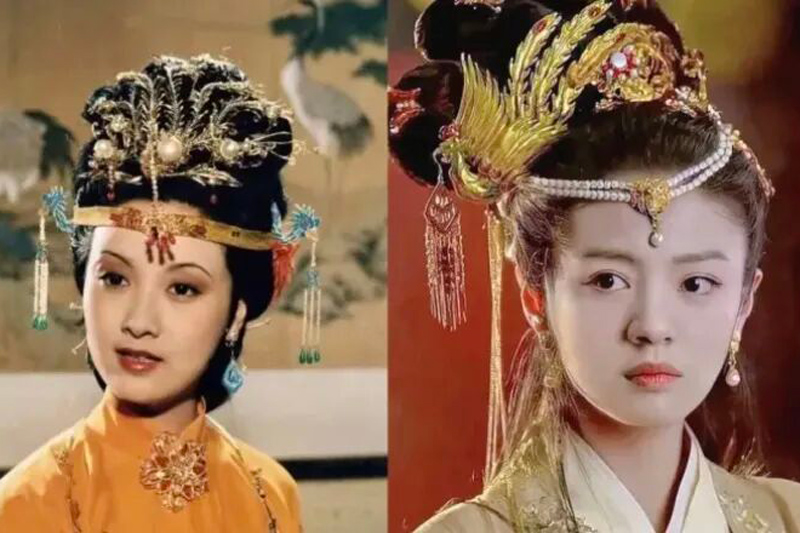
Now, the industry standard has shifted toward what is often described as “bai you shou” (白幼瘦)—pale, young, and thin. The ideal female face has become narrower, with sharper chins and smaller overall proportions. When a costume designer tries to place a traditional Ming-style phoenix hairpin on such a face, the ornament looks absurdly large. It hides the eyebrows, weighs down the forehead, and turns the actress into a walking jewelry stand rather than a compelling character. That is why producers have quietly replaced those magnificent pieces with soft hair bands, light tassels, and smaller pins.
This is not a matter of good or bad taste. It is simply a practical response to who is on screen today. The phoenix hairpin did not vanish because people stopped loving it. It vanished because the faces that once wore it with pride have themselves become rare in mainstream period dramas.
The Golden Age of the Phoenix
No character in Chinese literature or television owns the phoenix hairpin quite like Wang Xifeng (王熙凤) from Dream of the Red Chamber. In the novel’s third chapter, her grand entrance includes this description: “On her head she wore a gold-thread headdress with eight treasures and clustered pearls, coiled with a hairpin of five phoenixes facing the sun, each bearing hanging pearls from its beak.” Imagine five tiny golden birds, each dangling a pearl drop, with a larger pearl or mirror-like bead in front of every beak to mimic rays of sunlight. The craftsmanship alone is staggering.
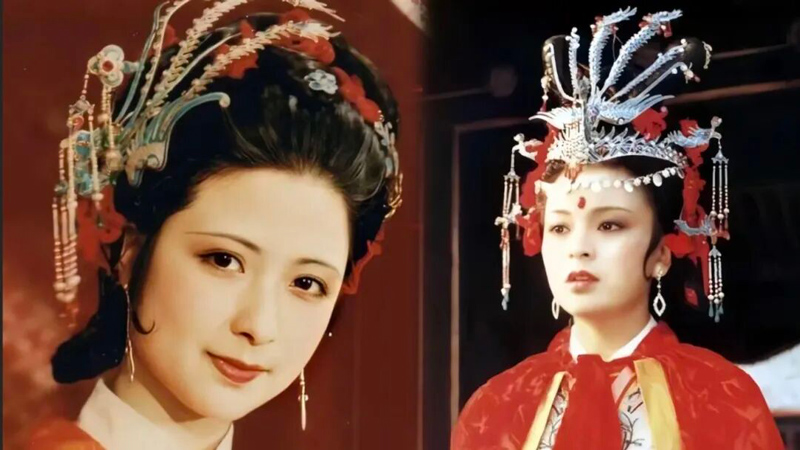
Beneath those phoenixes sat a base piece called the Di Ji (䯼髻), or “gold-thread eight-treasure clustered-pearl headdress.” It resembles a small crown made of woven metal wires, tight to the scalp. The Imperially Revised and Expanded Mirror of Qing (御制增订清文鉴) defines the Di Ji as “a bun-shaped headpiece worn by Han women, hammered from gold and silver like a steamed bun.” This Ming dynasty style—which most period dramas today try to recreate—sits directly on top of a coiled hairdo. It acts as the main event, surrounded by smaller complementary ornaments. The phoenix hairpin was never a mere accessory. It was a statement of rank, wealth, and dramatic flair.
Classic TV productions took creative liberties too. Some integrated Rong Hua (绒花), a velvet flower craft recognized as intangible cultural heritage, into their phoenix designs. Others blended ancient motifs with modern imagination. But the most breathtaking examples come from archaeological finds. The filigree gold phoenix hairpin unearthed from the tomb of Prince Liang Zhuangwang (梁庄王) of the Ming dynasty shows a level of metalwork that even today’s finest jewelers struggle to replicate. The wires are thinner than a hair, the pearls still luminous after centuries. That is the standard the old dramas aimed for.
Two Ways, One Hairpin
Did you know there are two distinct ways to wear a phoenix hairpin? The Zheng Feng (正凤), or “upright phoenix,” sits directly at the front center of the hair bun. It demands respect and formality. In the late Ming period, some noblewomen even used a large Zheng Feng in place of the full phoenix crown for certain ceremonies. The other style, Pian Feng (偏凤) or “side phoenix,” is much more relaxed. It tilts to one side of the head, smaller and more practical for daily life. You could pair it with a simple robe and still look perfectly dressed for a garden walk or a family dinner. The same ornament, two completely different attitudes.

For decades, the phoenix hairpin thrived because it was the ultimate multifunctional status symbol. Put it on, and your entire look instantly elevated from ordinary to imperial. Designers experimented with new alloys, gemstone settings, and even spring-loaded mechanisms to make the phoenixes bob naturally as the actress walked. Then, around the 2010s, big hairpieces fell out of fashion. Headbands and loose hair became the default. Many younger viewers had never even seen a proper Ming-style phoenix hairpin until Li Yitong’s Golden Branch photo went viral.
Now, a quiet revival is underway. Some new productions are bringing back the phoenix, though critics argue that today’s small-faced actresses still cannot carry it. Is that criticism fair? Perhaps not. Wang Xifeng’s actress in the 1987 Dream of the Red Chamber had a round, expressive face that filled the screen. But a different era demands different solutions. The phoenix hairpin may yet return—not as a copy of the past, but as a reinvented symbol. Would you like to see it back? And whose classic phoenix look remains etched in your memory?