
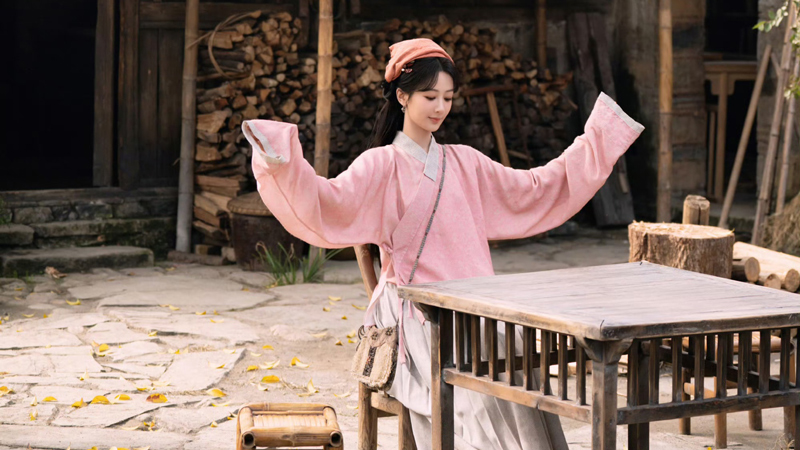
In the misty mountains of Ming Dynasty (1368–1644) Huizhou (徽州), ink was not just for writing. It was bloodline, power, and a woman’s forbidden battlefield. The upcoming historical drama The Mo (家业) brings this forgotten world to life. When a corrupted tribute ink case topples the century-old Li family ink empire, one banished daughter, Li Zhen (李祯), picks up the soot-covered tools her ancestors used. She has no clan, no fortune, and no permission—women do not make ink. Yet by May 17, 2026, her story will ignite screens on CCTV-8 and iQiyi. Starring Yang Zi (杨紫) as Li Zhen and Han Dongjun (韩东君) as Luo Wenqian (骆文谦), this is not another palace romance. It is a gritty, ink-stained fight for survival, legacy, and the right to grind a new future.
The Ink Massacre
A single forged tribute ink stone collapsed a dynasty. In the drama’s opening, the emperor’s tribute ink case explodes into scandal. For generations, the Li family’s Hui ink— prized for its pine-soot depth and lasting luster — dominated the empire. But now, the head of the Li family is disgraced. The eight branches of the clan fracture. And the eighth branch, Li Zhen’s own blood, is expelled entirely. Stripped of their name and home, they become ghosts in the very town their ink built.

Li Zhen watches her father’s hands — once steady on the ink slab — tremble with shame. The family workshop burns. Rival ink houses, like the Luo and Tian clans, circle like wolves. “We are nothing,” an elder whispers. But Zhen refuses. She remembers her grandfather’s lesson: “Ink is alive. It remembers every strike, every fire, every drop of sweat.” So she does the unthinkable. She steps into the smoke-filled mill where no woman has ever tread. Her first batch cracks. Her second smears. Her third… glows faintly with a secret she discovered by accident.
The show’s two-minute trailer, titled “Ink Rising,” barely contains this rage. We see Li Zhen’s clenched jaw as she pounds ink paste with a heavy mallet — a motion that takes years to master. “I will use ink,” she growls at a room full of sneering merchants, “to take back everything, openly and fairly.” This is not a gentle craft. It is a war fought in cauldrons of boiling glue and pine soot.
Grinding a Legacy
Old ink masters have a saying: “People grind ink, but ink also grinds people.” Li Zhen learns this the hard way. Each morning, she mixes raw materials — wild pine branches, precious camphor, gold flakes. Each night, her arms ache from kneading dough-like ink paste. The men mock her. “Go weave silk,” they scoff. Yet she discovers an ancient formula lost for seventy years: a midnight-black ink that gleams like jade under candlelight. The secret? A specific ratio of hemp oil and musk that she stumbles upon while burning failed batches.

Her rival is Luo Wenqian, second son of the Luo ink house. He is cold, calculating, and brilliant. Their first meeting is a battle of wits over a batch of counterfeit ink. He accuses her of cheating. She throws a wet ink cake at his chest. “That stain,” she says, “is purer than your bloodline.” But as the imperial court demands higher tribute and rival clans plot murder, he becomes her reluctant ally. The trailer shows their shift: from sword-point arguments to sharing a midnight fire, grinding ink together in silence. He teaches her the “dragon’s vein” technique; she shows him how to soften charcoal with spring rainwater.
By episode twelve, according to production notes, Li Zhen faces her greatest test. The Huizhou Ink Guild votes to ban women from ever owning a workshop. She does not protest. Instead, she enters the annual Ink Competition — a male-only event — disguised as a mute servant. When her entry (a box of dragon-patterned ink sticks) wins first prize, she pulls off her hood. The silence is deafening. Then an old master whispers, “That… that is the lost Hui ink formula from the Tang Dynasty.” She has not just broken a rule. She has resurrected a ghost.
May 17 Arrival
The producers at Huace (华策) Media and Keton Media have packed The Mo with authentic details. Every ink cake shown on screen was handmade by real Hui ink craftsmen in She County. The actresses trained for three months on the “thousand-beat” method — hammering ink paste exactly 1,000 times per batch. Yang Zi, known for roles in Ashes of Love, reportedly burned her hands twice during rehearsals. “I stopped acting,” she said in a behind-the-scenes clip. “I just became a woman trying not to cry over another cracked ink slab.”
The “Inkstone Village” poster released on the same day reveals a dreamy watercolor world: Hui-style white walls and black tiles reflected in a rain puddle, with Li Zhen standing alone on a stone bridge. But do not mistake beauty for softness. The single-character posters show each elder’s face half-hidden in shadow — a reminder that in Huizhou, an ink family’s smile often hides a knife. Veteran actors Fu Dalong (富大龙), Wu Mian (吴冕), and Tian Xiaojie (田小洁) play the rival clan heads. Their eyes, in every still, carry the weight of decades of betrayal.

Why should you care about a drama about ink? Because The Mo is not about calligraphy. It is about what we leave behind. Li Zhen’s journey from expelled daughter to ink master mirrors every person who has been told “that’s not for you.” When she finally stamps her own mark — a tiny phoenix beside the Li family crest — on a tribute ink cake for the emperor, she is not just restoring a business. She is writing a new rule: legacy has no gender. Tune in May 17. Bring a tissue. And maybe a handkerchief — because this one gets messy.