
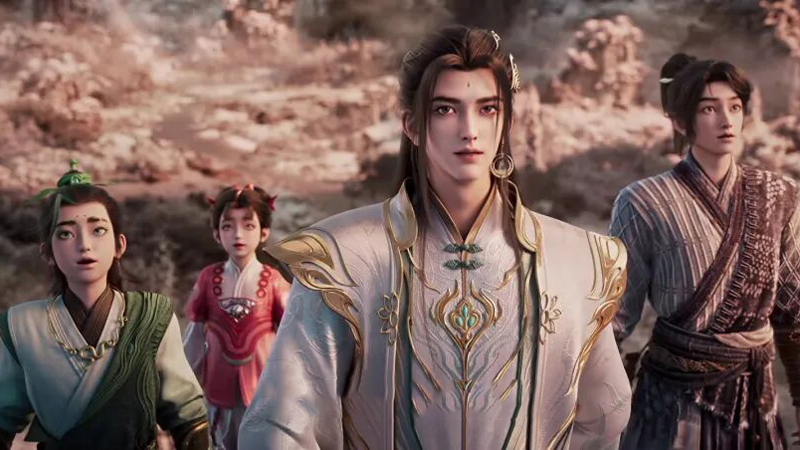
What if a mountain’s ancient inscription held the secret to a goddess’s destiny? In the animated series Sword of Coming (剑来), a seemingly straightforward stone carving on Shenxiu (神秀) Mountain hides a reversed prophecy. Wei Bo (魏檗) shows Chen Ping’an (陈平安) the wonders of the immortal world, from a grand protective array born from a Confucian painting called Steam Rising Over Yunmeng Marsh (气蒸云梦泽) to the towering peak of Shenxiu.
But the four bold characters “Tian Kai Shen Xiu” (天开神秀) are not what they seem. They whisper a truth about Ruan Xiu (阮秀), the blacksmith’s gentle daughter, whose past life as the ancient Fire God will pull her away from everyone she loves. This is not a story of sudden power, but of quiet goodbyes and a love that never had a chance to speak.
The Reversed Prophecy
When Wei Bo leads Chen Ping’an, Pat-on-Shoulder Emperor, and Chen Nuanshu to Shenxiu Mountain, they gaze up at the four mighty words carved into its sheer face. Most can only see them from below, as the peak is too high to fully appreciate without flying. But Ruan Qiong (阮邛), the new sage who replaced Qi Jingchun (齐静春), has forbidden unauthorized flight. He knows something others don’t: Shenxiu Mountain is a vault of hidden destiny. The characters “Tian Kai Shen Xiu” literally mean “Heaven Opens Divine Beauty,” yet he insists they must be read backwards.
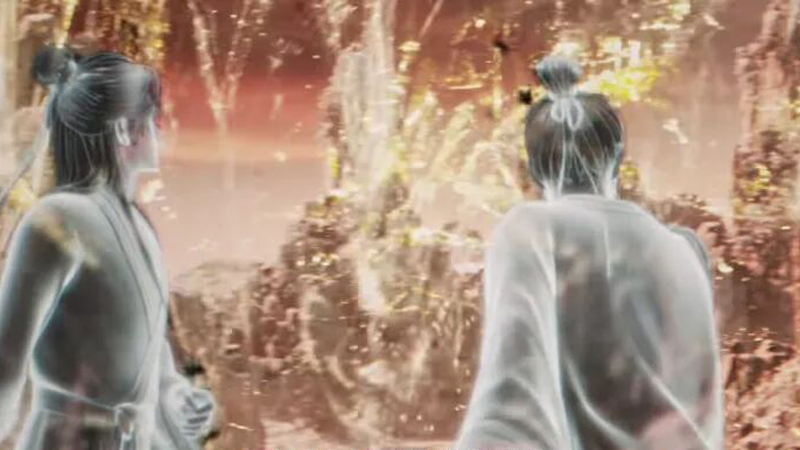
Read in reverse, they become “Xiu Shen Kai Tian”—Ruan Xiu Opens Heaven. This is no coincidence. It is a quiet clue buried in stone, left for those with eyes to see. Ruan Qiong’s protective rules are not just about control; they are about shielding his daughter from prying eyes. The Old Man Yang (杨) helps hide her true nature for a while, but secrets like hers do not stay buried forever. The mountain itself becomes a prophecy waiting to unfold.
Chen Ping’an immediately thinks of Ruan Xiu when he sees the inscription. Even then, a thread connects her to something far larger than her quiet life helping in her father’s forge. She is the reincarnation of a primordial deity, and the mountain’s reverse message is the first hint of her fiery ascension. What looks like a boastful carving on a rich man’s peak is actually a map of her fate.
A Pure Heart’s Pull
Why does Ruan Xiu fall for Chen Ping’an? To many viewers, it seems sudden—more like pity than love. She sees a boy who has lost everything, who lives alone and works tirelessly just to survive. But her feelings run deeper. In a town full of scheming immortals and greedy cultivators, Chen Ping’an’s mind remains startlingly clear. After he returns from escorting Li Baoping (李宝瓶), Ruan Xiu secretly peers into his heart. She finds no darkness, no hidden grudge, just the same pure mirror she saw before. That relief she feels is the seed of her affection.
He is the only one in Mud Bottle Alley who does not pretend. He feeds his chickens, sweeps his yard, and treats everyone—from the lowliest beggar to the visiting swordswoman—with the same honest respect. Ruan Xiu watches him from a distance, and what she sees is not a boy to be pitied, but a soul to be treasured. Even her father notices how she plumps up Chen’s poultry, a small act of care that speaks volumes. Her love is not dramatic; it lives in small, unspoken gestures.
Yet she knows her feelings are one-sided. Chen Ping’an has already given his heart to Ning Yao (宁姚), and he is not the type to hold two people inside him. Ruan Xiu accepts this without resentment. She does not compete or confess. Instead, she cherishes the moments they have—walking the same streets, sharing the same air. Her love becomes a quiet fire that burns only for her. And when the time comes for her to ascend, she does not say goodbye. She simply leaves, carrying that warmth into the cold heavens.
Love Unspoken, Heaven Bound

The moment of Ruan Xiu’s transformation into the Fire God is not loud or triumphant. It is lonely. She does not allow Chen Ping’an to see her final form. Perhaps she fears he would try to stop her, or worse, that he would feel guilty. She disappears into her divine duty without a word, leaving behind only memories: the smell of her father’s forge, the sight of her feeding those fat chickens, the echo of her laughter in Mud Bottle Alley. This is what fans call a “heart-unsettling” ending—not tragic, but achingly incomplete.
The animated series Sword of Coming is full of such details. A mountain inscription, a forbidden flight rule, a girl’s quiet glance—each one builds a larger story. Ruan Xiu’s arc teaches that love does not always require reciprocation. Sometimes it is enough to witness someone’s goodness and let that change you. She becomes a goddess, yet she loses the simple joy of watching Chen sweep his yard. Her power comes at the cost of her place in the human world.
So the next time you see a majestic peak or read a bold stone carving, remember: meaning often hides in reverse. What seems like a boast may be a prophecy. What looks like a side character may be a sleeping god. And what feels like a small, unreturned love may be the very thing that lifts someone to the stars. Ruan Xiu opens heaven, but she closes the door on her own heart. And that, perhaps, is the most human thing about her.