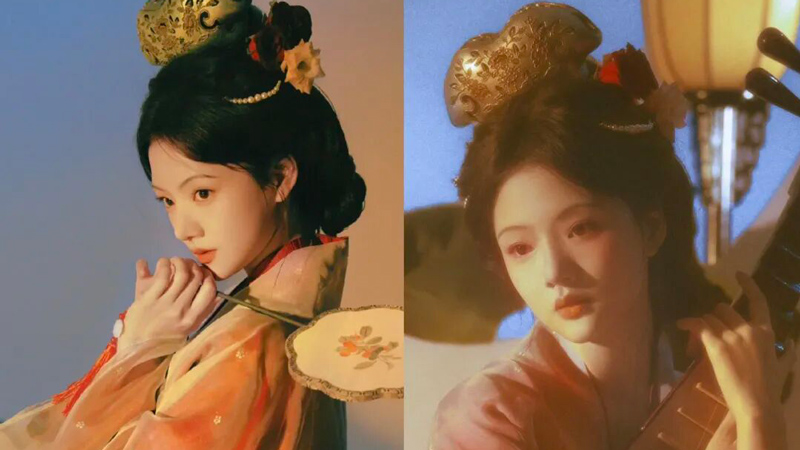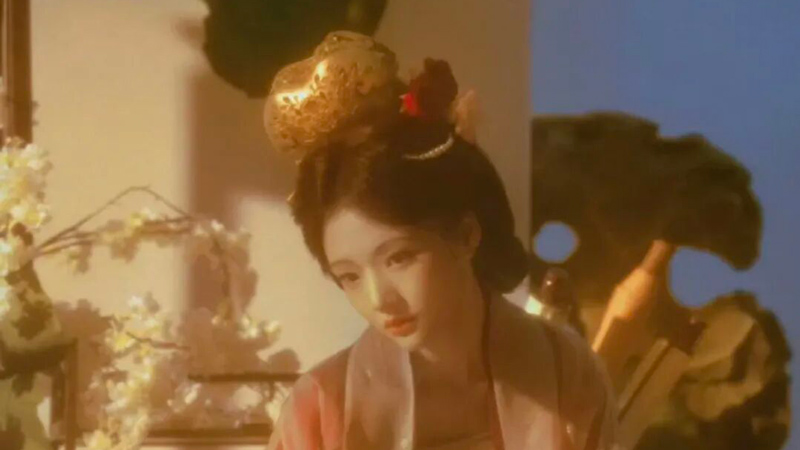
When actress Ren Min (任敏) recently debuted a new set of photos in Song-dynasty style (宋风) attire, viewers instantly recalled her role as Hui Rou (徽柔) in the hit drama Serenade of Peaceful Joy (清平乐). But a closer look at her headpiece reveals a striking difference. Instead of the elaborate Northern Song crown she wore on screen, this time she sports a small silver coronet from the Southern Song period. The original artifact was unearthed from a tomb in Liyang (溧阳), Jiangsu. It’s simple, subtle, and tells a completely different story about female beauty—one that moved from towering extravagance to quiet refinement.
High to Humble
In the Northern Song era, women’s crowns were bold and massive. Styles like the “round crown” and “shoulder-wide crown” dominated. These pieces sat high on the head, widening the profile and creating an aura of power and wealth. They matched the court’s ambitious spirit and the flourishing urban culture of Kaifeng. Wearing one meant you belonged to the upper class. It was a statement of status, not just fashion.
But everything changed after the court fled south to Lin’an (present-day Hangzhou). The Southern Song court lived under constant threat. Society became introverted, cautious, and deeply appreciative of delicate beauty. The large crown shrank. It no longer towered above the forehead but rested lightly behind the bun. A woman now looked slender, gentle, and reserved. The shift was physical and psychological—a nation in exile expressed its identity through smaller, quieter adornments.

According to Mengliang Lu (孟粱录), a Southern Song record, streets in the capital had entire lanes dedicated to crown makers and sellers. This wasn’t a niche hobby. Everyday women from middle-class families wore such pieces. The small silver crown became a democratic luxury. It didn’t scream for attention, yet it signaled taste, restraint, and a deep understanding of the era’s unwritten rules of elegance.
The Silver Treasure
The direct inspiration for Ren Min’s crown is an actual artifact excavated in 1992 from Xinsha Village, Liyang. The tomb belonged to an elderly woman named Zhou Deqing (周德清), who died in the late Southern Song. Her silver crown measures only 6.5 cm in height and 13.5 cm in length—small enough to cup in one hand. It’s formed by two thin silver sheets shaped like Ru Yi (如意) clouds, snapped together like a clam shell. The bottom opening fits over a hair bun, while the top is carved with openwork Ru Yi patterns.
Worn at the back of the head, this crown hides as much as it shows. From the front, you might barely notice it. But when she turns, the silver gleams softly, and the tangled flower motifs—peonies, chrysanthemums, trailing vines—reveal themselves. No gems, no gold. Just pure silver, darkened over centuries to a blackish patina. The craftsmen used hammering, engraving, and piercing techniques. Every line flows smoothly, every petal is distinct. This is Song-era minimalism at its peak: rich without being loud.
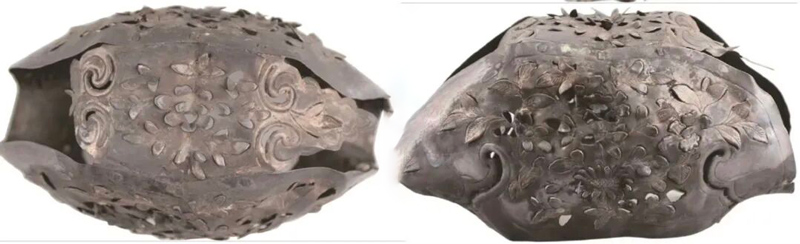
What makes this piece even more fascinating is who wore it. Zhou Deqing was not a princess or a noble. She was likely a well-off matron from a local gentry family. The crown’s presence in her grave suggests that such items were cherished personal possessions, not just burial props. She wanted to enter the afterlife looking graceful. For her, that grace came from silver, not gold. The crown connects us directly to one woman’s taste and identity, eight centuries later.
Gold or Silver?
Contemporary replicas often gild the silver with gold—a technique called yin liujin (银鎏金, silver with gold wash). The original Liyang crown has no trace of gilding. Neither do most authentic Southern Song silver crowns. But modern aesthetic tastes sometimes prefer a warmer, shinier finish. This raises an interesting question: Should a replica stay true to the artifact, or update it for today’s eye? Neither answer is wrong, but each reflects a different attitude toward heritage.
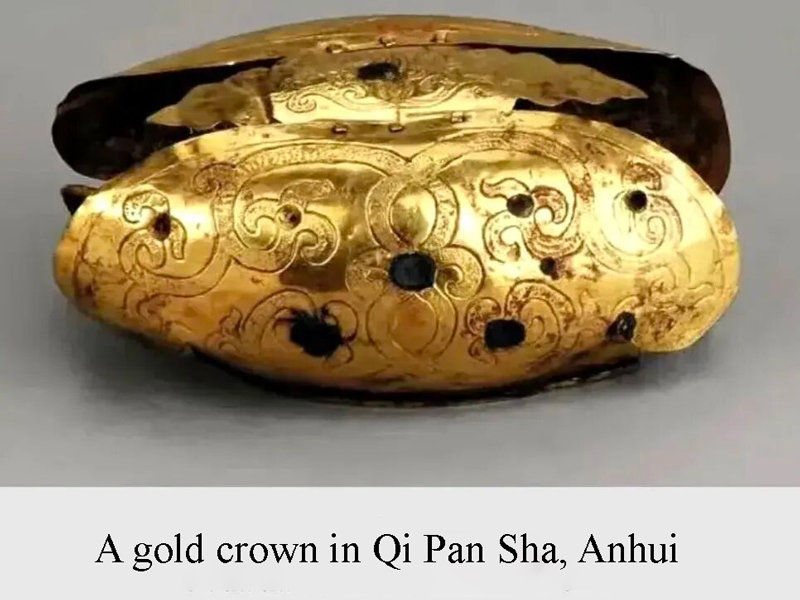
For contrast, consider a gold crown from the same period, unearthed from a Southern Song tomb in Qi Pan Shan (棋盘山), Anhui. That piece uses two gold sheets hammered into shape, with finely carved lotus patterns along the rim and “dragon-tooth weed” motifs across the body. The craftsmanship is exquisite. Yet even gold here is treated modestly—no large jewels, no thick inlays. The design remains restrained. Whether in silver or gold, the guiding philosophy is the same: less is more, detail is everything.
So which do you prefer—the quiet, unadorned silver original or the modern gilded version? One whispers history; the other adds a touch of warmth. Neither overshadows the wearer. That’s the real genius of Song dynasty aesthetics. A small silver crown, barely visible at first glance, can elevate an entire presence. It proves that true elegance never needs to shout. It simply stays, like a soft light in a dark room, waiting for those who care enough to look closely.