

No Phoenix? Just a Lotus Crown!
For decades, television dramas have trained audiences to expect one thing from a queen: a glittering phoenix crown. So when Wu Jinyan (吴谨言) appeared in the historical drama Feng Bu Qi (凤不栖) wearing a towering lotus flower headpiece instead of the usual phoenix ornament, viewers did a double take. No golden birds, no dangling tassels—just layered white petals rising from her head like a sacred blossom. The look stunned social media, but it was not a costume designer’s wild fantasy. It came straight from a stone relief carved 1,500 years ago.
The Nelson-Atkins Museum of Art in Kansas City houses a remarkable fragment from the Northern Wei (魏) dynasty called Empress Wenzhao Paying Homage to the Buddha (文昭皇后礼佛图). In that carved scene, a queen kneels with the exact same lotus crown. Wu’s styling team did not copy every stitch—they adapted. Yet the result opens a window onto a forgotten moment in Chinese fashion history, when Buddhist faith reshaped royal dress long before the phoenix became queen of all crowns.
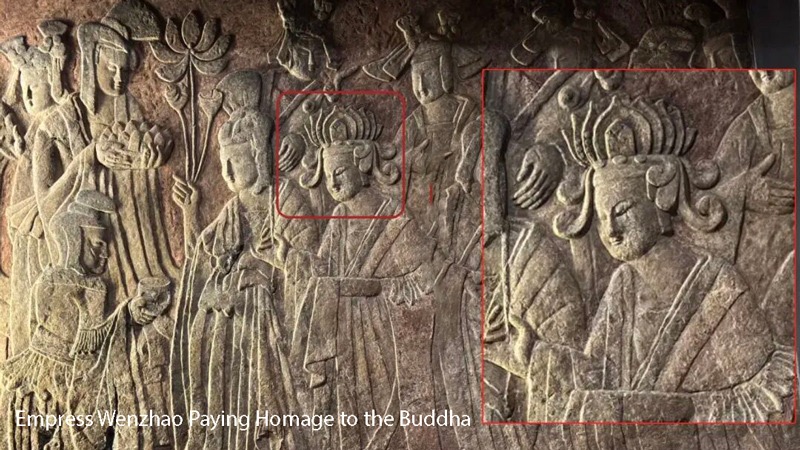
The Lotus Crown
Why a lotus? In Buddhism, the lotus rising from muddy water symbolizes purity and enlightenment. During the Northern Wei, emperors and empresses embraced Buddhism with extraordinary devotion. The dynasty sponsored cave temples, commissioned giant Buddha statues, and made ritual homage a public spectacle. When Empress Wenzhao appeared before the Buddha, her headgear had to reflect both her rank and her piety. A phoenix would have screamed earthly power. A lotus whispered spiritual grace. The crown Wu wears in Feng Bu Qi mirrors the museum relief almost petal by petal: multiple layers of lotus leaves stacked upward, each carved with clear veins and smooth, flowing lines. No gold filigree, no gemstones. The simplicity itself becomes the statement.
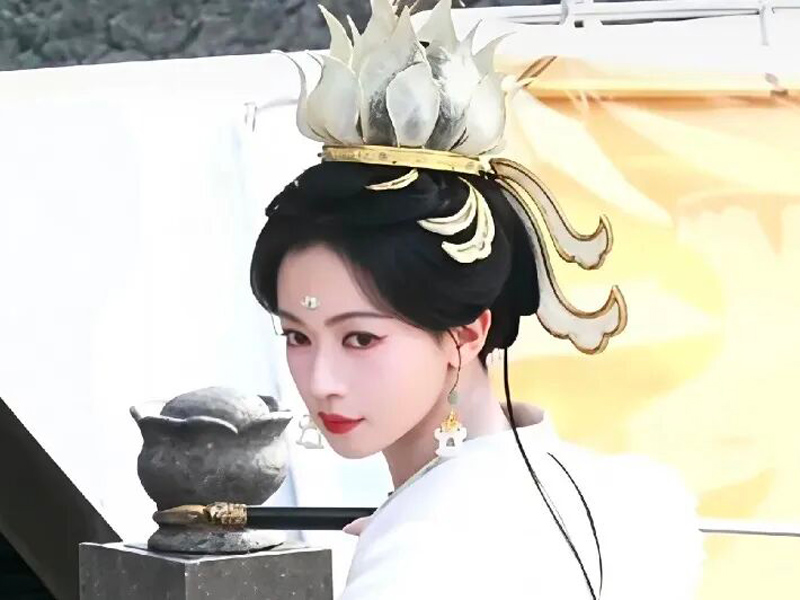
Look closer at the crown’s shape. The top rises in a soft mound, just like the queen’s headpiece in the ancient carving. The white-and-gold color scheme feels elegant but restrained—neither flashy nor dull. That balance was deliberate. Northern Wei court dress after the Emperor Xiaowen’s (孝文帝) sinicization reforms favored dignified simplicity over southern excess. The lotus crown achieved something rare: it made the wearer look holy rather than wealthy. Wu’s version captures that same cool, otherworldly aura. When she walks on screen, the crown does not jingle or sparkle. It sits like a quiet prayer above her face, exactly as the stone empress wore it a millennium ago.
Temple Flaps
But the lotus alone does not complete the look. Flanking the crown, two curved Bo Bin (博鬓)—temple flaps—sweep down to shoulder level. In the Nelson-Atkins relief, these flaps appear as wide, ribbon-like extensions on both sides of Empress Wenzhao’s head. They are not decorative afterthoughts. In Northern Wei royal protocol, these flaps distinguished a queen’s formal headdress from those of lower-ranking ladies or Taoist priestesses. They served a practical purpose too: anchoring the crown securely while adding a majestic frame to the face. The carved stone shows the flaps falling in soft arcs, their edges curling slightly outward, creating an almost winged silhouette.

Wu’s costume team reproduced that effect with careful attention to movement. In still shots, her temple flaps hang straight and dignified. But when she turns her head or walks through a palace courtyard, the flaps sway gently—not wildly, just enough to remind viewers that this is a living woman, not a statue. The slight upward flick at the edges echoes the stone original’s dynamic lines. Ancient sculptors understood that rigid symmetry kills life; they carved those curves to suggest breeze and motion. Wu’s designers translated that into fabric and wire. The result feels both historically grounded and dramatically alive. No wonder early commenters called the look “meditative power.” It is devotion made visible, worn on the head like a declaration.
White and Red
Wu appears in two lotus-crown outfits: one white, one red. The white version has drawn the most scholarly praise because it aligns closely with Northern Wei aesthetic preferences. After the dynasty moved its capital to Luoyang (洛阳) and adopted Confucian court rituals, clothing tones grew lighter. Some historians argue that the Wei court favored white due to the Theory of Five Virtues, which assigned the dynasty the virtue of earth and the color yellow—but surviving Buddhist art suggests a different story. The Empress Wenzhao relief uses pale, muted shades; white, light gold, and soft gray dominate. These choices reflected Buddhist ideals of purity and detachment from sensual pleasures. Wu’s white gown, paired with the ivory lotus crown, radiates exactly that chilly sanctity.

The red outfit takes more creative liberty. No evidence suggests Northern Wei queens wore crimson to Buddhist rites. Red in later dynasties became associated with joy, fertility, and military merit—none of which fit a solemn homage scene. So why include it? Feng Bu Qi tells a story of rebirth and political revenge. The red version likely serves a narrative purpose: marking moments of passion, anger, or transformation. It is the costume department’s calculated anachronism. Still, the lotus crown and temple flaps remain identical to the white set. That consistency matters. Even in red, the silhouette stays faithful to the museum relief. Wu’s team did not chase empty spectacle. They built two emotional registers—pious stillness and fiery resolve—on the same archaeological foundation. That is how historical drama should work: not as a museum exhibit, but as a living conversation between then and now. Which color suits a queen better? Possibly both, depending on what story she needs to tell.