
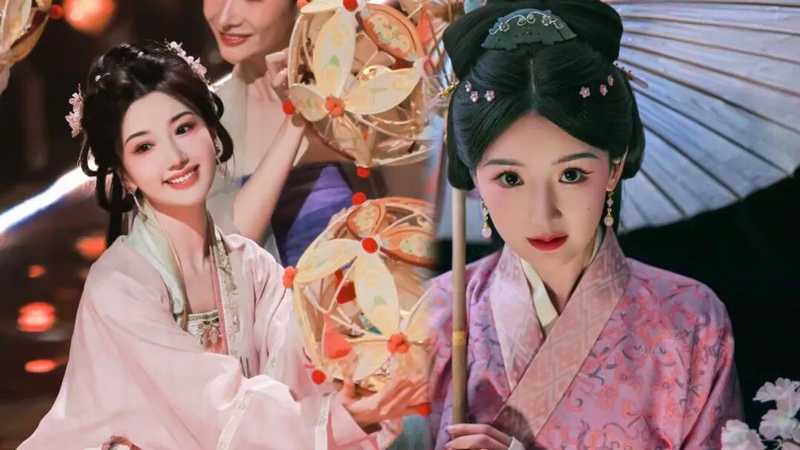
Remember that quiet, tragic Ying Guiren (瑛贵人) from Empresses in the Palace (甄嬛传)? The one who was forced to take her own life after a false accusation? If you saw Mao Xiaotong (毛晓彤) recently in a pink Hanfu outfit on a variety show, you might have blinked twice. She wore a soft green and pink ensemble that screams nothing of the Qing dynasty palace. Instead, it radiates a sweet, energetic vibe that fans barely recognized.
One commenter asked: “Is this still the same Ying Guiren?” The answer is a confident no. She has swapped heavy Manchu robes for a flowing Southern Song dynasty silhouette. And the transformation is not just in clothes—it is in attitude, makeup, and a bold embrace of traditional Chinese fashion that feels fresh, not dusty. So what exactly did she wear, and why does it work so well?
Southern Song Silhouette
The core of her look is the classic Song dynasty layering formula: a long Bei Zi (褙子) worn over a skirt and inner top. She chose a peach-pink Bei Zi with wide, flowing sleeves that reach below the knees. Underneath, a matching short-sleeved crossover top, and below that, a spring-green pleated skirt called a Bai Die Qun (百迭裙). The color pairing—pink on top, green below—is not random. It mimics the vivid image of peach blossoms in full bloom against fresh spring leaves. Ancient Chinese writers used “Tao Yao (桃夭)” to describe a bride’s radiant beauty, while “Chun Chen (春辰)” refers to the star that signals the start of spring. Together, they create a gentle yet lively contrast that makes her look like she just stepped out of a Song painting.

Look closer at the Bei Zi’s edges. They are embroidered with peach flowers, wild geese, and crabapple blossoms. These are not decorative fillers. Peach flowers symbolize romance and longevity; wild geese represent loyalty and the changing seasons; crabapple stands for resilience and feminine grace. The patterns are small but deliberate. They turn a simple garment into a walking poem about spring’s energy and a young woman’s hopeful heart. Compared to the heavy, structured Qing dynasty robes she wore as Ying Guiren, this Song outfit breathes. It allows movement, shows the natural waistline, and layers fabrics that flutter in the wind. No wonder viewers did a double-take.
Hair & Peach Bloom
Clothing alone does not explain the shock. Her hairstyle and makeup complete the time travel. She wore a modified multi‑loop bun, a classical updo usually seen on unmarried girls in ancient art. The loops sit high on the head, with soft tendrils framing the face. This shape adds height and a playful bounce—very different from the flat, two‑pronged “flag headdress” of Qing dynasty noblewomen. To modernize it, stylists left some hair loose and curled at the ends, blending Song dynasty formality with contemporary softness. The result: a hairstyle that says “young lady on a spring outing,” not “palace consort trapped in schemes.”
Then there is the face. She wore what old beauty manuals called “peach blossom makeup”. The Zhuang Tai Lun (妆台论), a Ming dynasty text on cosmetics, describes it precisely: apply face powder first, then take rouge on the palm, and pat it onto the cheekbones. A heavy application becomes “wine blush”; a lighter one becomes “peach blossom.” Mao’s version is the latter—a soft, diffused pink across the apples of her cheeks, blending upward toward the temples. No harsh contour. No dramatic eyeliner. Just a natural flush that mimics the glow after a light jog. Combined with the pink Bei Zi and green skirt, this makeup makes her look seventeen again. It is a deliberate choice to highlight innocence and vitality, two qualities her character Ying Guiren rarely got to show.

Beyond the Pink
This is not Mao’s first pink Hanfu moment. On the hit show National Treasure, she once wore a Zhiju (直裾) from the Warring States to Han dynasty period. The zhiju is a straight‑hemmed robe often called “China’s earliest dress”—unisex, wrap‑around, with a wide belt. Her version used pink edging on a cream base, with goose‑yellow accents and a jade comb in her hair. While the zhiju style usually evokes a solemn, scholarly vibe, her pink choice added unexpected bounce. She looked like a young noble from an ancient kingdom, not a stern historian. That outfit proved pink can work on any era, from pre‑imperial tombs to Song dynasty dramas.

Now she is filming The Ingenious One 2 (云襄传2), a martial arts romance. Leaked set photos show her in another Song‑inspired combination: an open‑front jacket over a white crossover dress, again in pink and white. This version is simpler, with fewer embroideries, but the color scheme stays. It fits a “chivalrous but tender” character—someone who can fight with a sword but still blush at a kind word. Compare all these to her Ying Guiren days. In Empresses in the Palace, she wore deep purple, navy, and dark pink robes with heavy gold trim. Her hair was pulled into a severe two‑pronged style. She looked elegant but trapped. Today, Mao Xiaotong switches between Southern Song, Warring States, and Tang influences with ease. She is no longer that tragic consort. She is a modern actor playing with history, and pink Hanfu has become her signature time machine. Some fans say: “Hanfu suits her better.” Looking at these three looks, it is hard to disagree.