
Forget minimalism. A new wave of cultural ceremonies across China is bringing ancient dynasties back to life, and five actresses just stole the show. Each walked out in a Hanfu masterpiece inspired by a different era—from the solemn Warring States to the opulent Tang (唐) and the mysterious Shu (蜀) civilization. These are not museum copies. They are breathing, moving art pieces that make you wonder: why does the past look so much more alive than the present? Let’s meet the women who wore history.
1. Zhang Yaqin (张雅钦) – Warring States Red
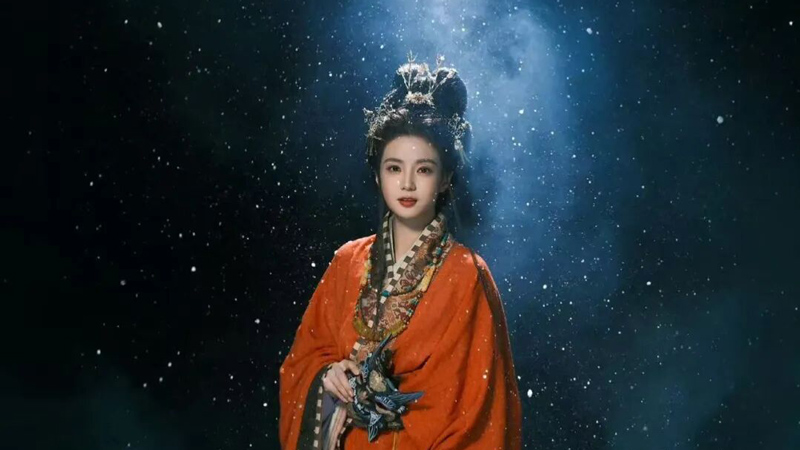
Zhang Yaqin channels the fierce elegance of the 5th century BCE. Her outfit is a Zhanguo Pao (战国袍), specifically a Zhiju Pao (直裾袍) based on textiles from the Mashan Chu Tomb (马山楚墓). The robe is a deep cinnabar red, trimmed with ancient patterned bands. She pairs it with a headpiece that mixes Buyao (步摇) from the Han and Wei-Jin periods. The result? A look that feels both heavy with history and wildly dramatic.
What makes it stand out is the color. That red isn’t cheerful—it’s the shade of ritual and war. The straight lapel and wrapped front create sharp vertical lines, making her silhouette look like a bronze sword. Unlike later dynasties that favored softness, this Warring States style demands respect. It whispers of underground palaces and unbroken oaths.
Zhang does not just wear the costume. She becomes a vessel for an era when every embroidered thread carried a spell. The entire assembly feels authentic yet fresh, proving that 2,500-year-old tailoring can still shock modern eyes. No wonder netizens called it “beautiful to the point of speechlessness.”
2. Zhao Zhaoyi (赵昭仪) – Tang Splendor
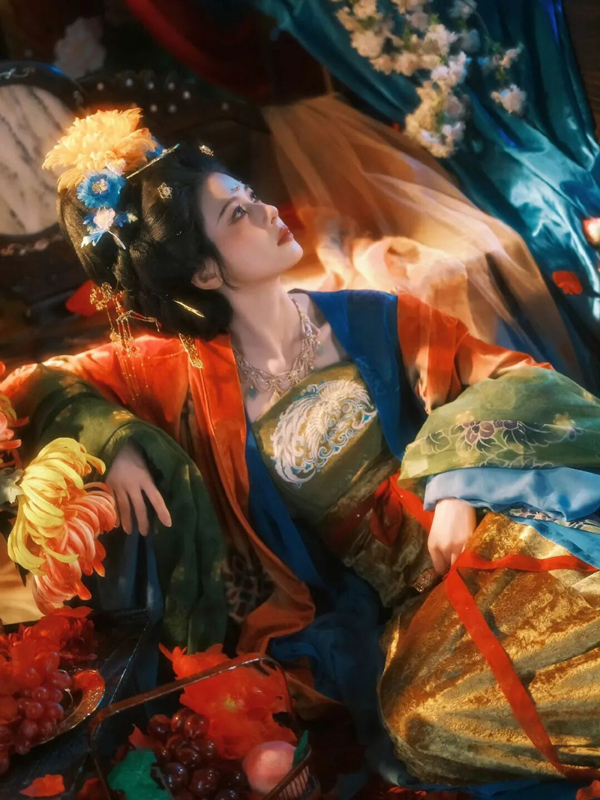
Next, Zhao Zhaoyi brings the party. Her ensemble is pure Tang dynasty court style—the so-called “rich flower” look that has taken over period dramas. The palette is loud: gold, orange, royal blue, and emerald green. These are the exact saturated hues seen on Dunhuang (敦煌) murals and Tang pottery figurines. She does not just wear colors; she wears a declaration of imperial confidence.
The silhouette is wide and generous. A high-waisted skirt, a draped scarf, and an open-front jacket let the layers breathe. Gold leaf ornaments dangle from her hair buns. When she moves, it feels like a festival. This is Chang’an (长安) at its peak—where foreigners, silk, and spices mixed under a tolerant sky. The design exaggerates every element: bigger sleeves, brighter contrasts, bolder patterns.
Zhao’s interpretation walks a fine line between costume drama and historical homage. It does not apologize for being lavish. Instead, it dares you to look away. For a generation tired of beige and gray, this Tang explosion is a wake-up call. It screams: elegance can be loud, and history never had a muted mode.
3. Wang Likun (王丽坤) – Bronze Mystery
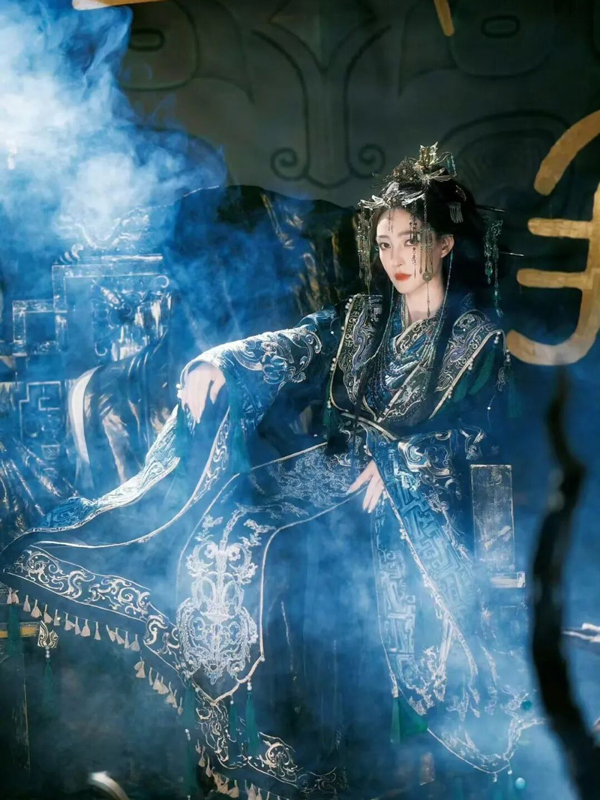
Wang Likun takes a darker, stranger path. Her costume uses bronze-pattern embroidery to evoke the San Xing Dui (三星堆) civilization of ancient Shu. The base colors are deep ink green and midnight blue, overlaid with metallic gold stitching. The texture mimics aged ritual vessels—rough, sacred, and slightly unnerving. She looks like a high priestess who just stepped out of a sacrificial pit.
This is not a typical Hanfu. There are no flowing flowers or cute tassels. Instead, you see animal-face motifs and geometric spirals. The headdress rises like a bronze tree branch. Wang stands still, and suddenly you are not watching a celebrity but an oracle. The outfit suggests a dialogue across three thousand years, between the Shu people and us.
What makes it brilliant is the restraint. No gold foil overload. No attempt to be pretty. It chooses mystery over beauty, and that choice pays off. The bronze-inspired look forces you to stare, to ask questions. It is the least “wearable” of the five, but also the most unforgettable—a reminder that Chinese aesthetics include the eerie and the sublime, not just the delicate.
4. Ha Ni Ke Zi (哈妮克孜) – Song Elegance
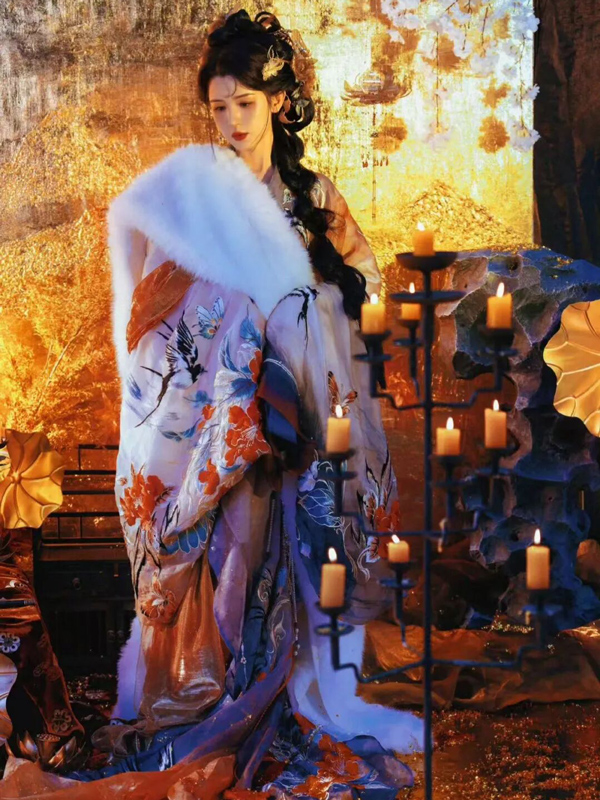
Ha Ni Ke Zi softens the tone. Her outfit is an artistic reimagining of Song dynasty court dress. The structure follows the classic trio: a large outer robe, a short open-front jacket, and a pleated skirt. But the execution is airy. The outer layer is so thin you can see her arm through it. The skirt falls like water.
The Song dynasty valued subtlety above all. Colors were washed, lines were simple, and movement was everything. Ha Ni Ke Zi captures that spirit without being a slave to accuracy. Her sleeves are wider than historical evidence allows, but that extra fabric creates a floating effect. When she turns, the hem ripples like a breeze over a lake. It is poetry in motion.
This version trades heavy embroidery for texture and drape. It says elegance is not about how much you put on, but how gracefully you carry what you have. Modern viewers love this because it feels familiar—almost like a long dress from a minimalist brand. Yet under that simplicity lies a thousand-year-old philosophy: less is a kind of more.
5. Huang Mengying (黄梦莹) – Ming Grandeur
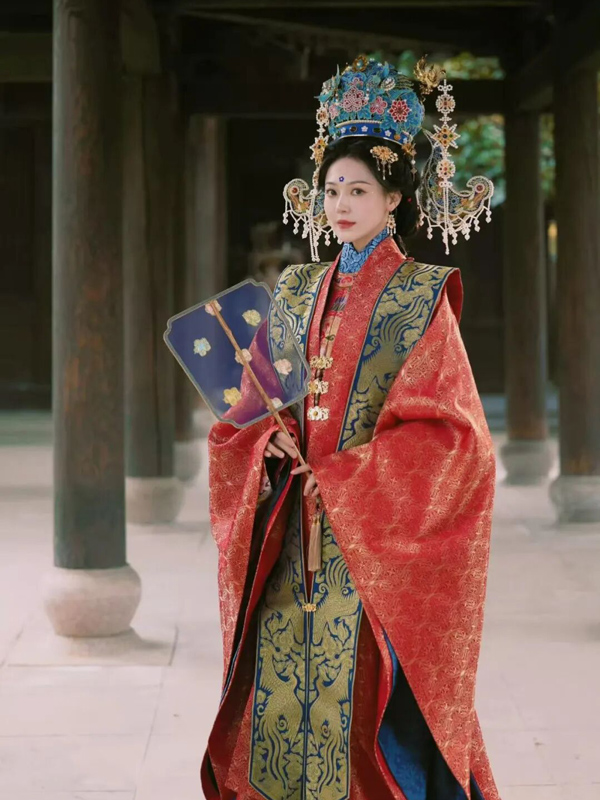
Finally, Huang Mengying crowns the lineup as a Ming crown princess. Her attire is based on Daming Yiguan (大明衣冠), the classic reference for Ming official dress. She wears the Dasha Xiapei (大衫霞帔)—a long red robe with a embroidered sash. Gold threads form phoenixes and auspicious clouds against the vermilion silk. Royal blue edges add structure. On her head sits a Feng Guan (凤冠), studded with kingfisher feathers, pearls, and tassels.
The Ming dynasty loved rules, and this outfit follows every single one. The red is exclusively for high-rank women. The number of phoenixes, the length of the sash, the shape of the crown—all codes. But within those constraints, the craftsmanship explodes. Goldwork shines like liquid fire. The kingfisher feathers change color as she tilts her head. It is not art for the masses; it is art for the throne.
Huang wears this heavy set without being crushed by it. She stands straight, chin up, each step measured. This is power dressing from the 14th century. And it works perfectly on a modern red carpet because the message is universal: some clothes don’t ask for love—they demand obedience. Among the five looks, this one is the loudest in its silence.