
An exhibition built around Suzhou craftsmanship opened on September 5 beside the Crescent Moon Spring under the Mingsha Mountain dunes in Dunhuang, Gansu, and runs through September 7. The 2026 “Hundred Artisans: Bound for Dunhuang” program, guided by the publicity department of the Suzhou municipal committee and hosted by the Wuzhong District committee, brought more than 30 craftspeople from Suzhou’s Wuzhong District west along the old Silk Road with over 100 works, staging a Suzhou craft exhibition, a heritage costume show, cross-city artisan exchanges and hands-on workshops in one desert stop.
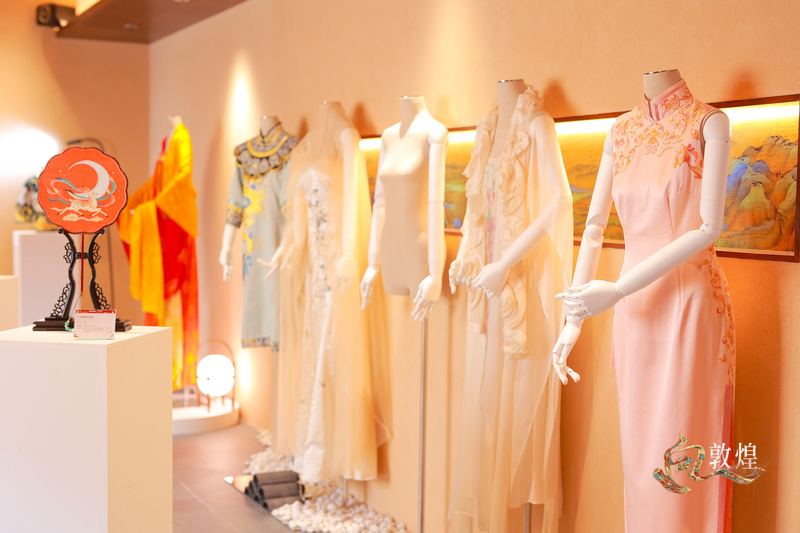
The exhibition is curated as three walks, each with its own reading of the route. The “Warp and Weft” gallery (经纬织造) gathers woven and embroidered textiles and reads them as evidence of technique passing through thread. The “Desert Study”takes the opposite turn: jade carvings, olive-pit carvings (核雕) and wood carvings sit on shelves while a full map of the Silk Road is laid into the floor, so that moving through the room traces the corridor that carried such goods west. A third space of incense implements and tea ware evokes the still-life arrangements of a Jiangnan scholar’s studio (清供雅集). Every piece on display carries a completed copyright registration with a “copyright card” that links to the Wuzhong copyright trading platform, where the works can be browsed and bought online; a companion market run by the Wuzhong Hundred Artisans added Suzhou-and-Dunhuang co-branded products.
Headline billing went to a heritage costume show staged with the setting sun as backdrop and the dunes as the floor. Forty outfits made by Wuzhong artisans and companies walked in three chapters, “Silk Road Interwoven,” “North and South, One Craft” and “Artisans on the Silk Road.” The garments layer Su embroidery, Kesi silk tapestry (缂丝) and Song brocade (宋锦) with Dunhuang’s classic imagery, so that the fine, dense, clean character of Jiangnan needlework meets the desert palette of ochre, mineral blue and mural motifs. Craftspeople also carried olive-pit and jade carvings onto the stage while cameras projected close-ups of the works onto screens, letting the audience see the fineness of the carving without leaving their seats.
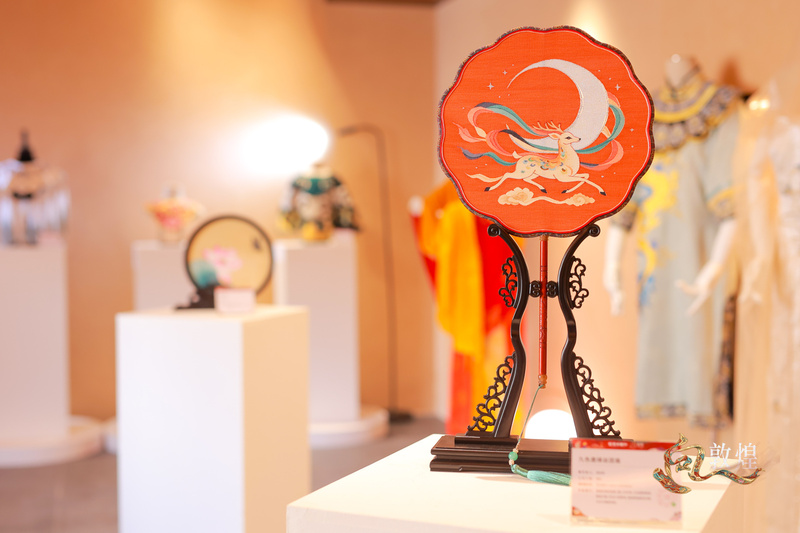
Three pieces drew particular attention as gifts. A Kesi table screen by Huang Jiali (黄佳丽), “Running Deer Reaching for the Moon” (奔鹿揽月), weaves ribbons around a nine-colored deer and the crescent spring, an image of the Silk Road binding two distant places. Fu Xianghong’s (府向红) Su embroidery “Summer Fruits, Smiling Wide” takes the abundance of ripe fruit as a wish that the two cities’ exchanges keep bearing. Chen Yan’s (陈彦) Kesi panel “Nine-Colored Deer” (九色鹿) reworks the Jataka of the Nine-Colored Deer painted in the Mogao Caves (莫高窟), rebuilding the mural’s spirit in silk. The trio was presented to the Dunhuang Academy (敦煌研究院) and local Dunhuang bodies as a token of the bond between Jiangnan and the western frontier.
Around the exhibition, the artisans ran Silk Road workshops where visitors tried the techniques first-hand, and the group traveled to the Mogaoli artisan village to study local practice and sit down with Dunhuang cultural-tourism and folk-craft workers. Their talks circled two questions: how to keep traditional craft alive as a living trade, and what happens when a Dunhuang cultural IP meets Jiangnan hands. The link itself is ancient, since Suzhou served as a weaving hub on the route from the Tang and Song dynasties, when Jiangnan textiles moved up the Hexi Corridor through Dunhuang toward the Western Regions. A Wuzhong publicity official described “Bound for Dunhuang” as a salute to the source of the Silk Road and a step toward a future where northern and southern crafts grow together.