
A half-finished piece of embroidery may be the truest exhibit in the room. In one gallery of the Guangdong embroidery show now at the Guangzhou Library, rows of “unfinished” works let visitors follow the craft step by step, from the initial design and the tracing of the draft onto fabric to the coloring, the selection of silk floss and the final stitching. That gallery is the fifth of six at “Nineteen Years of Guangdong Embroidery: Aesthetic Education in Bloom”, a free public exhibition of work by inheritor Tan Jingyu (谭靖榆) and her students, on view through September 1 in the basement hall of the library.
The show opened August 21 and runs to September 1, closed Wednesdays, with free entry throughout. It is organized by Guangzhou Xiuyun Culture Communication Co. and hosted by the Chuyu Embroidery Studio of Liwan District, with support from the Guangzhou Library and the Liwan District Intangible Cultural Heritage Protection Center. Tan Jingyu, one of Guangdong’s top ten fashion designers and a new-generation inheritor of the craft, comes from a family of Guangdong embroiderers and is the granddaughter of Chen Shaofang (陈少芳), a Master of Chinese Arts and Crafts and a representative inheritor of the national intangible heritage item Yue embroidery in its Guangdong form. For years she has carried the craft into schools, and the exhibition reads as a report on that classroom work.
Six galleries are arranged like a lesson plan. The first shows original works by Tan Jingyu and fellow inheritors and teachers, establishing the technical baseline. The second collects prize-winning student pieces selected by provincial, municipal and district education departments. The third marks ten years of teaching at Guangya Primary School and Xiguan Experimental Primary School, extended by results from Foshan Polytechnic School and Lexianfang Primary School. The fourth tells the story of Wenchang Primary School, the first school in Guangzhou to take on a heritage-in-schools program after the Ministry of Education’s 2014 Guidelines for Improving Education in Fine Traditional Chinese Culture. The fifth, the unfinished-works gallery, doubles as a craft primer and a student product corner, with three-piece bag sets, Yajin (压襟) lapel ornaments, sachets, scarves and round fans showing how the embroidery moves into daily objects. The sixth hangs two garments that took first and second prizes from the China Textile and Apparel Education Association, evidence that the classroom craft can hold its own in fashion.
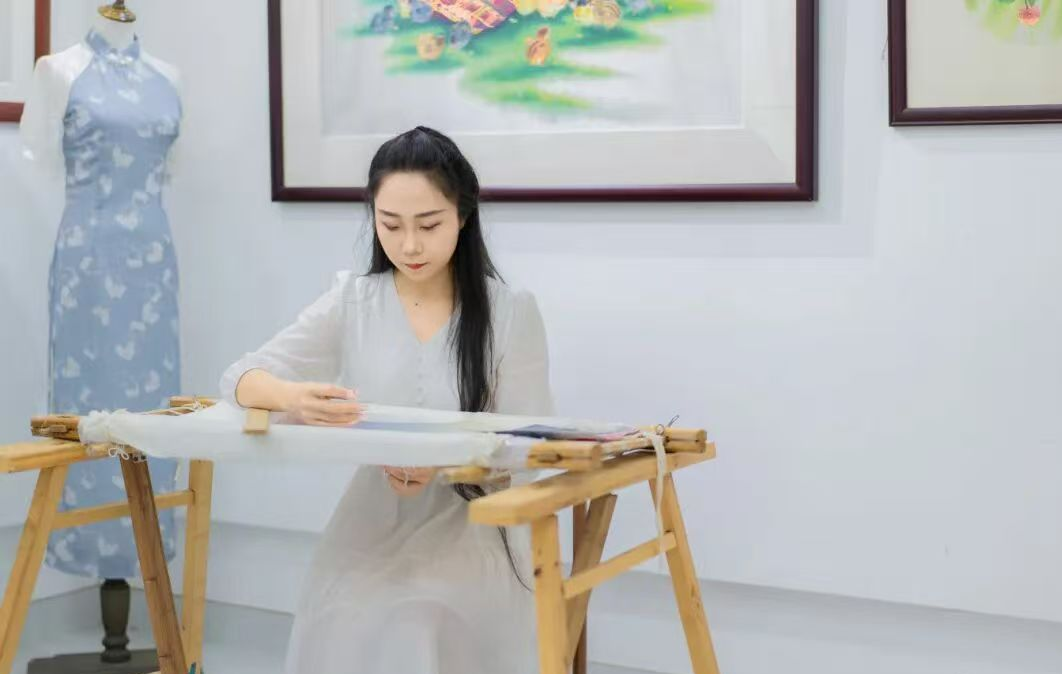
An actual embroidery frame sits in the hall, set up as it would be during work, so visitors can watch how a piece grows one stitch at a time. The exhibits range from full-coverage masterpieces to small themed works, students’ classroom exercises, archival photographs and technique panels, mixing museum-grade pieces with beginners’ first attempts. The numbers behind the show are equally concrete: between 2008 and 2026, Tan Jingyu’s team has trained about 2,400 students across 38 schools in Guangzhou and Foshan and collected 42 awards from provincial, municipal and district education competitions.
Visitors and guests at the opening framed the value of the show in terms of education rather than craft alone, saying that bringing Lingnan heritage into schools strengthens young people’s attachment to their hometown culture and feeds their creativity. The exhibition’s guiding idea is deliberately modest: Guangdong embroidery teaching does not aim to turn every child into a professional embroiderer, but uses needlework to cultivate taste, aesthetic judgment and cultural confidence. The gallery stays open through September 1, and the pieces on the walls, finished and unfinished alike, make that argument one thread at a time.