
For the first time in its 500-year history, Hanzheng Street has an industry standard to measure itself against. Three group standards covering product quality, market management and the “Hanzheng Street Hanpai Apparel” regional public brand were released at the opening of the 2026 Hanzheng Street International Fashion Week and the 9th Hanzheng Street International Garment Expo on the evening of August 28, at the street’s brand apparel wholesale plaza in Wuhan. The week runs through September 3 under the banner “Tides Surging Through Hanzheng, Old Street Reborn,” and it packs fairs, runway shows, competitions, exhibitions, shopping and incubation into a single six-in-one program.
Sun Ruizhe (孙瑞哲), president of the China National Textile and Apparel Council, opened the ceremony with a date the street knows by heart. The Hanzheng Street small-commodity market launched in 1979 and drew back the curtain on nationwide commodity-circulation reform; on August 28, 1982, People’s Daily promoted its experience in an editorial. This year’s opening landed on the same calendar date, 44 years later, a deliberate echo. Today the street is the only textile and apparel cluster above the 100-billion-yuan mark in central China.
Standards for a 500-Year Market
Inside the wholesale plaza, 2,600-plus merchants cover children’s, men’s and women’s wear, and more than 40 percent of them have registered original brands, according to plaza deputy manager Liu Yalan (刘亚兰). The three standards released on opening night are the first exclusive industry standards in the street’s five centuries: 22 major indicator categories, with three core safety indicators, formaldehyde, pH value and color fastness, set higher than the national baseline. The accompanying “2026 Hanzheng Street Fashion Industry Development Report” was published at the same ceremony, marking the end of an era in which the street’s apparel trade ran without written standards.
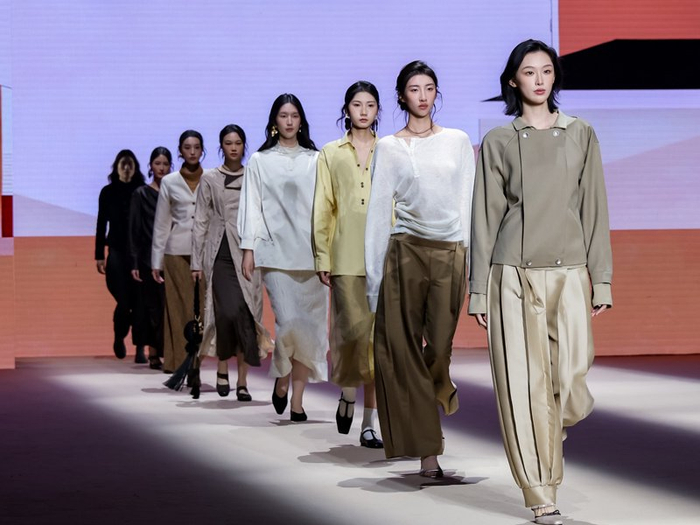
The new Hanzheng Street International Original Fashion Design Center has gathered more than 150 professional designers and 60-plus global fabric and trim suppliers serving rapid iteration for 200-plus local brands. Xie Fangming (谢方明), executive vice chairman of the China Fashion Association, argued that Hanzheng Street should be not only a trading hub but also a source of design innovation; Golden Summit award-winning designers now give on-site classes, an AI design boot camp called the first “Yangtze” cohort debuted to strong response, and a fabric-and-trim supply chain platform is live. The 2026 Hanpai Fashion Design Competition ran in parallel, with professional and campus tracks drawing more than a thousand entries from over a hundred schools, and Golden Summit designer Wu Xuekai (武学凯) led the opening runway show “Rivers and Lakes,” which unfolded in three movements, “Old Dreams of the Docks,” “Refined Walks of the Market” and “Hanzheng Splendor,” reading Chu-Han style through modern fashion language.
Zhao Hongliang (赵宏亮), mayor of Qiaokou (硚口) District, walked reporters through the year’s changes. On heritage, the Xin’an Jiuru Historic District has completed the overall purchase of 1,300 households, 56 percent of the area, with the rest kept under a “shared courtyard” model that preserves old-street character, and the renovation is 80 percent complete; Changdi Street and Dajia Street have been reopened, and the Hanzheng Academy and the old street teahouses have resumed operation. On industry, four low-end markets were closed, 14 existing markets upgraded, and more than a thousand designers now feed local brands, with Hanpai menswear holding about half of the national autumn-winter market. On August 28, Changdi Street began trading with heritage crafts, Hanpai snacks and creative goods, plus runway walks, Hanfu parades and pop-up performances aimed squarely at younger shoppers; through August and September, the street will run garment expos and original-brand shows and, with Ant Group and Douyin Group, a double consumer season.
Made in Hanzheng, Sold Worldwide
Hu Liyan (胡丽颜), a clothing principal who has worked in Hanzheng Street for 29 years, remembers when the street copied designs and sold through domestic wholesale channels; today her three original womenswear brands, Gushi AS, Gushu and Sanqianzi, work with a top design team and push outward. The street itself is building the export infrastructure: a national-first industrial park combining textile and apparel with AI models and cross-border compliance now hosts more than 700 merchants on the Yangtze Cloud-Apparel Chain; a “Kuaomaohui” (跨贸汇) program pairs special teams with SHEIN and Amazon to solve intellectual-property, cross-border tax and platform-operations problems; Hubei’s “AI Plus Cross-Border E-Commerce” innovation contest runs alongside; and a small-batch, quick-response center covers flexible production. One hundred influencers are broadcasting from the street to turn foot traffic and livestreams into sales.
The 9th expo is already running across the Longteng First Avenue market, the Yunsung Wuhan International Fashion Center and the Jinzhengmao Hanpai Apparel headquarters. The closing ceremony on September 3 at the Yunsung center will announce the first standards-compliant enterprises and the inaugural “Hanzheng Authentic” (汉正正品) list, building a tiered brand matrix on a “standards-plus-certification-plus-brand” model. Hanzheng Street began in 1979 as the “No. 1 Street under Heaven” of small commodity trade; in 2026 it presents itself as a 100-billion-yuan textile cluster answering one question, how a 500-year commercial artery completes industrial renewal, consumption upgrades and cultural continuity under the slogan “Old Street Reborn.”