
At nine on the morning of August 19, the Qixi Festival, a procession of Hanfu-clad couples began filling Shuiyun Square (水韵广场) in Yunxi County, Hubei. The occasion was the 2026 collective wedding ceremony under the banner “Tianhe Bears Witness, Hearts Settle in Yunxi”, which paired 77 couples from Shandong, Heilongjiang, Zhejiang, Anhui, Guangdong, Hunan and Hubei with a full program of traditional wedding customs.
Classical ensemble music began the rite. Facing each other in pairs, the couples made their vows, pledging mutual respect, a shared household and lifelong commitment, then recited a joint oath: “Through wind and rain, we will not part; knowing each other, we will build a harmonious family.” The crowd behind the ropes answered with applause as the newlyweds exchanged clasped-hand bows in the older style.
One pair stood out. Yan Guangfu (晏光富) had delayed his planned July 30 license date in Shanghai and traveled specially with his bride, Xie Danzhen (谢丹珍) of Zhuxi County (竹溪县), to take part. After the ceremony, Xie said the town had lived up to its billing: the Tianhe River (天河) — whose name also means the Milky Way — glittered with lights on both banks, and the Qixi Square, the magpie corridor and the heritage craft stalls scattered through the town made the day one the couple will not forget.
A National Festival Lands in Yunxi
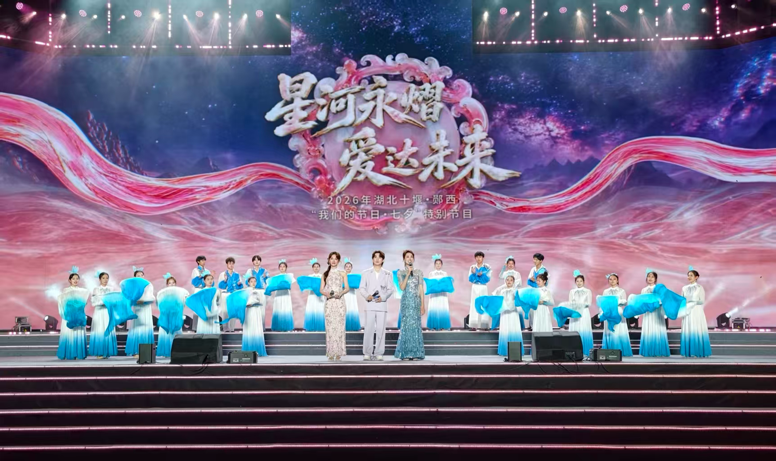
The wedding sat inside a larger program. The national “Our Festival: Qixi” themed event ran in Yunxi, billed as the “Hometown of Chinese Qixi Culture,” from August 19 to 20, organized by six national bodies including the Civilization Practice Bureau of the CPC Central Committee’s Publicity Department, the Ministry of Civil Affairs, the Ministry of Culture and Tourism, the Communist Youth League, the All-China Women’s Federation and the China Federation of Literary and Art Circles. The opening ceremony that evening opened with the song “Qixi in Heaven, Yunxi on Earth,” then moved through three chapters — “Meeting by the Star River,” “Longing under the Moon” and “Keeping Faith at the Tianhe.” The Yunxi Sanxian (三弦) ensemble performed “The Cowherd and the Weaver Girl” in the local opera style, and singers Wulan Tuya (乌兰图雅), Dai Quan (戴荃) and Lang Ge (狼戈) took the stage in turn. More than 30 media platforms, including CCTV, China Youth Daily, Hubei Daily and Hubei Civilization Net, streamed the event live to an audience counted in the tens of millions.
Outside the main stage, the Shiyan (十堰) heritage market set up 60 booths, and on August 20 five traditional crafts — embroidery, qiqiao weaving, Huamo (花馍) flower buns, root carving and handmade tea — were demonstrated at Qixi Square by 35 artisans. The afternoon of August 19 also featured an immersive digital drama, “Red Yunxi,” a six-province exchange linked to the South-to-North Water Diversion project and the launch of a book on the region’s civilization-building history.
Seventeen Years of Qixi in One County
None of this is new to Yunxi. The county, long called “the throat of Qin, the gateway of Chu,” is known as the Hometown of Chinese Qixi Culture and the Hometown of Chinese Magpies, and its “Yunxi Qixi” custom is listed on the national intangible cultural heritage roster and named one of China’s top ten cultural IPs. Local practices — floating river lanterns, welcoming the Seventh Sister, making qiqiao treats and Weaver Girl embroidery — have been maintained for generations, and the county has staged Qixi-themed events for 17 consecutive years, with collective weddings a regular feature. The 2026 edition simply scaled the formula up: more couples, more ministries, more cameras, and the same moon over the Tianhe.