
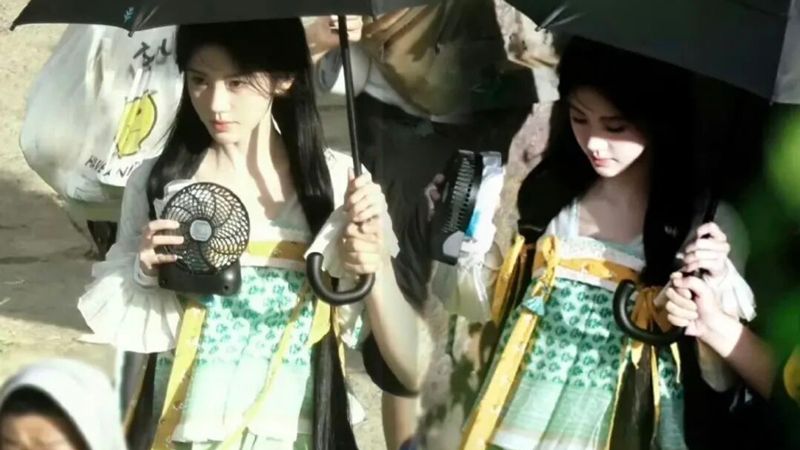
Ju Jingyi’s latest costume drama Lai Zhan (来战) hasn’t even aired, yet one outfit from the set has already sparked a heated online debate. In a leaked behind‑the‑scenes photo, she wears a short, single‑panel fabric piece tied high across her chest, almost like an apron or a decorative flap. Netizens immediately dubbed it the “fart curtain” for its odd placement. But is this really a bizarre invention by the costume department? Or does it actually have a deep-rooted history in traditional Chinese fashion?
The short answer is yes—this so‑called flap is not a fantasy creation. It is a stylized version of an ancient garment called Weishang (围裳), a waist‑skirt that once flourished in imperial China. To understand why it sits so high on the chest, we have to travel back to the Sui and Tang dynasties, when waistlines rose and layering became an art form. This article unpacks the real story behind that “strange” little skirt—from its proper names and historical murals to its clever seasonal twists—and reveals why it is far more than a quirky prop.
The Name Game
Most viewers have never heard of Weishang, so they default to funny nicknames like “fart curtain” or “belly flap.” But historians take it seriously. In the Dictionary of Ancient Chinese Costume (中国古代服饰辞典), Weishang is defined as a short decorative skirt worn around the waist or lower abdomen. Scholars also use the term Yaoqun (腰裙), which literally means “waist skirt,” to describe the same item. Unlike full-length undergarments such as Mofu (抹腹) or Moxiong (抹胸)—which are actually forms of ancient underwear—the Weishang is an outer accessory. It was never meant to be hidden.
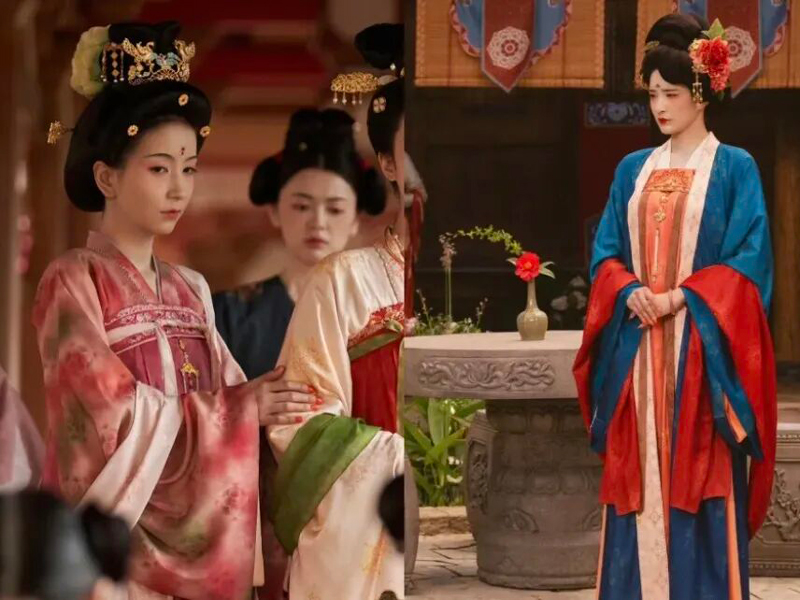
Some online commenters have confused it with a belly band, but that is a historical mistake. Murals from the Tang dynasty clearly show noblewomen wearing this single‑panel skirt over their long robes, tied at the front with a decorative knot. Its purpose was not modesty but visual layering. By adding a short piece of fabric over a longer skirt, the outfit gained depth and movement. The effect is remarkably similar to the tiered ruffles of Western cake‑style dresses, yet this Eastern version predates them by centuries.
The confusion over names reflects a larger gap in public knowledge about traditional Chinese clothing. While Hanfu enthusiasts have revived many styles, the Weishang remains relatively obscure. That is precisely why its appearance in Lai Zhan feels so fresh and strange to modern eyes. But once you know its history, the “fart curtain” suddenly looks like a clever nod to a forgotten fashion.
The Ancient Trend
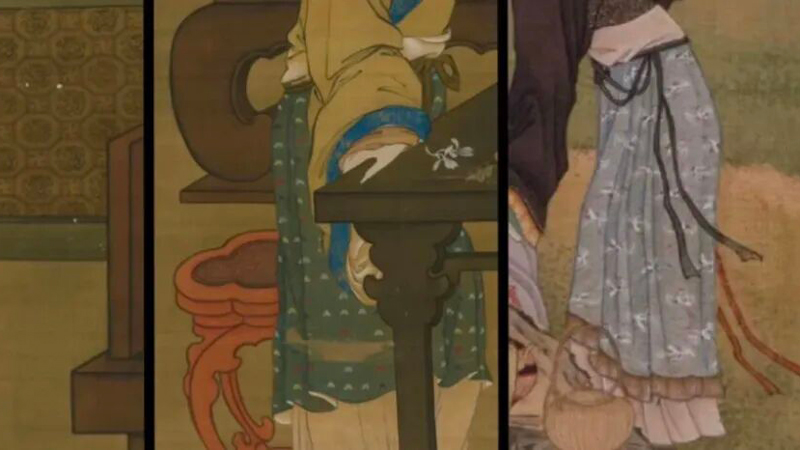
Why does the Weishang sit so high on Ju Jingyi’s chest, almost like a modern crop top overlay? The answer lies in Sui‑Tang dressing habits. Starting from the Sui dynasty, women deliberately raised their waistlines to create a taller, more elegant silhouette. The main skirt was tied above the natural waist, and naturally, the matching Weishang followed suit. By the early Tang period, this high‑waisted layering had become a nationwide craze, as evidenced by countless tomb murals and painted figurines.
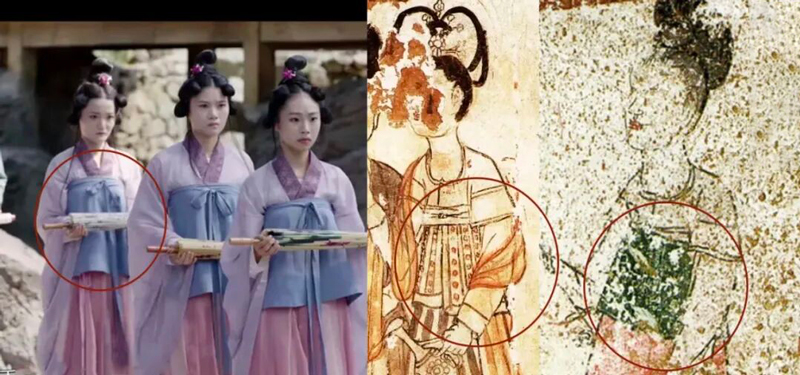
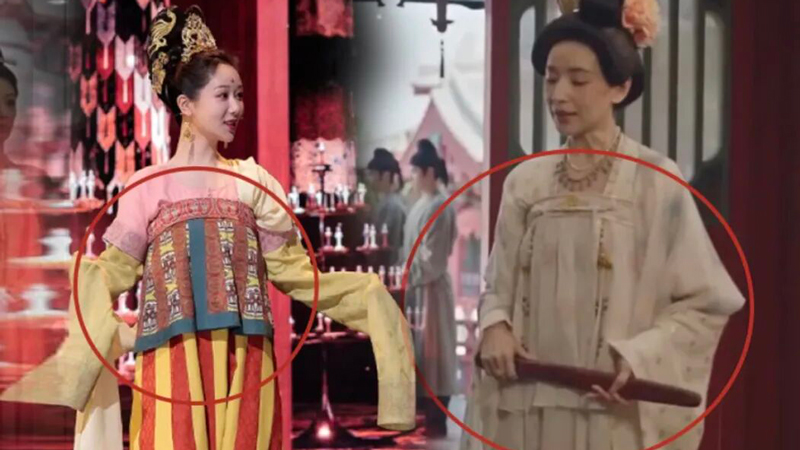
One of the most famous examples is the mural from the tomb of Princess Xincheng (新城长公主), a Tang royal. In that painting, nearly every attendant wears a high‑positioned Weishang over a long striped skirt. The stripes are made of vertical fabric panels, giving the whole ensemble a light and youthful vibe. Compare that with the outfit Yang Zi wore in the TV show Flourished Peony (国色芳华)—she also donned a similar high‑waist skirt. The visual impact is clear: the extra layer breaks up the monotony of a long robe and adds a playful, dynamic rhythm to the wearer’s movement.
This was not a rigid rule, though. Historical records show that the Weishang could be worn open at the front or wrapped and overlapped on one side. Its length varied from hip‑high to knee‑level, depending on personal taste and the occasion. For everyday activities, women preferred shorter, more flexible versions that did not restrict walking or kneeling. For banquets or ceremonies, they chose longer, more ornate pieces with embroidered edges and beaded tassels. In other words, this “little skirt” was the ultimate multitasker in an ancient wardrobe.
Smart Design
Beyond aesthetics, the Weishang solved practical problems that modern fashion lovers rarely think about. Ancient Chinese women adapted its material and construction to the seasons. In winter, they padded the inner layer with cotton wadding, turning the decorative flap into a warm belly protector. This extra insulation helped guard against cold winds that could easily seep through the loose robes of the time. In summer, they switched to thin, breathable silks or hemp weaves, ensuring that the layered look did not cause overheating or discomfort.
This seasonal intelligence shows that traditional dress was never just about looking good—it was about surviving and thriving in a pre‑modern world without central heating or air conditioning. The Weishang was a portable micro‑climate adjuster. It could be added or removed in minutes, making it far more adaptable than a full coat or jacket. Even more impressive, this functional design did not compromise its decorative role. The same piece that kept a woman warm in December also made her look graceful and well‑dressed at a spring festival.
So when you see Ju Jingyi’s character wearing that high‑chest flap in Lai Zhan, you are not just watching a costume drama. You are looking at centuries of accumulated wisdom—about fabric, climate, body movement, and social presentation. The show’s production team may have taken creative liberties with other historical details, but this particular garment is grounded in real archaeological evidence. It is a small but meaningful bridge between a modern audience and the everyday lives of Tang dynasty women, who knew exactly how to make a simple piece of cloth work hard and look beautiful at the same time.
Since the weishang (围裳) is both a waist and chest decorative flap (vs a functional apron) and you mention “more ornate pieces with embroidered edges and beaded tassels”, might this tasseled ribbon overskirt also fall under weishang? (eg. https://www.amazon.ca/Toddler-Chinese-Princess-Dresses-Traditional/dp/B0CP8YB6X2)
Tassels are just decorations for weishang. Real weishang is a wrap‑around single panel, not loose hanging ribbon tabs sewn to a skirt.