
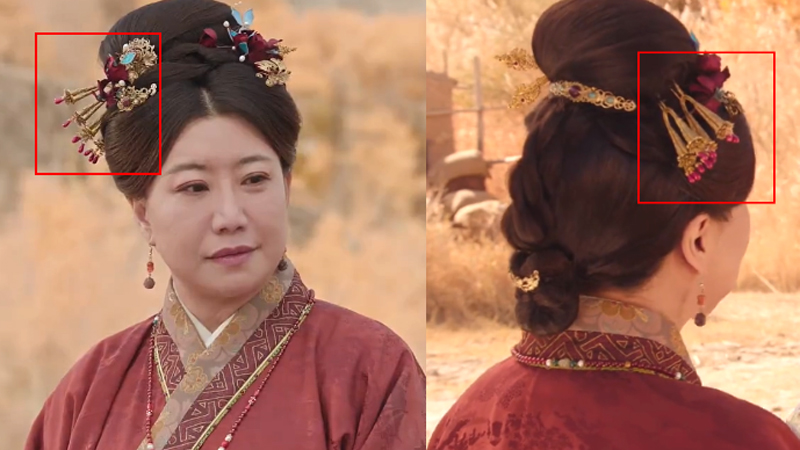
Have you ever spotted a character in a period drama and felt an instant tug of familiarity, not from their face, but from something glittering in their hair? In the hit series The Road to Splendor (花开锦绣), Madame Mo (陌) makes a striking entrance. She is played by Fan Tiantian (范湉湉), an actress who previously commanded attention as the formidable Lu Meilin in Fanhua (繁花). Here, she takes on the role of a military general’s wife—bold, outspoken, and unapologetically grand. Yet, what truly catches the eye is not her performance alone, but the peculiar pair of cylindrical hairpins slanting from her temple. They are not the single-pronged Ji (笄, ancient hairpin) or the dangling Buyao (步摇, swaying ornament) common in so many costume dramas. Instead, they look like tiny metal tubes tipped with crimson beads. Where did these come from? And why do they feel so refreshingly unfamiliar?
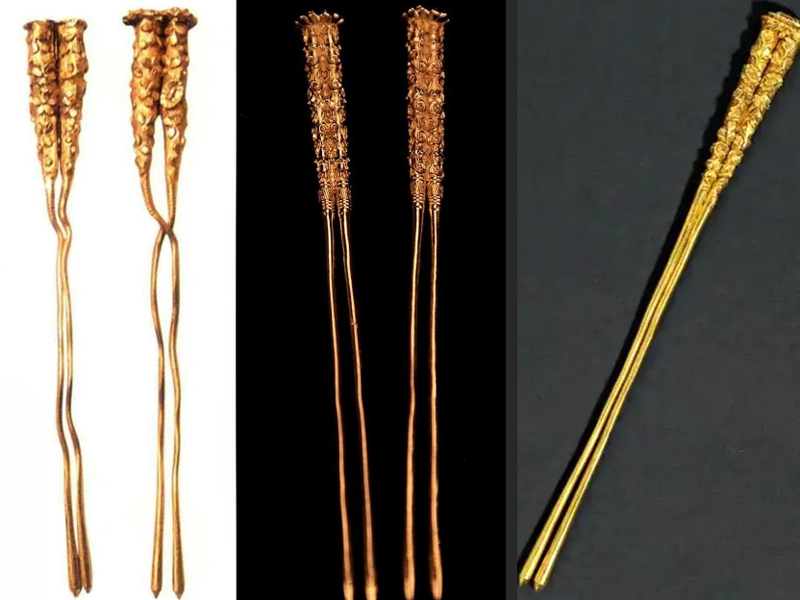
The answer takes us back to the Song Dynasty, a period often overshadowed by the Tang’s flamboyance but equally rich in its own quiet innovations. That cylindrical hairpin is called a Floral-tube hairpin. It was a signature accessory for women of that era, worn equally by commoners and noble ladies. Its shaft is a slender, hollow cylinder, often engraved with simple trailing vines or curling grass patterns. Some versions feature a tiny dangling bead or tassel at the end. Unlike the ornate, oversized pins of the Tang (唐, 618–907 CE), this piece whispers rather than shouts. It fits the Song aesthetic like a glove—restrained, refined, and deeply mindful of proportion.
Two Classic Styles
Archaeological finds reveal that the Floral-tube hairpin came in two dominant configurations. The first is the “parallel-head” type, where a single base supports two cylindrical tubes side by side, with two prongs extending downward to secure the bun. This is exactly what Madame Mo wears in the drama—two neat tubes aligned like sentinels, each with a red pearl dangling below. The second is the “bridge” or “arched” type, where the headpiece curves into a gentle bow shape, holding anywhere from three to seven tubes along its arc. This version sits higher and wider, reserved for ceremonial occasions or wealthier households. Both styles share the same cylindrical core, but their arrangement changes the visual weight entirely—one is daily elegance, the other is festive grandeur.
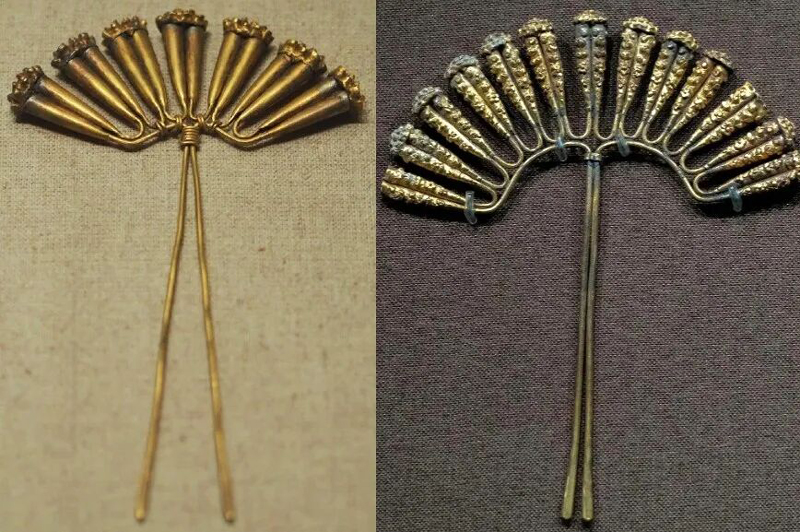
What makes these designs so clever is their engineering. The double-pronged structure, inherited from earlier Han (汉, 206 BCE–220 CE) and Wei-Jin (魏晋, 220–420 CE) periods, ensures the pin stays firmly in place. But the Song artisans took that functional base and added a sculptural element—the tube itself becomes a miniature canvas. They did not chase after gold phoenixes or mythical beasts like their Tang predecessors. Instead, they carved fine, shallow lines that catch light only at certain angles. It is a quiet boast: you have to come close to appreciate the craft. That interplay of distance and detail perfectly mirrors the era’s feminine ideal—composed, graceful, and never loud.
Why the Song Fell for It
Two cultural currents propelled the Floral-tube hairpin to fame. First, the Song Dynasty was obsessed with flowers. From the emperor to street vendors, both men and women wore fresh blooms in their hair—peonies, chrysanthemums, even plum blossoms in winter. This was not mere vanity; it was a social ritual, a marker of season and status. The Floral-tube hairpin, with its tubular shape mimicking a flower bud or calyx and its dangling bead suggesting a pistil or petal, offered a permanent, metal version of that floral craze. It let a woman display her love for nature without wilting petals or seasonal limits. She could wear spring in winter, summer in autumn—all pinned to her bun.

Second, the Song aesthetic turned away from ostentation toward quiet sophistication. Compared to the Tang’s love for oversized, glittering pieces, the Song preferred clean lines and subdued finishes. A Floral-tube hairpin from a distance looks like a simple metallic stripe—neat, orderly, almost austere. Only up close does the engraved foliage emerge, delicate as a whisper. This duality appealed to a society that valued inner cultivation over outward display. It matched the ideal woman of the time: poised, well-educated, and emotionally restrained. She did not need to dazzle; she needed to suggest. And this little cylinder did exactly that—it hinted at elegance without flaunting it.
Interestingly, the trend did not die with the Song. In the Yuan Dynasty (元, 1271–1368 CE), the Floral-tube hairpin continued but morphed into chunkier, less ornate versions—plain rings or simple grooves, reflecting the Mongols’ robust, practical taste. By the Ming (明, 1368–1644 CE) and Qing (清, 1644–1912 CE), however, the style had largely vanished. Sumptuary laws, changing hair fashions, and the rise of new materials like jadeite and nephrite shifted preferences toward solid jade combs and gold filigree. The tubular pin became a relic, a whisper of a bygone age—until a costume designer for The Road to Splendor resurrected it.
Screen Adaptation and Modern Eyes
The production team behind the drama did not simply copy museum pieces. They took the historical Floral-tube hairpin and adjusted it for the camera. The tubes are slightly larger than excavated examples, because small details get lost on screen. The red beads at the ends are not authentic to Song finds—most surviving pieces have plain or blue-green drops—but they chose crimson to echo Madame Mo’s dark burgundy robes. That color match creates a cohesive visual palette, making the hairpiece feel intentional rather than accidental. It also adds a touch of warmth to her stern military wife persona, softening her edges without compromising her strength.

What is more, the placement matters. In the show, she wears the pins tilted to one side, not symmetrically centered. This asymmetry is a modern directorial choice, breaking the rigid formality of historical correctness for a more dynamic, contemporary silhouette. It tells us that the designer understood the spirit of the Song—the love for subtle novelty—rather than slavishly copying every measurement. They asked: what would a Song woman wear if she had today’s visual literacy? The answer is this hybrid—historically grounded, yet visually refreshed.
So, do you find Madame Mo’s Floral-tube hairpin beautiful? That question is trickier than it seems. Beauty, after all, is not just about symmetry or sparkle. It is about resonance. When we see that cylindrical pin, we are not just looking at metal and beads. We are seeing a thousand years of aesthetic evolution—from bone Ji of prehistoric times to the gold phoenixes of Tang, then the quiet tubes of Song, and finally their ghostly absence in later dynasties. We are also seeing a production team that cares enough to dig beyond the clichés of costume dramas. They could have given her any standard hairpin, but they chose this obscure, almost forgotten shape. That choice itself is a statement: history is not a museum; it is a living wardrobe, waiting for the right actress to wear it again.