
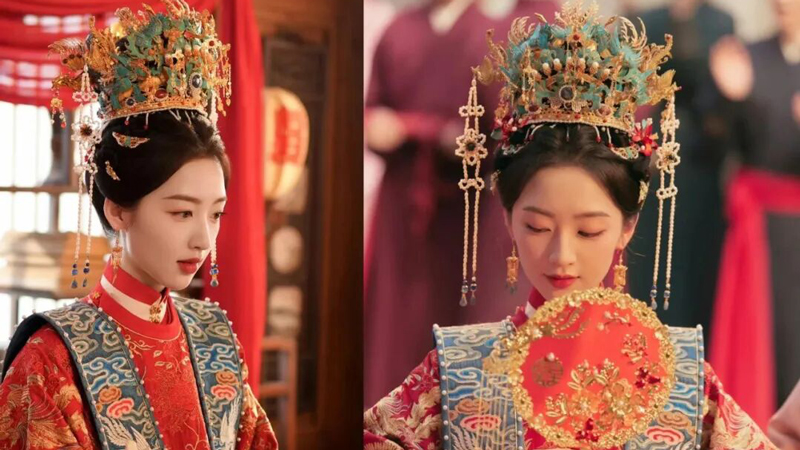
In a recently released still from the historical drama The Road to Splendor (花开锦绣), young actress Deng Enxi (邓恩熙) appears in full bridal regalia. Atop her head sits a gilded ceremonial crown, its base inlaid with kingfisher feathers, decorated with intertwining dragon and phoenix motifs, and flanked by cascading pearl tassels. This striking image has sparked a spirited debate among costume drama enthusiasts: is that a legitimate Phoenix Crown, or is it the lesser-known Flycatcher Crown? The distinction matters because, in the rigid social hierarchy of the Ming dynasty, wearing the wrong hat was not a fashion faux pas—it was a potential political crime.
Royal Rules
The Phoenix Crown was the ultimate status symbol for the empire’s top-tier women. It was not an accessory one could simply purchase or borrow. Strictly reserved for the empress dowager, the empress, and the crown prince’s consort, it could only be worn during the grandest state occasions: enthronements, imperial audiences, and the emperor’s own weddings. Its construction was a marvel of meticulous craftsmanship. The framework was woven from lacquered bamboo silk, over which a base of kingfisher feather inlay was applied. Gold-crafted dragon and phoenix components were then soldered on, followed by the setting of countless pearls and precious gems.
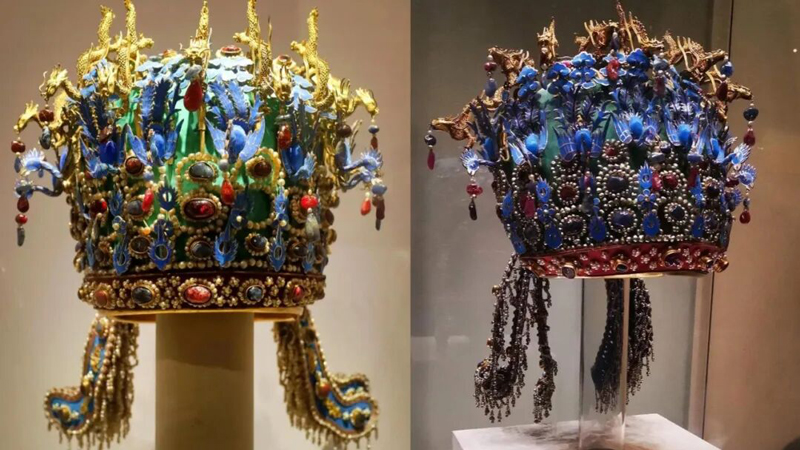
Excavated examples from the Dingling (定陵) Mausoleum, the tomb of the Wanli Emperor (万历皇帝), reveal the sheer extravagance involved. One crown belonging to Empress Xiaoduan (孝端) contained over a thousand pearls and hundreds of gemstones. This was not mere decoration; it was a portable treasury. A defining feature was the pair of wing-like side flaps at the back, known as Bo Bin (博鬓). These served a practical purpose—balancing the heavy crown to prevent it from tipping forward—while also adding an imposing sense of gravitas. In essence, if it had both dragons and phoenixes, it was unmistakably a Phoenix Crown.
Over the three-century span of the Ming dynasty, the precise number of dragons and phoenixes varied. Unearthed artifacts show designs like twelve dragons with nine phoenixes, or six with three. However, the rule remained simple: the combination of both mythical creatures was the exclusive marker of the Phoenix Crown system. It was the paramount insignia of female imperial power, and its visual language left no room for ambiguity—or imitation by those of lower rank.
The Peacock’s Mark
Confusion with the Flycatcher Crown is common, as the two share a superficial visual similarity. Both are ceremonial headpieces adorned with pearls and kingfisher feathers. However, the Flycatcher Crown occupied a distinctly lower tier in the Ming social stratosphere. It was the official headdress for imperial consorts, concubines, and the wives of high-ranking officials. Where the Phoenix Crown boasted dragons, the Flycatcher Crown’s central motif was the di (翟) bird, a pheasant-like creature. The number of these birds on the crown increased with the wearer’s rank—a visible, feathered hierarchy.
Its construction was noticeably simpler than its royal counterpart. The use of pearls and gems was significantly reduced, and the overall scale was smaller. More critically, it completely lacked dragon and phoenix imagery and was never designed with the balancing Bo Bin side flaps. Surviving portraits of Ming dynasty noblewomen often depict them wearing these distinct Flycatcher Crowns. These paintings serve as historical evidence, showing a clear visual distinction that contemporary viewers often overlook.
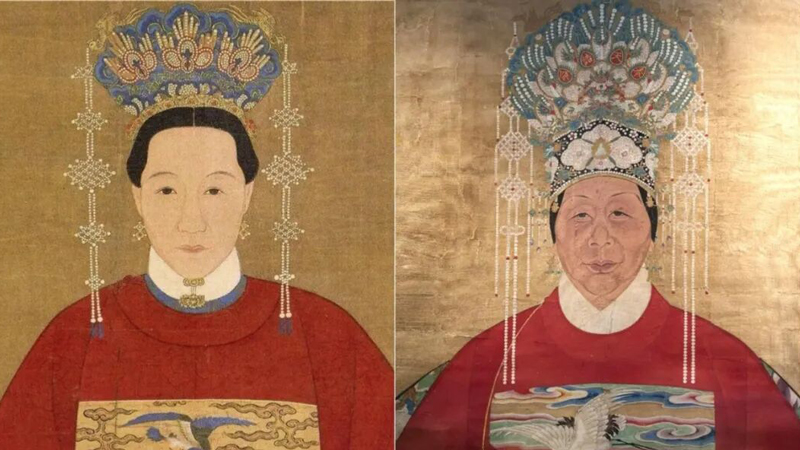
For ordinary commoners, wedding ceremonies did permit a headdress in the Flycatcher Crown style, but strictly without any dragon or phoenix embellishments. Over time, as generations passed, the general public began to loosely refer to all bridal crowns as “phoenix crowns,” blurring the historical lines. This linguistic shorthand is why many today mistakenly identify any grand, ornate bridal crown as a Phoenix Crown, ignoring the strict class distinctions that once governed its use.
Artistic Touch
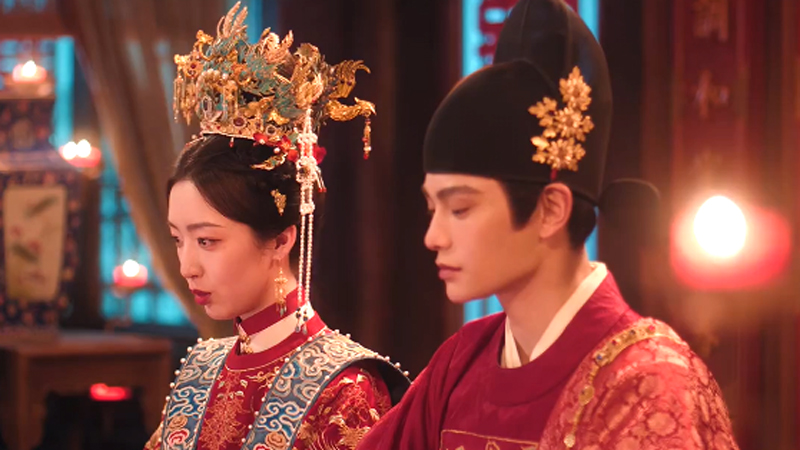
So where does this leave Deng Enxi’s headpiece in The Road to Splendor? A close examination reveals it leans heavily toward the Phoenix Crown category. The front of the crown features a prominent gold dragon ornament, with phoenix figures spreading out on either side. Their wings are crafted with kingfisher feather inlay, paired with gold trims and rubies. This is a clear dragon-phoenix combination, placing it firmly in the imperial aesthetic. However, the production team has clearly taken some dramatic liberties.
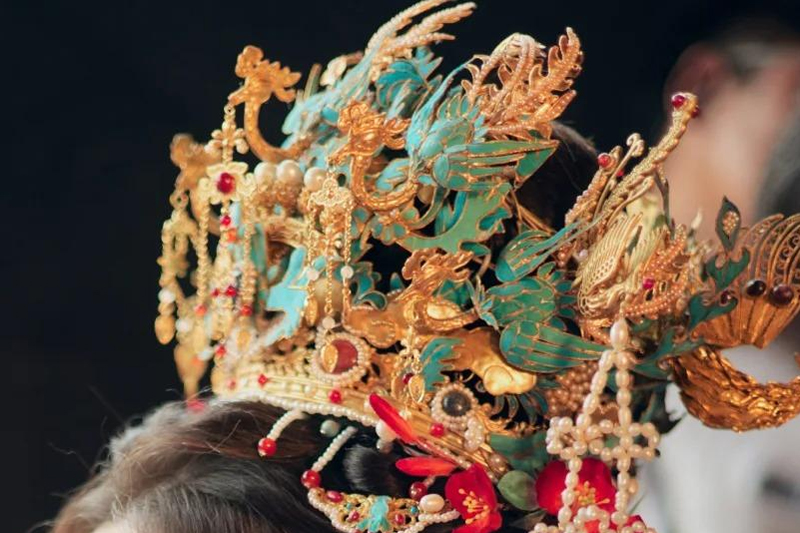
Historical Phoenix Crowns were notably larger and more imposing. The drama’s version has been scaled down for comfort and camera angles. The rear Bo Bin flaps have been entirely removed, and the brim has been adorned with small red flowers and delicate gold details. These alterations soften the crown’s formal, almost severe, majesty and inject a sense of celebratory joy more fitting for a wedding scene in a television series. The result is a hybrid—historically inspired, but designed for visual impact rather than strict accuracy.
Within the story, Deng Enxi’s character, Fu Tingyun (傅庭芸), is a daughter of an aristocratic family. She is neither the empress nor the crown princess. According to Ming dynasty etiquette, her wedding would have mandated the Flycatcher Crown, not the imperial Phoenix version. The production’s decision to use the Phoenix Crown design is a deliberate act of artistic enhancement. It amplifies the grandeur of the wedding ceremony and creates a more striking visual for the audience. It is a powerful example of how period dramas prioritize narrative emotion and spectacle over historical precision, bending the rules of the past to serve the story of the present.
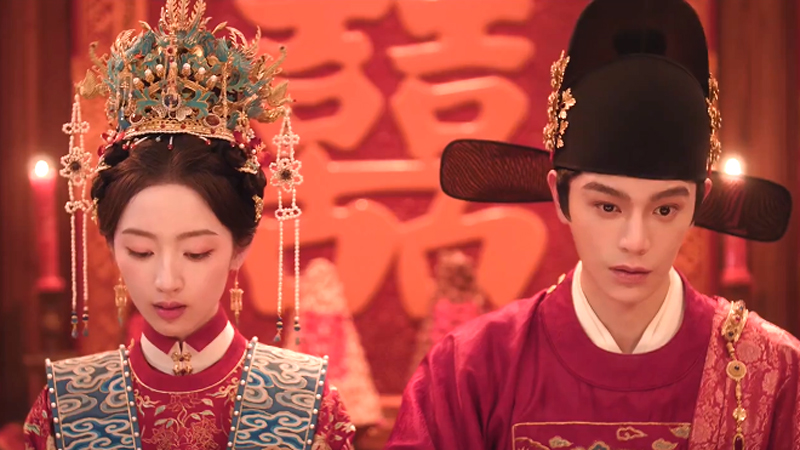
Ultimately, the debate over Deng Enxi’s crown highlights the fascinating tension between historical fact and dramatic fiction. While the crown she wears is a beautiful recreation of a Phoenix Crown, its use in her character’s wedding is a clear anachronism. Yet, it is precisely this kind of creative choice that makes historical dramas so visually captivating. It invites the audience to appreciate both the intricate craftsmanship of the past and the imaginative freedom of modern storytelling, reminding us that even the most historical of garments can be a canvas for artistic expression.