
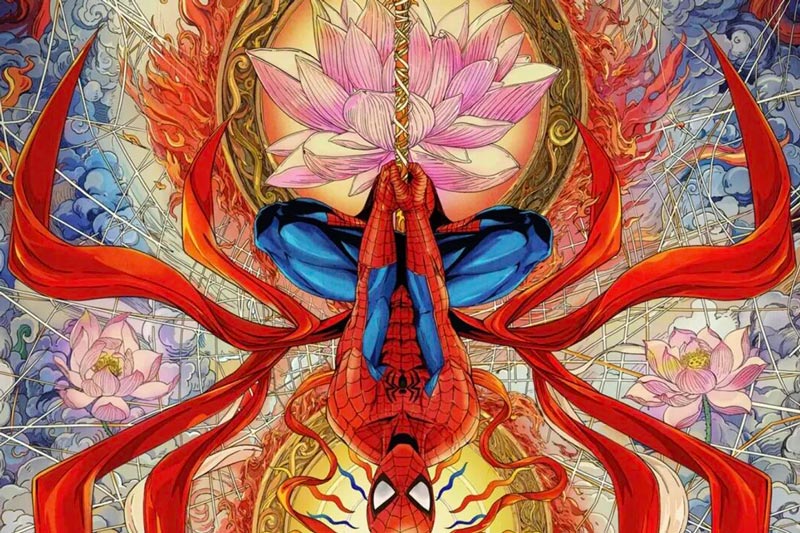
A Spider-Man (蜘蛛侠) promotional poster for the Chinese market has unexpectedly ignited a heated debate across the internet, particularly among Indian audiences. The image features a stylised lotus flower, and many online commenters from India immediately claimed it as their own cultural emblem, accusing the design team of misappropriation. Meanwhile, Chinese netizens pushed back, pointing out that the lotus has been part of their artistic tradition for millennia.
At first glance, this seems like a trivial squabble over a single decorative detail. Yet beneath the surface, it reveals a much deeper misunderstanding: the lotus is not the exclusive property of any one civilisation. The flower that blooms in Chinese paintings and the sacred padma of Indian scriptures share a botanical lineage but have followed entirely different cultural trajectories. Their meanings, aesthetics, and emotional resonance have diverged so sharply that treating them as the same symbol is a mistake.
Two Flowers, One Root
Many people casually use the terms “lotus” and “water lily” interchangeably, and in everyday language, that confusion is harmless. Botanically, the sacred lotus is the same species whether it grows in the Ganges or the Yangtze. However, in India, the red and white varieties of Padma (the Sanskrit term for the sacred lotus) are deeply embedded in ancient religious cosmology. For Hindus and Buddhists, it represents creation, divinity, and the cycle of rebirth—it is a throne for gods and a metaphor for spiritual awakening. That symbolic weight is profound and unmistakable.

But when this flower travelled eastward into China, it did not simply transplant its original meaning. Instead, Chinese culture absorbed the foreign motif and fundamentally transformed its soul. In the Chinese context, the terms lianhua (莲花) and hehua (荷花) are often used synonymously, alongside poetic names like furong (芙蓉). The only clear distinction is that the water lily is treated separately. This linguistic blending already signals a crucial point: the Chinese lotus is not a borrowed relic; it is a native creation that later absorbed foreign influences, reshaped them, and made them its own.

From Divine Pedestal to Scholar’s Soul
Long before Buddhism entered China, the lotus already flourished in local poetry and folklore. The Book of Songs (诗经), compiled over two millennia ago, contains verses that admire the lotus growing in marshy lowlands—a rustic image of romance and seasonal beauty, not a cosmic symbol. This early Chinese lotus was earthly, intimate, and human. It spoke of love between young men and women, of the quiet charm of water villages, and of the simple pleasure of watching pink petals sway in the summer breeze.
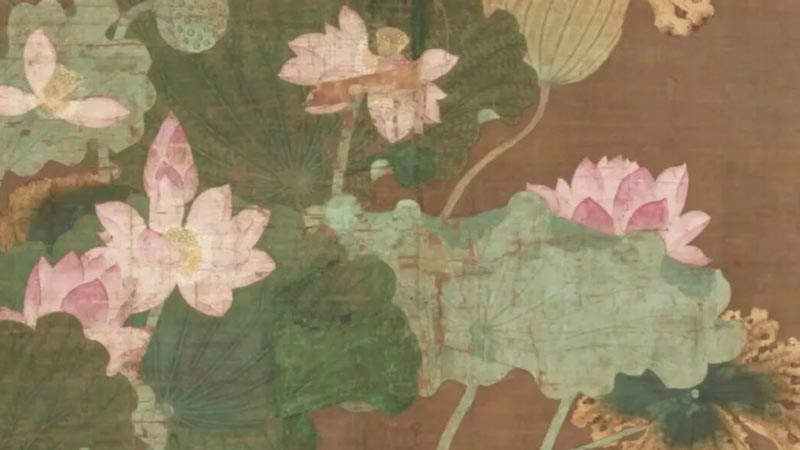
The decisive shift came during the Song Dynasty, when the philosopher Zhou Dunyi (周敦颐) penned his famous essay On the Love of the Lotus (爱莲说). He declared that the lotus “emerges from mud but remains unstained, washes in clear water but does not seduce”—a line that forever cemented the flower as a metaphor for moral integrity. From that point on, Chinese literati painted it, wrote endless poems about it, and revered it as the embodiment of the virtuous gentleman. It was no longer a divine pedestal; it became a mirror of human character. In folk culture, the lotus also carried auspicious wishes for harmony and abundance, appearing on New Year prints, porcelain, and embroidery—a cheerful emblem of everyday life, not a remote heavenly symbol.
Visual Grammar: Geometry Versus Freehand
If you compare Indian stone carvings with Chinese ink paintings, the visual difference is stark. Indian temple sculptures depict the lotus with thick, layered petals arranged in a near-geometric, symmetrical pattern. They serve as formal, solemn pedestals for deities—rigid, majestic, and hieratic. That style is unmistakably sacred, and it follows strict iconographic rules that have remained consistent for centuries.
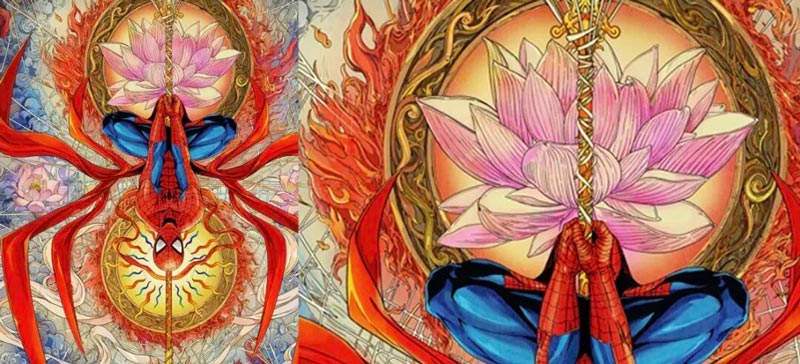
Chinese artistry, on the other hand, favours a more fluid and impressionistic approach. Song Dynasty scrolls show withered leaves drooping in the rain, bent stems swaying in the wind, and irregular clusters of blossoms that capture a fleeting moment of nature. There is no pursuit of absolute symmetry; instead, the artist seeks emotional resonance—a connection between the viewer and the living, breathing plant. This aesthetic, known as xieyi (写意) or “freehand,” values spontaneity and poetic suggestion. The Chinese lotus twists, bends, and curls in ways that feel organic and alive, a world apart from the rigid geometry of Indian stone lotus motifs. That is precisely why the Spider-Man poster’s design—with its flowing, stylised form—actually aligns more with the Chinese visual tradition than with the Indian one.
Ownership Is Not the Question
The online outcry over that single poster misses the larger point. Many Indian commentators assumed that any lotus image must be a reference to their national symbol, ignoring the fact that China has cultivated its own independent lotus culture for thousands of years. Yes, the lotus did arrive in China via the Buddhist transmission from India, but that historical route does not grant any modern nation exclusive rights over the motif. By that logic, Buddhism itself, which originated in India, would also belong exclusively to India—but its Zen interpretation has become quintessentially Chinese, as distinct as the Chinese lotus.
Cultural symbols are not fixed private assets. They travel, they take root in new soil, and they evolve. The Indian lotus remains a conduit to the divine and the cyclical universe; the Chinese lotus stands for moral resilience and worldly happiness. They look similar at a casual glance, but their inner worlds have parted ways long ago. In today’s globalised creative industries, such disputes over visual motifs will only increase. The proper response is not to claim ownership of a universal pattern, but to recognise and respect the distinct cultural layers behind each variation. So, whose lotus is it? Perhaps it belongs to no one—and to everyone, in their own unique way.