
When an international invitational exhibition makes its first stop in Songjiang (松江), it arrives with a local reason for being there: this year marks twenty years since Gu embroidery (顾绣), the district’s signature needle art, was listed in the first national batch of intangible cultural heritage. The occasion is the subject of a dedicated gallery inside “Art and Data in Symbiosis: Gathering the Best of Yunjian”, the Songjiang stop of the 16th International Traditional Art Invitational Exhibition, which opened August 18 at the Yunjian Hall Culture and Arts Center (云间会堂文化艺术中心) and runs through September 3.
Twenty-One Pieces Mark Twenty Years
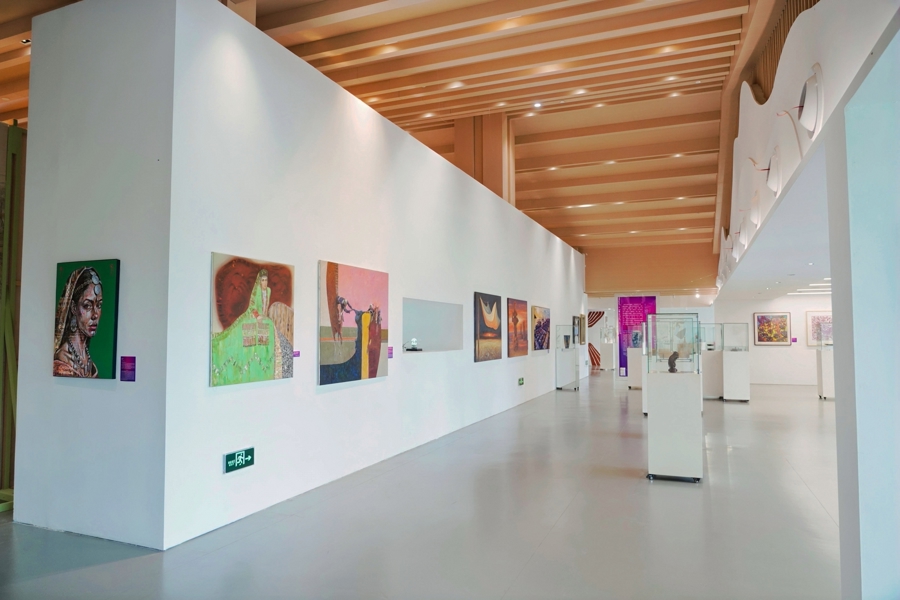
The Songjiang stop is jointly organized by the Shanghai Art Collection Museum, the Songjiang District Culture and Tourism Bureau, the Shanghai Vocational College of Arts and Crafts and the Shanghai Intangible Cultural Heritage Protection Center. It brings together more than 120 works, 75 of them international and 46 by local artists, drawn from over 30 countries and regions. The international side of the hall is deliberately varied: a Kuwaiti artist’s abstract mixed-media works explore quiet and struggle in inner emotion, a Tajikistan piece titled “Forty Maidens” turns a circle of dancers into a symbol of female vitality, Slovak contemporary painting renders the horizon as inner psychological space, and Egyptian iridescent ceramics shift like metal under light, so that work from around the world sits across from Chinese craft.
Inside the Gu embroidery gallery, 21 pieces trace the needle art’s twentieth year on the national register. Born in Ming-dynasty Songjiang, Gu embroidery is known for its painting-and-embroidery fusion: stitchers use the needle as a brush and thread as ink, splitting silk filaments so fine that a single hair’s width can carry shading, and reproducing the brushwork of Chinese painting. The selection walks through the generations: “Red Leaves and Magpies,” based on a Xu Beihong (徐悲鸿) painting and reworked in Gu embroidery’s own stitching, and “Galloping Horses,” both by national inheritor Qian Yuefang (钱月芳); “Ink Bamboo” and “Heavenly Maiden Offering Flowers” by municipal-level inheritors; and “Dong Qichang’s Combined Painting and Calligraphy Scroll” (董其昌书画合璧图卷), embroidered by the seven needleworkers of the Renwen Songjiang Activity Center (人文松江活动中心). The works show the hallmarks the craft is known for: thread split finer than a hair, stitches fine as a brush tip, and color that reads like painting.
Two Generations of Inheritors Weigh In
The show put inheritors and outside voices in the same room. Bao Jiashu (鲍家恕), a visiting scholar at the University of Oxford and a nominee for Shanghai’s Hongqiao Friendship Award (虹桥友谊奖), said after viewing the Gu embroidery that a technique several hundred years old still feels alive, and that an event of this kind matters not only for China but for the whole world. Chen Yinran (陈尹然), a post-95 “Shanghai Artisan” and a district-level inheritor, said the comparison with foreign work had given her a new question: Chinese pieces mainly display traditional technique and complex stitching, while Western works lean toward expressing ideas through inspiration, and she wondered whether the two could be combined in future work.
Alongside the Gu embroidery gallery, the hall presents other local heritage. A Songjiang cotton-weaving inheritor works a foot-operated loom to demonstrate the craft behind the district’s old claim of having “clothed the world”; Gu embroidery stitchers split thread and needle on site; and a silkscreen printmaking inheritor fixes Jiangnan folk life onto paper with each pull of the squeegee. The pairing is deliberate: the same June edition of the invitational exhibition, themed “Art and Data in Symbiosis,” ran at the Shanghai Art Collection Museum as a look at how traditional arts convert to and express themselves through the digital era, and the Songjiang stop extends that question into the district’s own crafts.
A First Stop in Songjiang
The international invitational exhibition has now involved artists from more than 80 countries and regions, close to 2,000 in total, since its early editions. Its first Songjiang stop doubles as a milestone for the district: a listed project in Shanghai’s cultural brand-building plan and a key program of the municipal traditional craft revitalization plan, it now feeds Songjiang’s push to build its “Root of Shanghai” cultural tourism identity. With the Gu embroidery anniversary as the local anchor, the show runs at the First Exhibition Gallery of Yunjian Hall until September 3.