
An imperial garden in northern Beijing now smells faintly of Guizhou (贵州) pepper and boiling beef broth. The Guizhou Heritage Roots Market opened on August 22 along the lotus-lined east shore of Beihai Park and runs through August 31, an unusual pairing: the ethnic-minority crafts of the mountainous southwest staged inside a former imperial retreat that dates to the Yuan dynasty.
The event, titled “Imperial Glow, Enduring Guizhou Flavors”, is guided by the Beijing Office of the Guizhou Provincial People’s Government and Guizhou Radio & Television Network Media Group, and organized by Jiayou Shopping Group (家有购物) together with the Beihai Park Administrative Office. The ten-day program straddles the last two weekends of the summer holiday and mixes heritage performances, craft workshops, costume try-ons, agricultural-product stalls and a food lane. For Guizhou’s organizers it doubles as a window for the province’s specialties and culture into the capital’s consumer market.
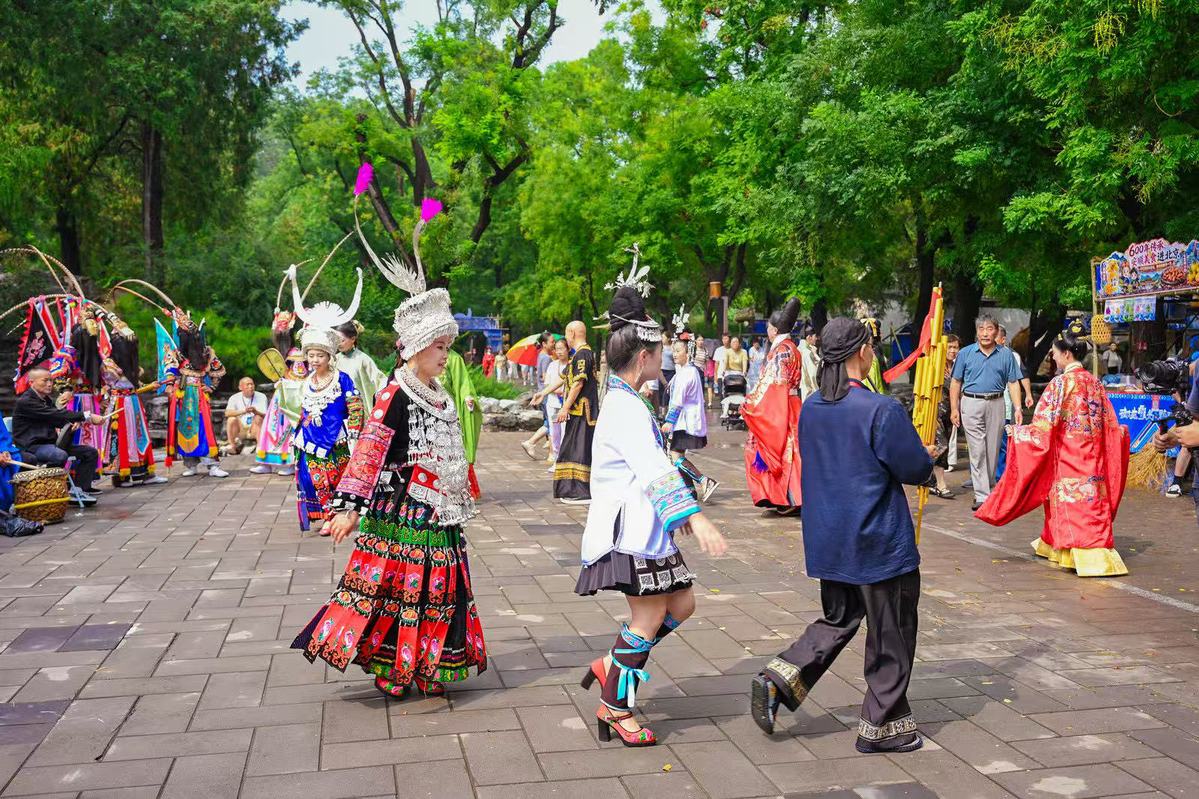
Opening day centered on a “Sound in Harmony” stage. Miao (苗族) dancers performed the Lusheng (芦笙) dance in full ethnic dress, the Dong (侗族) people’s grand chorus layered unaccompanied voices across the courtyard, and an Anshun (安顺) ground opera troupe acted out classic scenes in carved wooden masks and armor. Between sets, models in Hanfu walked the lakeside in a short runway show, drawing crowds of visitors with phones raised.
The “Shared Craft” workshop zone is the hands-on heart of the market. A master of the Shui script (水书), a writing system recognized as a national intangible cultural heritage item, teaches visitors to recognize and copy the ancient characters sometimes called living fossils of pictographic writing, and to make Shui-themed keepsakes. The sessions have been filling up quickly, organizers said, with many families lingering over the brushes.
A free dress-up area called “Hanfu Beauty” lets visitors borrow Hanfu, Miao and Dong festive costumes, then pose for photos along the lotus pond boardwalk against the White Pagoda. The station has drawn both Chinese tourists and foreign visitors since the first morning, many of them taking the imperial-garden backdrop as a fitting frame for the mingling of Han and minority dress traditions.
Around the stalls, the market concentrates a cross-section of Guizhou’s craft and produce: Miao embroidery, batik, and the horsetail embroidery of the Shui people, whose coiled horsehair-wrapped thread technique has carried the group’s memory for centuries; chestnut rose juice, Xingren (兴仁) Job’s tears and Tongren (铜仁) matcha; and street snacks from Anshun grilled intestines and crispy cracklings to beef rice noodles and sticky rice. Twenty-five stalls are grouped into five functional zones and three core experience areas, with several national-level inheritors demonstrating their crafts on site, including masters of Shui horsetail embroidery and Miao batik.
The market runs through August 31, straddling the last two weekends of the summer holiday, when park foot traffic is at its heaviest. For Beijing residents it is a shortcut to a province they might otherwise cross half the country to taste; for the market’s organizers, it is a test of whether mountain crafts can find a permanent audience beside an imperial lake.