
The collar that Western fashion calls the Mandarin collar sits neither high nor low, circles the neck without lapels, and needs no tie. It shows up on custom qipao from Shanghai, on the Nehru jacket, on the Beatles’ collarless suits, and on the standing-collar silhouettes that kept appearing at the Milan and Paris menswear shows in 2024. The line has traveled for more than 1,300 years, and its journey begins with the Yuanlingpao (圆领袍), the round-collar robe that Tang China treated as its national garment.
The Steppe Origins of a Round Collar
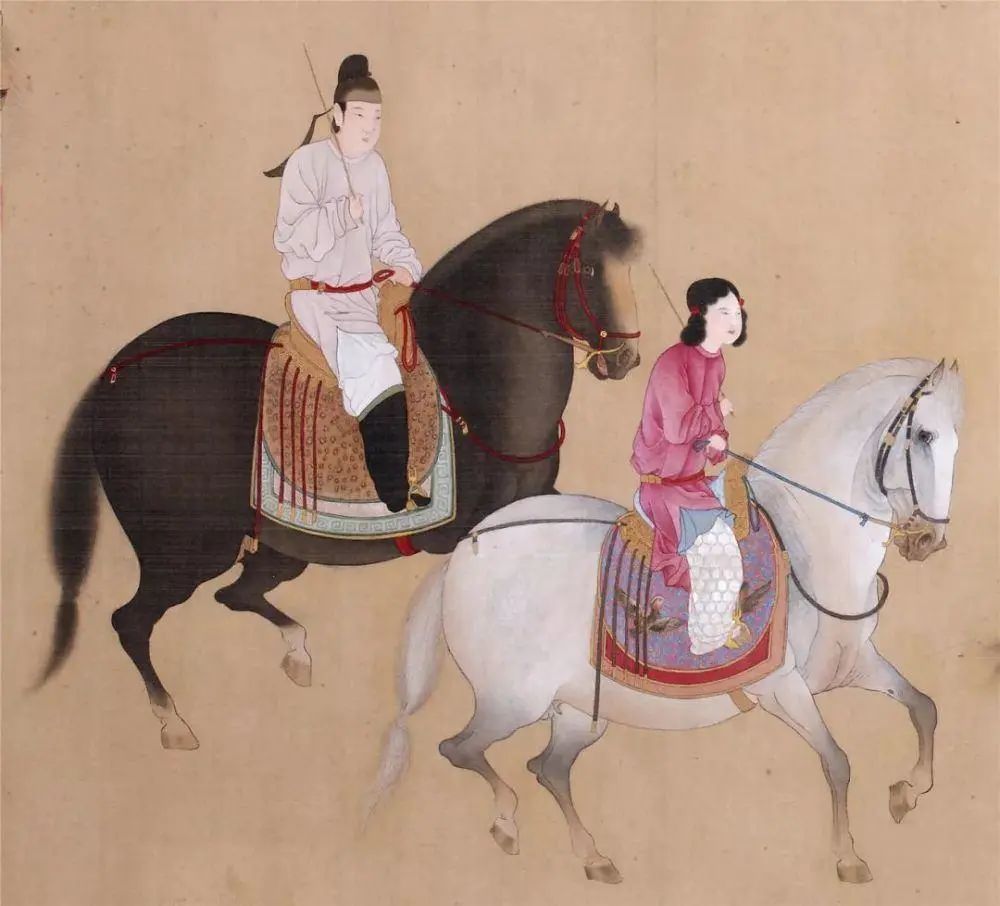
Foreign in origin, the Yuanlingpao, a robe whose collar forms a semicircle around the neck, had taken root in northern China by the Northern and Southern Dynasties. Scholars of Chinese dress generally trace the type to West Asia, while a second theory points to the Xianbei, the nomadic people of the northern steppe, whose traditional jacket was tight-fitting, with small collar and sleeves, built for warmth and riding.
Excavated evidence pushes the collar deeper into the past. Round-collar undergarments, called curve-collar shirts, appear in the Han dynasty; finds become frequent after the Eastern Han, and in the late Han and Three Kingdoms period the form may already have served as court dress, as attendant figurines from the Eastern Wu tomb in Nanjing suggest. Northern-dynasty tomb murals show men in round-collar robes with narrow sleeves made for archery and riding, and the Dunhuang murals of the Western Wei display a fully mature version. In the tomb of the Northern Qi general Xu Xianxiu (徐显秀), even the female attendants wear men’s dress. The Sui dynasty folded the northern robe into its official clothing system, and the Tang inherited it.

When the Whole Tang Wore One Robe
In the Tang dynasty the Yuanlingpao reached its peak. Although the robe was nomad in origin, it suited the Sui and Tang rulers, who had northern blood, and it became their natural choice for daily wear. The standard outfit of the official class was a cloth headwrap called Futou (幞头), a round-collar robe with narrow sleeves, a belt with carved plaques, and black leather boots. The Yuanlingpao was the most common item in Tang men’s dress, gradually displacing the formal court robes, spanning the Tang, Song and Ming dynasties, and becoming almost a synonym for the official robe.
Practical details explain its success. The round collar did not wrap the neck, and a single button sat at the right side of the collar line instead of ties, keeping wind and sand out. In hot weather a man could unbutton the shoulder and fold the collar open into lapels, a feature that made the Yuanlingpao the only garment in the Chinese tradition with a lapel. The robe also introduced side slits, possibly borrowed from Persia, for comfort on horseback — an element unknown in Qin and Han dress that later became a standard feature of Chinese clothing.
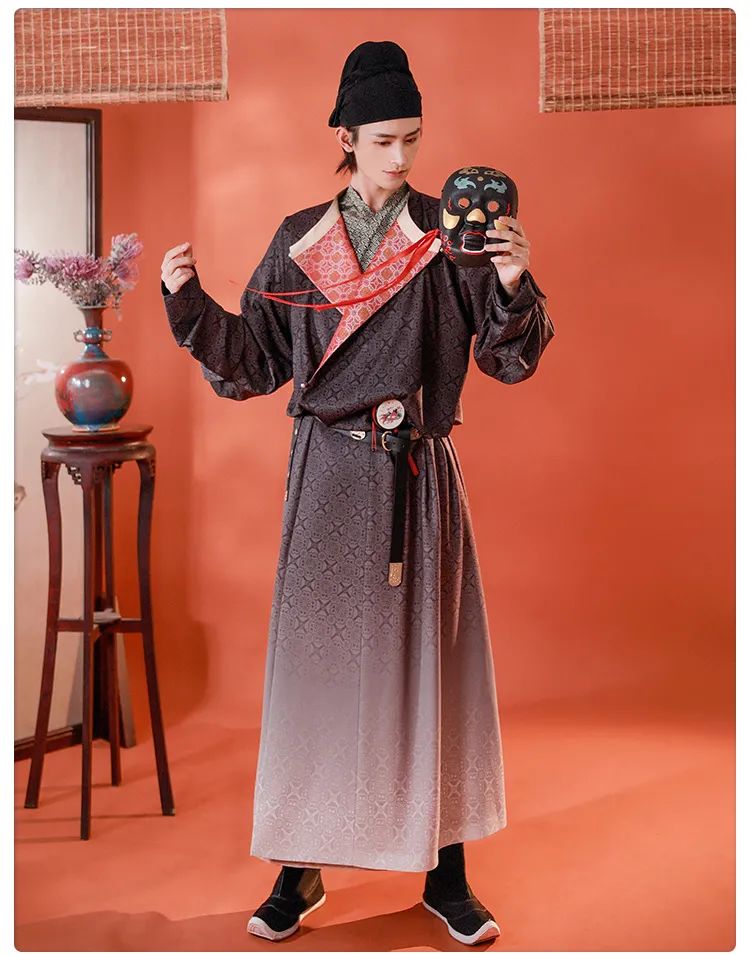
Beyond the collar, the robe split into two versions. The slit-sided version, convenient for riding and campaigning, was commoners’ daily wear; the closed-sided version carried a horizontal panel, the Lan (襕), added near the hem as a nod to ancestral custom. That panel had a famous legislative history. During the reign of Emperor Taizong of Tang, Grand Councilor Ma Zhou (马周) memorialized that the Rites contained no text on the garment-shirt, that the three-dynasty system had the Shenyi (深衣), and that a lan, sleeves and trimming should be added to make a scholar’s upper garment, while the slit-sided robe, called Quekuai Shan (缺骻衫), was left to commoners. Grand Commandant Zhangsun Wuji (长孙无忌) added that robe-wearers should carry the lan below the waist, in crimson, purple or green according to rank, with commoners in white. Tang scholars accordingly took the round-collar Lanshan (襕衫) as their upper garment, and the horizontal panel near the knee deliberately echoed the ancient Shenyi’s division into “upper garment and lower skirt” as a mark of respect for ancestral forms. Shen Kuo (沈括) summed up the fusion in his Dream Pool Essays: “Chinese dress, since the Northern Qi, has used nomad clothing entirely.”
Rank, Written in Four Colors
In the Tang, robe color alone marked an official’s grade. The color-rank system took shape in 621, the fourth year of the Wude era (武德), and was refined in 674, the first year of the Shangyuan era (上元), into four grades: purple, crimson, green and blue-green. Officials of the third rank and above wore purple with gold-and-jade belts; the fourth rank wore deep crimson and the fifth light crimson, both with gold belts; the sixth wore deep green and the seventh light green, both with silver belts; the eighth wore deep blue-green and the ninth light blue-green, both with stone belts. Commoners wore yellow with copper-and-iron belts.
Yellow was bound to the imperial house, and purple was rehabilitated: once attacked in the saying that “evil purple usurps vermilion,” it was recast as the color of power and rank. The system was revised seven times before settling back into the purple, scarlet, green and blue-green framework of the Zhenguan era (贞观). The hierarchy also bred defiance — in the late Tang the craze for purple and crimson robes spread among common people, who went so far as to fake military credentials. The robe was, in effect, an identity document.
The Tang Women Who Dressed as Men
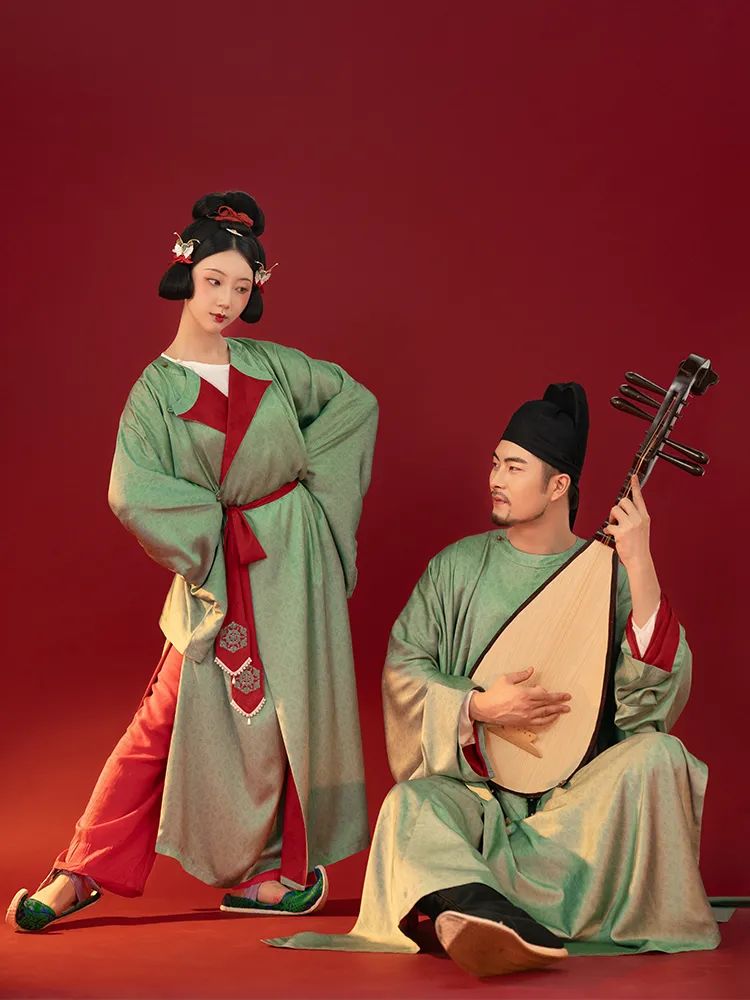
Women joined the trend. The Old Book of Tang records that in the early Kaiyuan years (开元) many women wore men’s clothes and boots, wrapping their heads in futou, putting on round-collar robes and leather boots, and riding out for polo and hunting — a practice contemporaries called “women imitating men’s dress.” Before the Tang, the boundary between male and female dress was considered absolute, and crossing it was seen as a breach of ritual. Nomadic society, where women herded and rode like men, had no such divide, and the open climate of the Tang let women shed the constraint. The fashion reads as a symbol of leveled hierarchies of gender, class and the distinction between Han and non-Han. In the paintings “Spring Outing of Lady Guo” and “Ladies Waving Fans,” women appear in round-collar robes, and the ceremonial dress of later titled ladies and empresses came to be built largely on the form.
A Two-Dynasty Career in Court Dress
During the Song and Ming, the robe settled into full ceremonial use. In the Song, the round-collar wide-sleeve Lanshan became the standard public dress of officials, worn with winged headwear and a leather belt, and made at its finest from four-warp silk gauze, an expensive weave of great technical complexity. The Ming combined the robe with the official uniform: it became the daily dress of emperors and officials, embroidered with rank badges called Buzi (补子) whose birds and beasts marked civil and military grades, and its sleeves diversified, the pipa sleeve becoming common. The painter Tang Yin (唐寅) is shown wearing the lanshan in his surviving portrait.
The garment also traveled. Joseon, the Korean dynasty, modeled its official dress on the Ming system, and Japan’s Asuka period had already imitated Tang practice. With the Manchu conquest and the imposition of banner dress, the Yuanlingpao left the main stage of Chinese clothing — but its legacy did not disappear; it simply changed shape.

The Standing Collar’s Rise
After the Yuanlingpao, the leading role passed to the standing collar. The Ming standing collar appeared in the mid-Ming, when China was entering the Little Ice Age and colder climate made a closed neckline practical, and it spread through the Central Plains and the Jiangnan region by the late Ming. By the end of the Ming, the standing collar with Pankou (盘扣) fastenings already resembled the future qipao: Ming collars used metal buttons without long tails, while the qipao would use long-tailed cloth Pankou. Under the Manchus, the “men follow, women keep their dress” rule let Han women continue wearing Ming-style standing-collar jackets and Beizi (褙子).
In the mid-Qing the standing collar absorbed Manchu elements — piping, wide borders, long-tail Pankou and a squared placket — and spread further. In the Republican era, the “Chinese standing collar” became a defining element of both the Zhongshan suit (中山装) and the qipao: when Sun Yat-sen designed the Zhongshan suit after the fall of the Qing, he kept the standing collar deliberately, as a carrier of Han dress identity. Collar by collar the Chinese collar line changed shape: round in the Tang, standing in the Ming, tailored into the qipao in the Qing, folded into the Zhongshan suit in the Republic, a relay that finally stood up and knocked on the door of Western fashion.

A Name Born in the Qing Court
The term “Mandarin collar” points back to the high officials of Qing China. “Mandarin” came into European languages through Portuguese “mandarim” and Malay “menteri,” and traces ultimately to the Sanskrit “mantrin,” meaning advisor or minister; Europeans used it for the mandarins of the Chinese court. Their ceremonial robes — the changpao and longpao — carried high, stiff standing collars as a mark of rank and formality. Between the late 19th and early 20th centuries, as Western observers grew familiar with Chinese dress, “Mandarin collar” fixed itself in English. At the same time, the Shanghai qipao of the early 20th century — itself a modernization of Manchu dress — honed the high standing collar into a symbol of Oriental feminine elegance. Popular in Shanghai and Hong Kong through the 1920s to the 1940s, its clean, collarless line stood in sharp contrast to the ruffled collars of the contemporary West.
Nehru, the Beatles, and Dr. No
After the Second World War, the standing collar entered Western fashion at scale. In the 1960s the Nehru jacket, named for India’s first prime minister Jawaharlal Nehru, swept Western menswear and carried the Mandarin collar into the mainstream; the Beatles’ early collarless suits, minimal designs by Pierre Cardin, made the collar a symbol of pop culture and youth rebellion; and in 1962 the first James Bond film, Dr. No, dressed its villain in a white standing-collar jacket, tying the collar to screen images of mystery, power and exotic allure. Even the US Army’s ACU combat uniform uses a standing collar, so soldiers can wear body armor without chafing. From high fashion to service uniforms, the collar’s “no tie, neat, upright” character took it around the world.

The Collar Comes Home
In the 21st century the collar’s journey closed its loop. Western designers keep drawing on Chinese dress: Shanghai Tang built its brand on the standing collar and Pankou, and Giorgio Armani and Ralph Lauren have both used standing collars in their collections, with the trend sharpening at Milan and Paris menswear shows from spring 2024. Inside China, the Hanfu revival and the Neo-Chinese wave brought the Yuanlingpao back into young wardrobes: Mamianqun skirts, Yuanlingpao robes and Neo-Chinese outerwear travel overseas, the Hanfu tag on TikTok has passed 100 million views, graduates in Song brocade and Hanfu appear at overseas ceremonies, and the English-language internet even coined “Chinamaxxing,” a tag with more than four billion views.
The collar that began on West Asian steppe routes and in Xianbei tents was fixed in the murals of the Northern Dynasties, became the national garment of Tang China, was ritualized across the Song and Ming, shaped dress in Korea and Japan, yielded to the standing collar in the Qing, and was carried to the world by the qipao and the Zhongshan suit. “A deep cultural fusion in global fashion,” one fashion historian called it, “in which traditional forms are reinterpreted to carry both timeless elegance and modern relevance.” The next time you see a standing-collar shirt, a Mamianqun skirt or a Neo-Chinese jacket, look at the small arc at its collar — 1,300 years of East and West are folded into that curve.