
A Qiqiao (乞巧) offering display is not a painting you hang and walk past. It is a diorama built from grain, paper, bamboo and patience, and Wangniudun (望牛墩) put 21 of them, one from each village in the town, on show from the evening of August 18 at the Wangniudun Cultural Square in Dongguan. The “Gathering of Qixi” exhibition anchors the 2026 “Our Festival: Qixi” series, a 13-event program that runs through August 22 as part of the “Bay Area Weekend in Dongguan” campaign.
Every offering follows a three-part structure that a curator would recognize as a fixed grammar. The front zone is the offering table: towers of grains, fresh fruit, traditional cakes and a neat set of tea vessels, laid out as they would be for worshipping the Seventh Sister (七姐). The middle zone is the craft stage, the section that carries the “qiaogong” (赛巧) competition tradition and tests the maker’s hands most. The rear zone is the Magpie Bridge (鹊桥) tableau, with the bridge and auspicious clouds built entirely by hand and paired with lifelike figures of the Cowherd and the Weaver Maid, the two lovers whose reunion the holiday remembers.
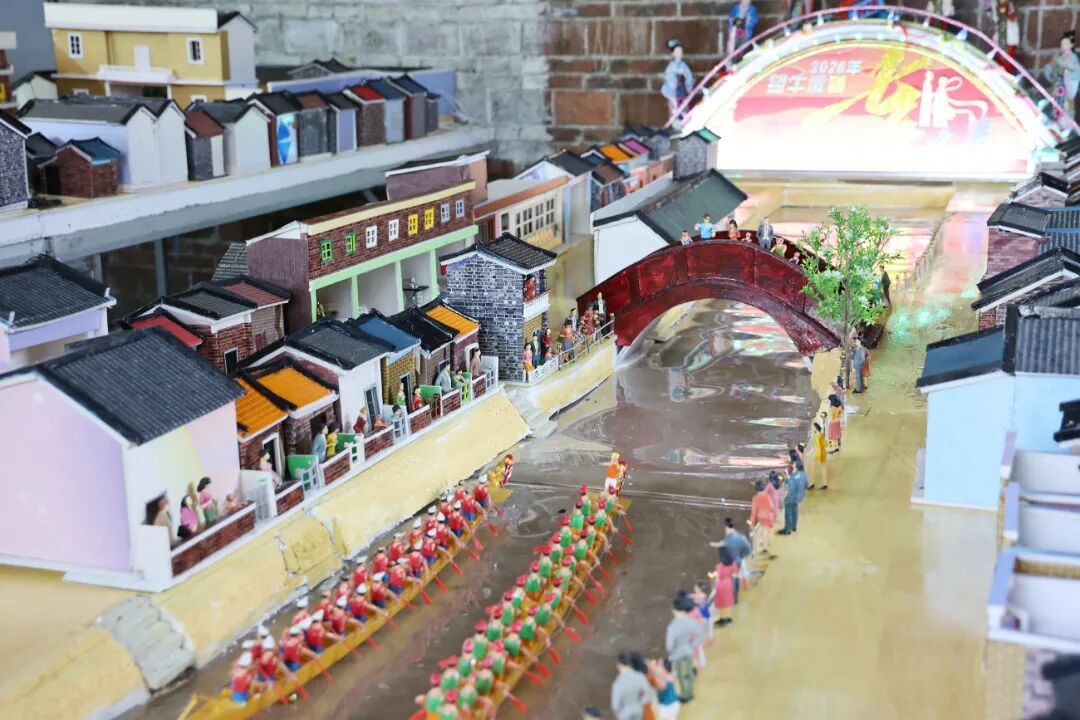
The level of finish varies by village, and this year’s standouts lean on local memory. Wangdong Village (望东村) rebuilt the 1960s riverside of the Wangxi River (望溪) in miniature: a strip of bank, old houses and the water between them, folded into one case. Uncle Hong (洪叔), the craftsman behind it, recreated the scene from the hometown he remembers, compressing a generation of riverside life into a single wooden display.
Some villages pushed the form toward the present. Several offerings wove in the province’s rural revitalization initiative and the “Beautiful Courtyards” campaign, so a miniature courtyard with a vegetable patch and a tiled gate reads as both a folk object and a policy statement. The mix of memory and current affairs is what keeps the qiaogong competition from turning into museum repetition.
Alongside the exhibition, the evening program ran in parallel. At 7:30 p.m. the “Ancient Charms of Qixi” prayer night recreated the full local rite of worshipping the Seventh Sister, with instrumental ensemble “Autumn Night,” the dance “Qiqiao Embroidery,” the recitation “Ode to Longing Across the Star River,” a pipa solo of the ci-poetry tune “Queqiao Xian” (鹊桥仙) and Cantonese opera duets performed by local inheritors and troupes. A traditional prayer ceremony closed the night. Next to the square, the “Taste of Qixi” market opened its stalls of water-town snacks, craft goods and drinks.
The program builds through the week. August 19 brought the “Trendy Qixi” parade, with offering-table floats, myth-themed cosplay, Yingge (英歌) dance, lion dance and street flash-mob troupes, followed by the Matchbox Concert and the youth arts season showcase. Later that evening, “Fairy Scattering Flowers” aerial performers on wire rigs drifted over the crowd as imitation petals fell. Cantonese golden-song night and a matchmaking evening follow on August 20 and 21, while the offering exhibition itself stays up through August 21 and the market runs daily from 4 p.m. to 9 p.m. A local resident, Ms. Chen, came with her family and said she hoped more young people would learn the town’s water-town Qiqiao customs; standing by the display cases, she had brought her child to see the tradition her own village still keeps.