
“Every stitch of this peach-blossom sachet follows a rule — the blessing of Qixi and the life of the old town are sewn right into it,” a visitor named Ms. Li said on the evening of August 16, threading a needle under the guidance of a heritage craft teacher at a pop-up stall in Xinchang Ancient Town (新场), Pudong New Area. Her words captured the mood of the 2026 “Love in Pudong: Qixi With Civility and Harmony” event, which opened that night and runs through August 19.
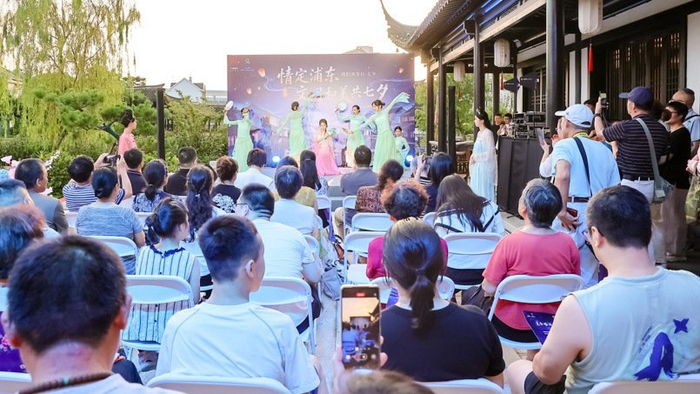
Xinchang, a water town about 30 kilometers south of downtown Shanghai, is part of a joint application with other Jiangnan (江南) towns to have the region’s canal settlements listed as a World Heritage site. The Qixi festival program leans into that push: performers in ancient-style dress walk the streets in Hanfu, explaining the Qiqiao (乞巧) customs — the traditional prayers and craft tests associated with the seventh day of the seventh lunar month — while leading visitors through hands-on activities. Along the town’s south street, guests collect seven themed fan leaves and assemble their own Qixi folding fans; at the Salt Culture Museum, a blessing station lets visitors write wishes for family and loved ones, and a special evening session on the festival itself explores the meaning behind the holiday.
The Qiqiao customs on display trace back to the legend of the Weaver Girl and the Cowherd, who are said to meet on the seventh day of the seventh lunar month. Traditionally, young women prayed to the Weaver Girl for skilled hands — threading needles, arranging fruit offerings, and competing in small craft tests. In Xinchang, those practices are framed as a family outing: the craft stalls along the south street are staffed by heritage teachers, and the blessing station at the Salt Culture Museum, set up for the holiday, lets children and parents write wishes together and tie them to the railings beside the canal.
Heritage and family stories shared the main stage. A disciple of a national-level intangible cultural heritage inheritor spoke about keeping a craft tradition alive, and representatives of “civilized families” and “most beautiful families” shared their household rules. Dr. Zheng Junhua (郑君华), a civil family representative, read out a maxim written by her father-in-law, a calligrapher, that has hung in the family living room for years: “One who holds virtue finds joy; one who finds joy endures.”
The event is organized by the Pudong New Area’s New Era Civilization Practice Center, the district office of spiritual civilization development, and the district women’s federation, with Xinchang Town’s sub-center handling day-to-day operations. The ancient-style market that runs alongside the festival mixes craft sessions, Qixi-themed snacks, and specialty tea and coffee stands, and organizers said the market is intended to do double duty — carrying the event’s message about civility while extending the town’s evening economy.
For families, the festival has become an easy evening trip. “We came for Qixi and ended up watching the parade, trying the handicrafts, and both adults and kids had a great time,” said Ms. Wang, another visitor. “The night scene here is beautiful, and the festival makes the holiday feel ceremonial.”
Pudong plans to keep deepening the Qixi theme across its old towns, building on the “Ancient Town New Era Civilization Practice Alliance” to combine festival culture with local development. For now, Xinchang’s answer to the holiday is a quiet one: a sachet, a folded fan, and a lantern-lit street where tradition and a World Heritage application share the same route.