
Jieyang (揭阳), a walled county seat in eastern Guangdong that local boosters describe as one of the province’s best-preserved ancient cities, has spent this summer playing host to a season-long costume shoot of its own. The Jieyang Daily reported on August 11 that tourists now walk the old streets in wide-sleeved Hanfu while hired photographers trail behind, and the city has become one of the season’s most talked-about destinations for Hanfu photos. From the drum tower at Jinxian Gate (进贤门) to the academy, the arcaded shopping street and the alleyways beyond, the crowds keep the cameras busy from morning to night.
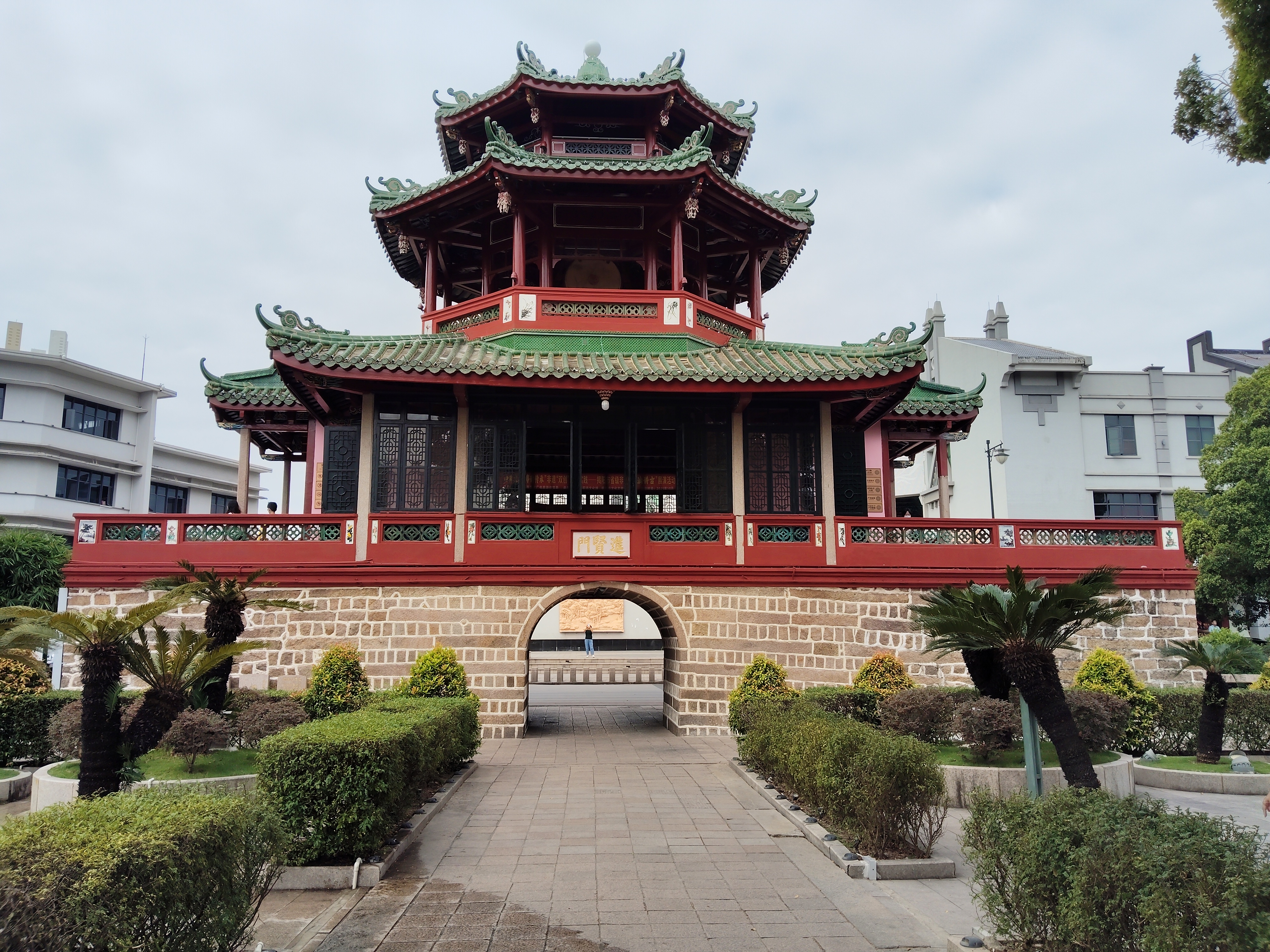
A Citywalk Through a Ming-Era County Seat
The classic route starts at Jinxian Gate, a tower built in the first year of the Tianqi reign (1621); its name carries the wish that worthy men would rise through the county, and visitors still stop there for a photo under the lucky omen. A few hundred meters on stands the Jieyang Confucian Academy, its red walls and yellow tiles framed by old banyan trees. Through the holidays the academy runs daily classical-reading sessions and evening performances of intangible-heritage crafts, which makes it a fixed stop for study tours and family groups.
Beyond the academy, Zhongshan Road unfolds as a stretch of arcaded shophouses built in the Nanyang style, with deep colonnades and dense signboards that keep the look of a century-old trading port. Deeper in, the Jincheng (禁城) wall, a Yuan-dynasty remnant, sits beside Copper-Beating Street, where flagstone lanes link ancestral halls, old houses and market stalls. Locals like to call the whole scene a Chaoshan version of Along the River During the Qingming Festival.
Shops Built Around the Camera
Huang Liwan (黄丽宛), who runs a Hanfu experience shop inside the old city, said this summer’s traffic has clearly beaten last year’s. “Most customers are young women and parent-child groups, and quite a few come from Beijing, Henan or the northeast,” she told reporters while dressing a client’s hair. Her shop provides full makeup and styling, then guides guests to the best spots: Jinxian Gate for a wide shot, the academy’s red wall for a close-up, and Zhongshan Road’s arcades, which take on a retro film-stock color once the evening lights come on.
The district now has a full ladder of such businesses, from basic Hanfu rental to complete styling with a photographer who follows the visitor from spot to spot. Huang Man (黄漫), a tourist from Foshan, put the appeal plainly: “Walking in Hanfu through a thousand-year-old city really does feel like time travel, and it is not expensive. I posted a nine-photo grid and everyone asked where I was.” The longer photo-shoot stays have pushed up spending at nearby restaurants and guesthouses.
A film is the biggest crowd-puller this summer. Dear You (给阿嬷的情书), a Chaoshan-dialect drama that has grossed more than 2 billion yuan at the box office, used the old city as one of its main locations. Xima Road (西马路) has become the first stop for out-of-town visitors: the street re-creates the rickshaw and old fabric bolts seen on screen, stalls sell the movie’s signature rice-less cakes, and check-in points such as Stone Lion Bridge and the “love letters” painted on the pavement draw steady queues. A restaurant called Grandma’s Kitchen serves the film’s snack and stays busy through the afternoon.
A Qipao Shop Rides the Film Wave
Lin Pingping (林萍萍), who moved from Jiangxi in June to open a qipao shop in the old city, said young women come in every day asking for the “Shurou look,” the dress worn by Ye Shurou (叶淑柔), the film’s lead character. “Some customers want more than the dress; they ask me to do their makeup so they can shoot a film-style set of portraits on Xima Road,” she said. During the reporter’s visit, three or four groups of shoppers walked in within half an hour. A visitor from Fujian trying on a pale-green floral qipao said she had decided on the trip after watching the film: “I have to walk Xima Road in a qipao, or the trip does not feel complete.”
To hold the momentum, the city has launched a “Follow the Film to Jieyang” itinerary that links every on-screen spot, and the municipal and Rongcheng District (榕城区) culture and tourism offices have scheduled summer events across the county. The documentary Jieyang Ancient City: New Rhymes of Chaoshan has been picked for China Central Television’s 2026 masterworks list, a sign that the old county’s stories are still being discovered and retold.