
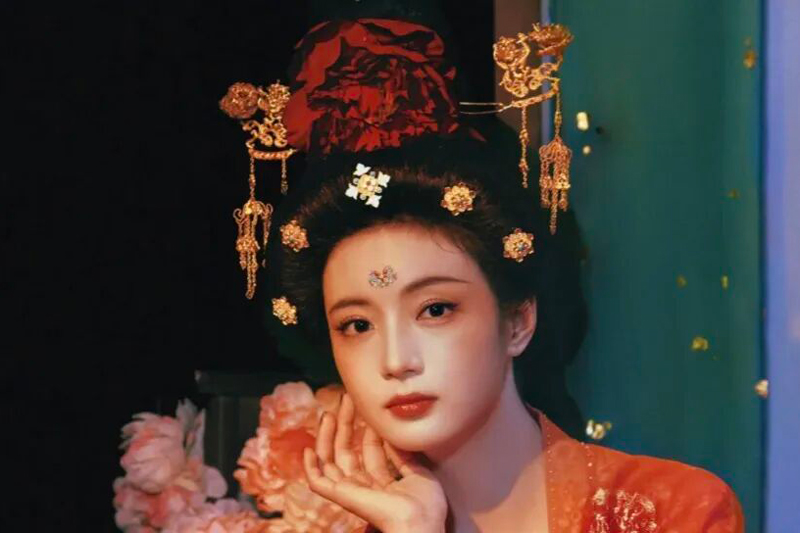
Are giant floral headdresses sabotaging the authenticity of Tang Dynasty dramas? With recent period pieces drawing fire for oversized blooms that dwarf actresses’ faces, a deeper question emerges: did Tang women actually wear these massive flowers, or has screen mythology distorted our historical lens?
The debate isn’t merely about aesthetics—it touches on how modern casting, thinning beauty standards, and recycled costume templates collide with archaeological fact. While some viewers blame today’s slender actresses for “failing to carry” these flamboyant accessories, the real culprit may be a centuries-old painting that planted a deceptive seed in the minds of costume designers.
Painting That Lied?
When critics point to Court Ladies Adorning Their Hair with Flowers (簪花仕女图) as proof of giant floral fashion, they overlook a crucial detail: no other surviving artwork from the late Tang or Five Dynasties period shows a single bloom covering half the wearer’s updo. The painting’s florals are disproportionately massive, creating a top-heavy imbalance that strikes art historians as anomalous. Shen Congwen (沈从文), the renowned scholar, famously suggested that these oversized elements might have been added later—possibly by Song Dynasty painters projecting their own fantasies onto an earlier era. He argued that the composition feels disjointed, with the flowers appearing almost pasted on, a telltale sign of retrospective embellishment rather than contemporary documentation.
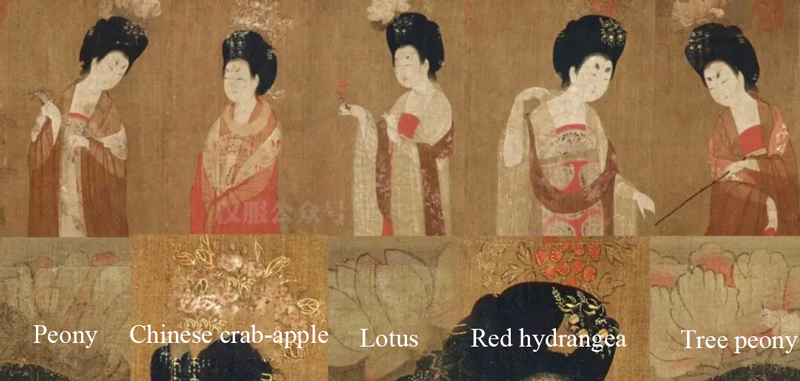
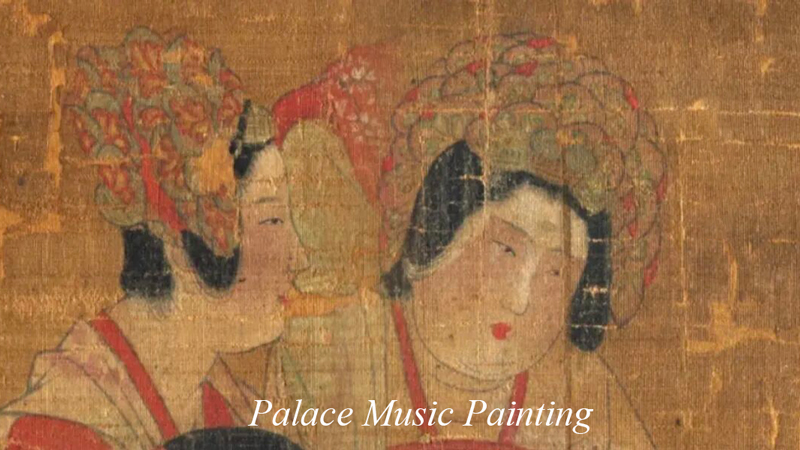
Examine excavated murals from late Tang tombs, and you will find elaborate high chignons adorned with tiny blossoms, delicate hairpins, and finely crafted combs—never a single flower monopolizing the crown. The Palace Music Painting (宫乐图) does depict floral crowns, but they are composed of multiple small blooms arranged symmetrically, not the overpowering singleton seen in the controversial scroll. This discrepancy suggests that what we consider “quintessential Tang” is largely a construct born from one anomalous image, amplified by decades of uncritical imitation in film and television.
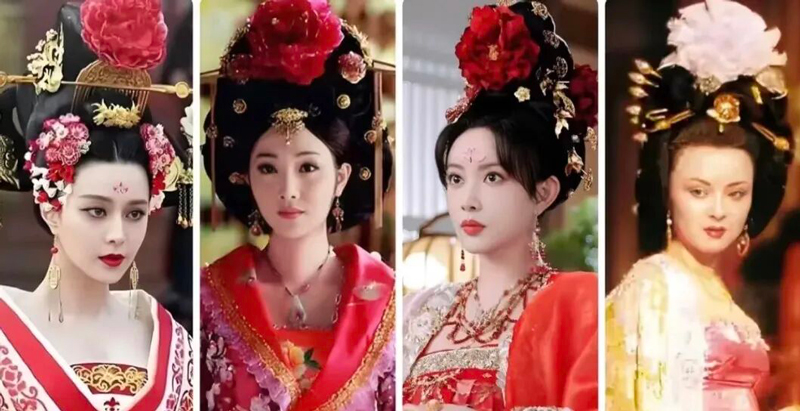
Why did this single painting wield such outsized influence? Early Chinese period dramas, lacking extensive historical reference, seized upon the most visually striking element they could find. That giant flower became a shorthand for “Tang luxury,” easy to replicate and immediately recognizable to audiences. But shorthand, as costume historians note, often sacrifices nuance for spectacle—and here, it sacrificed historical fidelity for a gaudy shortcut.
Fashionable Reality
Contrary to popular belief, late Tang and Five Dynasties women prized subtlety in their everyday ornaments. Their towering chignons, some reaching impressive heights, were constructed through intricate braiding and padding—a feat of hairdressing artistry. Yet the accessories themselves remained modest: tiny gold filigree flowers, jadeite hairpins, and nephrite combs tucked discreetly into the layered coils. The philosophy was “complex in structure, simple in adornment,” ensuring that the overall silhouette remained graceful rather than burdensome.
Ceremonial occasions did call for grander headpieces—elaborate coronets and large ornamental combs—but these were formal ritual objects, not daily wear. Even then, they never featured a single oversized flower dominating the entire coiffure. Instead, they employed symmetrical arrangements of multiple elements, maintaining visual equilibrium. This distinction between ceremonial grandeur and everyday elegance has been entirely lost in many modern productions, where every scene demands a floral explosion regardless of context.
What about the famous “flower-wearing” tradition in Tang poetry? Poets did praise women adorning their hair with fresh peonies or chrysanthemums, but these were real flowers, not fabric monstrosities. A fresh bloom naturally wilts and shrinks, its petals curling delicately—a world away from the stiff, exaggerated silk or plastic creations that now crown screen actresses. The poetic image was one of fleeting beauty, not permanent architectural statement. By ignoring this scale difference, costume designers have traded poetry for parody.
Proportions versus Performance
When Wang Churan (王楚然) appeared in the drama The Story of Fleeting Life (浮生) with a flower almost as large as her face, audience backlash was immediate. The prop overwhelmed her delicate features, making her look less like a Tang noblewoman and more like a walking centerpiece. Critics pointed out that the flower’s diameter exceeded that of her actual head, creating a jarring disconnect that no amount of acting could salvage. Her slender frame—so celebrated in contemporary beauty standards—became a liability when paired with such disproportionate ornamentation.
Conversely, when Zhang Yaqin (张雅钦) sported a similarly large flower in a promotional still, viewers found it more palatable. Her rounder face and fuller cheeks provided a visual anchor, making the bloom feel less alien. This observation sparked a thorny discussion: are production teams selecting actresses based on their ability to “ground” oversized props? More troublingly, does this pressure reinforce a preference for non-skeletal physiques in an industry already notorious for extreme thinness?
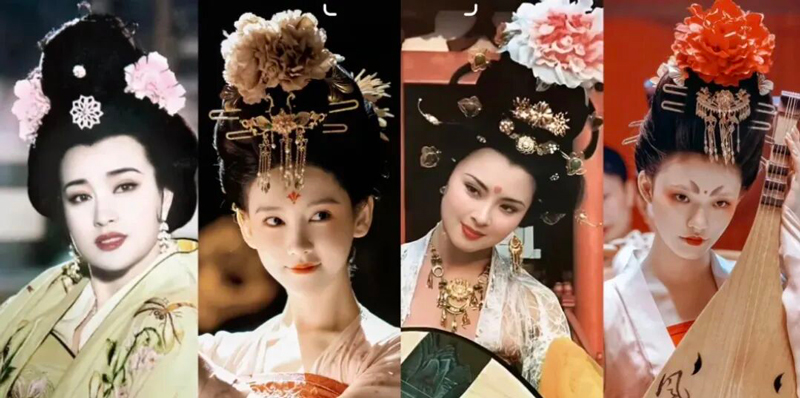
The case of Meng Ziyi (孟子义) and Li Yunrui (李昀锐) in the announced project Shang Gongzhu (尚公主) proved that the problem isn’t isolated. Their promotional posters featured the same gargantuan floral crown, triggering déjà vu among netizens. Costume designers, it seems, have fallen into a lazy pattern: Tang equals big, and big equals safe—at least in terms of ticking the “period drama” box. Yet this one-size-fits-all approach ignores the fundamental rule of good costume design: accessories should enhance the character, not eclipse them.
Perhaps the real question isn’t whether today’s actresses are “thin” or “round” enough to wear these flowers. It’s whether we can break free from a century-old visual cliché and rediscover the nuanced, proportionate elegance that actual Tang women embodied. After all, the most memorable period dramas are those where every element—from hairpin to hemline—serves the story, not just the Instagram screenshot. Until then, those giant blooms will remain less a tribute to history and more a testament to our collective failure to look beyond the easiest reference.