
The first sound visitors heard at Zhangze Lake National Urban Wetland Park on August 14 was not a ribbon being cut but the Shangdang Bayin Hui (上党八音会) — the region’s eight-tone ensemble — filling the shore with drums, gongs and suona horns before a single stall had opened. The “See Changzhi” Intangible Heritage Carnival had begun its seven-day run, organized under the theme “Cool Changzhi, Beijing-Changzhi Together” by the city’s Culture and Tourism Bureau, Agriculture and Rural Affairs Bureau, Commerce Bureau and Council for the Promotion of International Trade, with Sun Liulin, Zhang Mengmeng and Xing Zhangpeng, three municipal leaders, attending the opening.
Peking opera and the local Shangdang Luozi opera shared the opening stage, the capital’s measured melodies answering the county’s earthy cadences. Then came the walk-through: a hundred-odd stalls lining the park road, and behind them seven themed sections covering performances, a temporary exhibition, heritage displays and hands-on workshops. The attached exhibition, “Jinghua Jinyun Hui Shangdang: A Joint Show of Heritage Masterworks from Three Regions”, stays open free of charge until November 14, bringing together representative works from Beijing, Shanxi and Changzhi.
Changzhi’s own market drew the biggest crowds. More than 80 local heritage items were on hand — the silk-pile work of Changzhi Duijin (长治堆锦), Zhangzi paper-cutting, Lucheng cloth art, Licheng paper-cutting, Qinyuan handmade soap, ceramics from the Bayi kiln (八义窑), the Lihou tiger cloth toys (黎侯虎), Shangdang pine-soot ink, Xiangyuan gourd pyrography, Tunliu corn-husk weaving, Zhangzi dough figurines, and Tianqiao Village sugar painting among them — with the artisans themselves seated at the booths, cutting, stitching and shaping in front of the visitors. The Shanxi section carried its own heavyweights: Pingyao polished lacquerware, Jishan mother-of-pearl lacquerware, Jiexiu colored glaze, Gaoping embroidery, Jinzhong dough figurines and Jiangzhou Chengni inkstones, more than 20 items in all.
Twice a day the park becomes a moving exhibit. Heritage parades march the main road — from 10:20 to 11:20 and 17:30 to 18:30 on August 14, shifting to 10:30 to 11:30 and 19:30 to 20:30 on August 15 and 16 — performers in folk costume carrying heritage props, folk acts woven into the march. At 7 p.m. each evening the lakeside stage opens with a rotating bill: the Bayin Hui, whip dances, Shehuo procession performances, new Peking opera, and Guochao song-and-dance numbers. Costumed performers cast as figures from Chinese mythology wander the park for photo opportunities, and multiple “Chinese-style” photo spots turn the lakeshore into a backdrop.
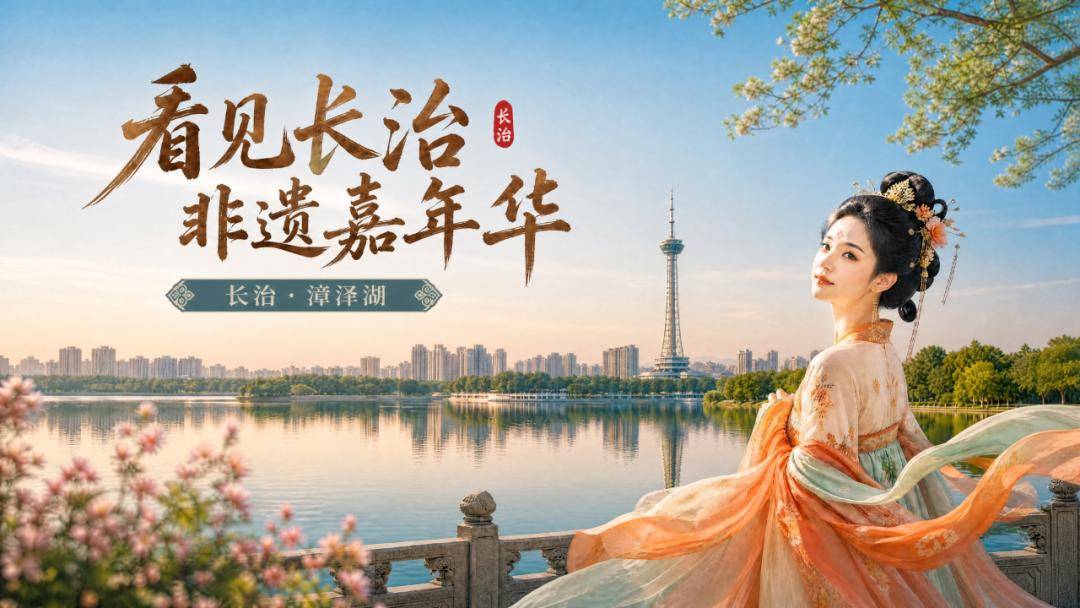
The giveaway that drew the longest queues, though, was the free styling. From August 14 to 16, the carnival releases 100 free Hanfu styling kits per day — a set of traditional clothing plus a professional updo, makeup not included. Sixty slots open online each day through the “Changzhi Tourism” mini-program; the remaining 40 are first-come, first-served on site. Online winners must verify at the Beizhai Visitor Center before 5 p.m. on the day, or their slots revert to walk-ins. Styled visitors get a free professional photographer — shooting and retouching included — plus a stamp-collecting card with commemorative seals, with heritage souvenirs for those who complete the collection.
For Changzhi, the carnival is also the visible outcome of the “Beijing-Changzhi counterpart cooperation” that pairs the two cities. Leaders of the opening called it an attempt to move heritage out of display cases and into hands — visitors do not just watch the craft masters, they sit down at the same tables and try the techniques themselves. The lakefront, by nightfall, is a procession of braided hair, embroidered sleeves and lacquerware glinting under the park lights, and it stays that way until August 20.