
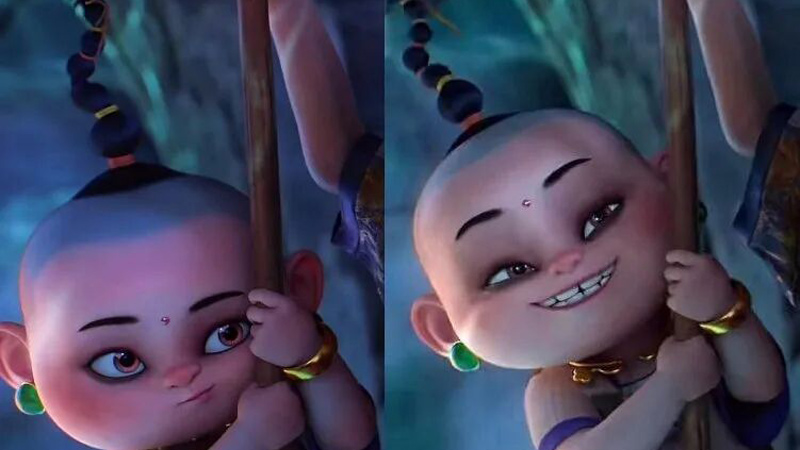
In the vibrant new animated film Ba Xian! (八仙!), one character stands out immediately, not for his actions, but for his hair. Lan Caihe (蓝采和), the immortal associated with flowers and youthful vigor, appears with a curious hairstyle: a single, stiff lock of hair jutting upright from an otherwise shaved head, bound with rings like a tiny whip. It is a stark departure from the serene, traditional depictions found in lunar New Year paintings and classic operas. This peculiar look is not a random act of artistic whimsy, but a deliberate design choice rooted in ancient Chinese folk traditions.
The filmmakers have reached back through centuries to a style once as common as a child’s smile, resurrecting a piece of history that many modern viewers have never encountered. This single, seemingly odd detail bridges a gap between ancient daily life and contemporary cinematic storytelling.
Ancient Roots, Modern View
To understand Lan Caihe’s hair, one must look past the screen and into the rituals of ancient China. The style’s origin is not a recent invention but a tradition that can be traced back to the Han Dynasty. Classical texts, such as the Book of Rites, describe a rite of passage for infants. After the first three months of life, a baby’s soft, natal hair was shaved off. For a boy, a tuft was left on either side of the fontanel, a style known as Zongjiao (总角). For a girl, a single lock was left at the very top of the head, called a Ji (羁). These were not merely aesthetic choices; they were symbolic. The hair was left to protect the fontanel, a vulnerable spot on a baby’s head. As these locks grew longer, they were often tied and twisted upward, creating a visual effect that people of the era affectionately called a “skyward cannon” or “skyward pigtail”. It was a symbol of childhood, care, and a parent’s wish for their child to grow up healthy and strong.
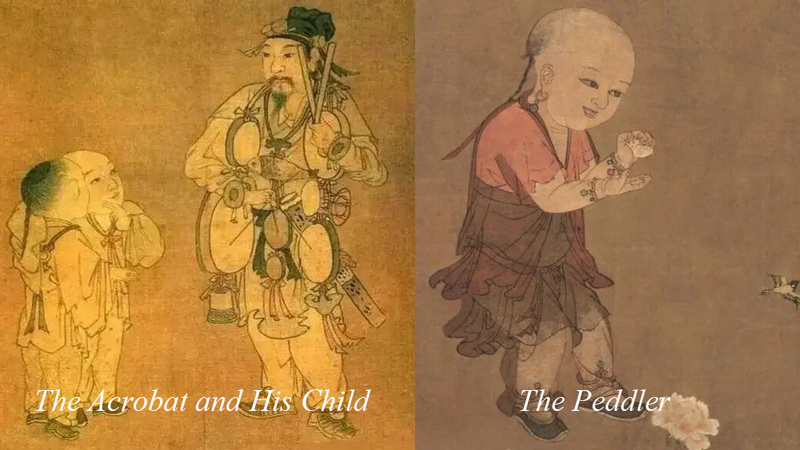
This practice evolved and became deeply ingrained in the culture. By the Tang and Song Dynasties, the strict gender rules of the Han period had relaxed. It became common to see both young boys and girls sporting a single upright tuft. A walk through a bustling medieval marketplace would have revealed countless children with this distinctive look. We know this because artists of the era captured these scenes. In famed paintings like The Acrobat and His Child (杂技戏孩图) and The Peddler (货郎图), children with upright braids are depicted playing and laughing amidst the crowd. It was a universal sign of youth and vitality, a visual shorthand for the innocence of early life. This wasn’t a fad confined to a single region or a fleeting trend. It was a deeply held folk custom, a small ritual that connected families across generations, a quiet prayer for protection woven into the fabric of daily life.
Cinematic Imagination
The designers behind Ba Xian! understood this rich history. They recognized that Lan Caihe, among the legendary eight, has always been the most approachable and human. In folklore, he is a wandering street performer in ragged clothes, singing for his supper and carrying a flower basket. He is the immortal of the common people. For the film, which focuses on the character’s boyhood, the choice of the skyward pigtail was a perfect fit. By giving him a hobby like playing with clay, shaping little ducks, the filmmakers grounded him in a world of relatable childhood. The hairstyle immediately connects him to a long line of historical children, anchoring his fantastical journey in the tangible reality of past millennia. It is a deliberate creative decision to use an ancient, authentic folk style to define a new incarnation of a classic figure, making him instantly recognizable and memorably distinct from his divine counterparts.
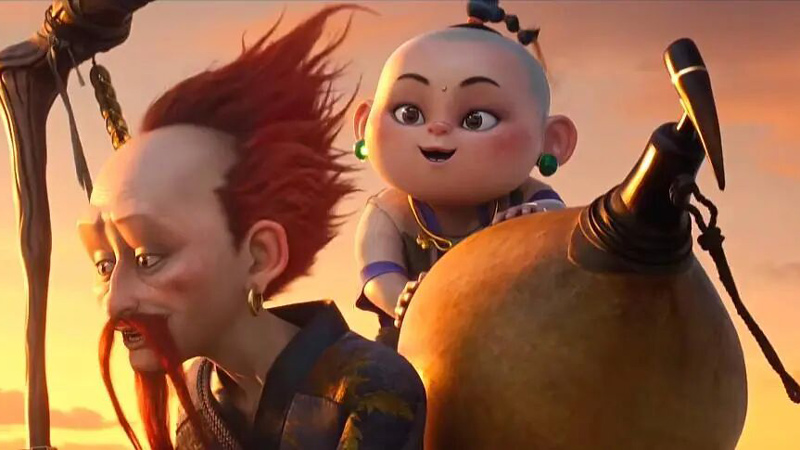
However, the animators did not simply copy a historical photograph. They adapted the ancient style to fit the demands of modern character design and animation. Firstly, they altered the texture. An authentic “skyward pigtail” is usually a tight, intricate braid. The film’s version is segmented, bound at intervals with cords, giving it a bouncy, almost segmented look like a series of small beads threaded on a string. This simplification makes it read more clearly on screen and gives it a playful, dynamic quality. Secondly, they took creative license with the angle. Real children’s hair is fine and soft, and it wouldn’t stand up as rigidly as depicted. The animators exaggerated the upward curve, making it defy gravity. This slight caricature enhances the visual impact, turning a simple hairstyle into a definitive and unforgettable silhouette.
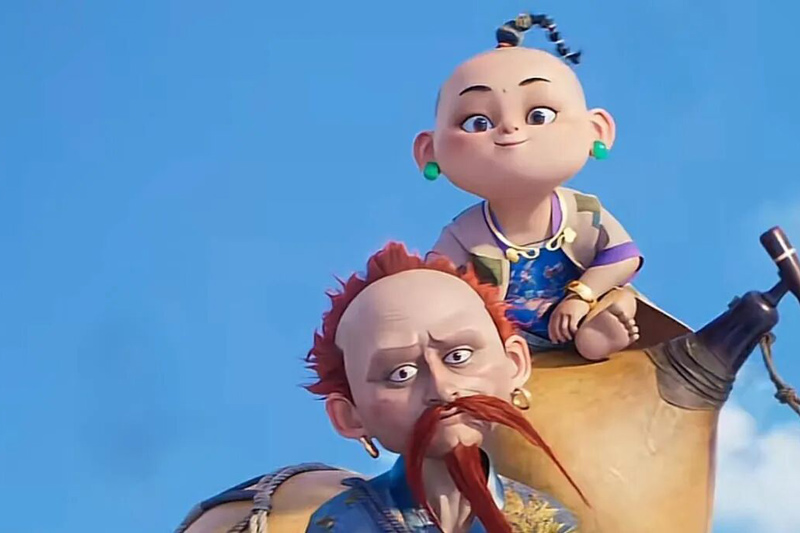
Many viewers might find Lan Caihe’s look eccentric simply because it is rarely seen in modern media. Mainstream historical dramas and period pieces tend to favor symmetrical styles like double buns for child characters. The single, rebellious skyward pigtail has largely been forgotten. The animated film’s stylized, energetic presentation makes it seem even more novel and unusual. Yet, this feeling of novelty is a testament to the filmmakers’ deep research. They didn’t rely on tired clichés. Instead, they delved into the archives of folk history to find a design element that is, in fact, deeply authentic. By refusing to stick to the old formulas, the team behind Ba Xian! has done something quite magical. They have taken a figure from ancient myth, steeped in tradition, and reimagined him for a new generation, proving that the most powerful way to honor the past is not to replicate it, but to give it a fresh, vibrant form of life.