
On August 19, 2026 — the eve of Qixi, the Chinese Valentine’s Day — collective weddings in traditional style are sweeping cities across China: Chifeng’s “Jade Dragon as Witness, Rendezvous at Qixi” wedding-culture carnival is recruiting 50 couples, Guiyang’s Confucius Academy is holding its 13th Chinese wedding ceremony, and nine departments led by the Yunnan Provincial Department of Civil Affairs are organizing the province’s third collective wedding. Growing numbers of couples are choosing Zhou-style or Han-style weddings to mark their big day. The joined-gourd cup toast, the loosening of the bridal tassel, the binding of hair, the three bows — these ancient rituals are walking out of the classics and into contemporary ceremonies. How did this thousand-year wedding system evolve, and what cultural code does each step carry? This guide follows the Yili chapter on the wedding rites of a common officer (仪礼·士昏礼) and the “Hun Yi” chapter of the Book of Rites (礼记·昏义) to walk through the full sequence: pre-wedding rites, the main ceremony, and post-wedding rites.
Han-Style Weddings: Rooted in Zhou Rites
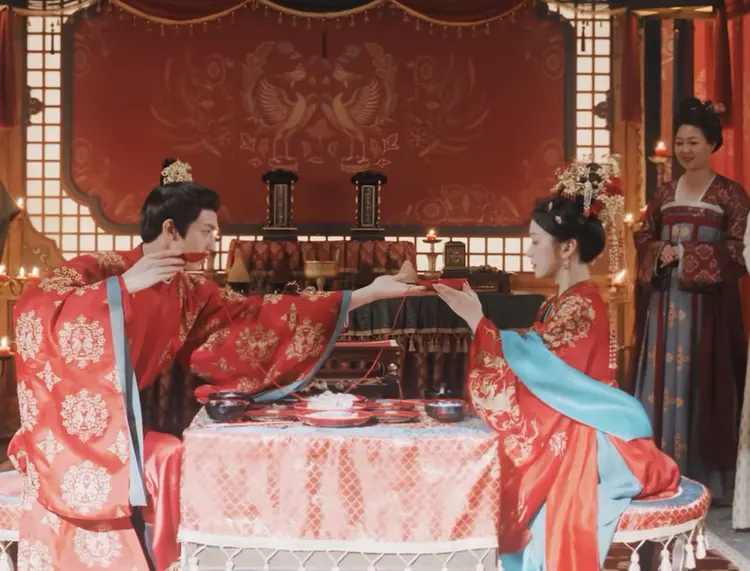
A Han-style wedding (汉式婚礼) is the ethnic wedding of the Han people, modeled on the rites of the Western Zhou dynasty and carried by an ethos of elegance, dignity and solemn respect. It differs from a Western wedding and equally from the so-called “Chinese wedding” of Qing- and Republican-era style. The form took shape in the Western Zhou, flourished through the Spring and Autumn and Warring States periods, and was stabilized in the Qin and Han dynasties. At a Han-style wedding the couple dresses in correctly cut Hanfu, with colors and styles chosen by period: the Han-Zhou era favored deep black and red, so a couple might wear the red-and-black Quju (曲裾) or the robe-and-skirt yishang ensemble; a Tang-style wedding pairs the “red groom, green bride” scheme; a Ming-style wedding uses Ming official robes, with the bride in a phoenix crown and Xiapei sash (凤冠霞帔).
“Wedding” was originally written as “hun li” (昏礼) — “dusk rite” — because the ceremony was held at dusk. Kong Yingda’s commentary on the “Hun Yi” chapter of the Book of Rites explains: “The rite of taking a wife is set at dusk, hence the name. The choice of dusk takes the meaning of yin arriving as yang departs; dusk falls two and a half ke after sunset.” The Han dynasty scholar Ban Gu wrote in the Baihutong (白虎通): “Hun means performing the rite at dusk, hence the name; yin means the woman follows her husband, hence the name.” In antiquity the marriage hinged on the groom’s personal procession to fetch the bride (qinying 亲迎), which was always carried out at dusk. Over the millennia, Han-style weddings evolved into three major types. The Zhou-style wedding (roughly 11th century BCE to 256 BCE), grounded in the Yili, embodied the patriarchal clan system and yin-yang philosophy: no music was played and no congratulations offered, and the dark-red xun-xun color pair (玄纁) stood for black heaven and yellow earth. The Tang-style wedding, formed at the confluence of Hu and Han cultures, institutionalized “red groom, green bride,” absorbed the nomadic practice of the “blue tent mutual bow” (青庐交拜), and made the poem urging the bride to unveil and the poem asking her to lower her fan required entertainments. The Ming-style wedding, simplified under Neo-Confucian influence, fixed the three-bow ceremony (一拜天地、二拜高堂、夫妻对拜) — one bow to heaven and earth, one to the parents, and one between the couple — and gave the wedding its enduring symbols of the steelyard scale lifting the red veil and the scattering of bedding songs.
Pre-Wedding Rites: Three Letters and Six Rites
The core framework of the Chinese wedding descends from the Zhou dynasty’s “six rites” (六礼): nacai, wenming, naji, nazheng, qingqi and qinying. Nacai is the first step: the groom’s family sends a matchmaker to propose, and once the bride’s family agrees, a wild goose is presented as the token of intent — the Yili records, “For the wedding rite, the proposal descends with the nacai. A wild goose is used.” Wenming means asking the bride’s name and her birth mother’s surname to establish her legitimate status before divination. Naji is the groom’s family “returning to the ancestral temple to divine; if the omen is auspicious, sending an envoy again to inform” the bride’s family. Nazheng, also called nabi, is the payment of betrothal gifts — the Yili prescribes “for nazheng: dark-red silks, bolts of cloth and a pair of hides” — after which the marriage enters formal preparation. Qingqi is the groom’s family divining an auspicious date and sending an envoy to inform the bride’s family; the polite word “ask” (qing) signals that the groom’s family does not presume. Qinying, the groom’s personal procession to fetch the bride, is the most important of the six.
Alongside the six rites run the “three letters” (三书), the documentary instruments of betrothal: the engagement letter (聘书), exchanged at the betrothal to seal the agreement; the gift letter (礼书), used at the delivery of major gifts and listing every item and quantity; and the letter of welcome (迎书), carried by the groom when he comes to bring the bride home. Across the six rites, the wild goose is the thread that runs through the entire protocol. Ban Gu’s Baihutong on marriage explains why: the goose is a migratory bird that flies south at the autumn equinox and returns north at the spring equinox — it keeps its appointments and never breaks faith, a figure for the couple’s pledge made before marriage and their constancy after it; the goose is also a bird of the yang that follows the sun, a figure for the bride following her husband; and geese fly in rows and settle in ranks, a figure for elder-and-younger order in marriage that must never be crossed. Because wild geese were hard to come by, later generations substituted geese raised at home and called the bird “yan’e” (雁鹅).
The Main Ceremony: Bowing, the Joined Cup
The heart of the wedding is the sequence of qinying, the three bows, the shared meal and joined-gourd cup (同牢合卺), and the loosening and binding of hair. Before she leaves, the bride combs up her hair, applies makeup and is covered with a red veil; in parts of the south the custom of the bride weeping at departure survives. A series of classic customs follows at the threshold: stepping over a fire basin, meant to dispel bad luck and bring a life of red-hot prosperity — the Qing scholar Xu Ke’s Qingbai Leichao (清稗类钞) records that when the bride’s sedan chair reached the gate, a fire basin was set for her to step across as protection against evil; stepping over a horse saddle, praying for a safe and smooth life; and in much of the south, treading on a sack of rice, meaning generations of inheritance and a thriving family line.
Tang brides did not wear a veil. Instead she held a round fan before her face, and relatives and friends were expected to chant poems urging her to lower it — a custom called queshan (却扇). The poet Li Shangyin left a famous verse in this genre: “Do not bring the painted fan out from the curtain, hiding the spring hills and delaying the gifted man.” The steelyard-scale veil lift also has a recorded origin: Wu Zimu’s Southern Song Mengliang Lu (梦粱录) describes the couple standing before the hall while a “woman of complete fortune” from the groom’s side lifted the veil with a steelyard scale or a weaving shuttle — the scale’s star markings represented the heavens and carried the wish of “heart’s desires fulfilled,” while the shuttle, a weaving tool, stood for diligence in women’s work; later this was simplified to the groom lifting the veil himself with the scale. The couple then enters the hall for the three bows: one to heaven and earth in gratitude for their blessing, one to the parents in filial devotion, and one between the couple as a pledge of lifelong companionship.
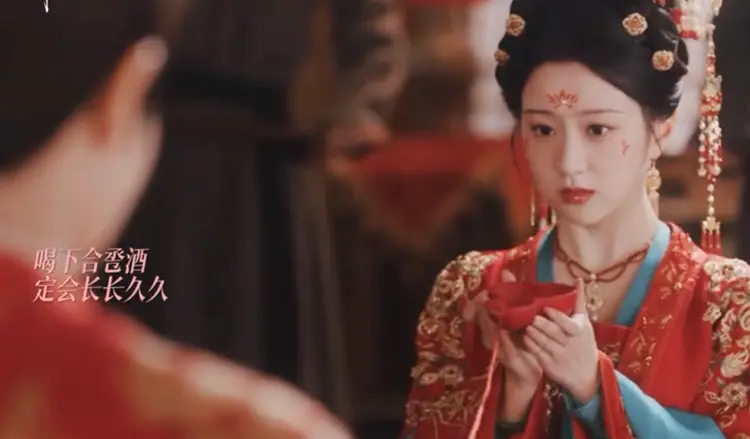
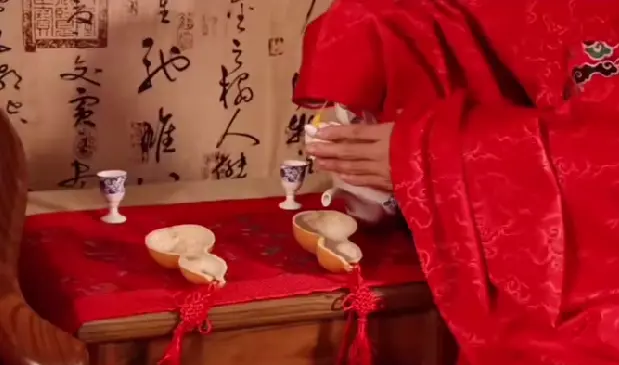
The shared meal and joined-gourd cup is the centerpiece of the ceremony and the ancestor of today’s crossed-arm toast. The “Hun Yi” chapter of the Book of Rites describes it: “The bride arrives; the groom bows her in, they eat from the same platter and sip from the joined gourd, so as to unite their bodies and level high and low, and thereby draw close.” “Eating from the same platter” means the couple shares meat from a single cauldron — from then on they share one larder and become one family. “The joined gourd” uses the bitter gourd cut into two halves to make two ladles; each spouse drinks from one, then the halves are fitted back together. The gourd carries three layers of meaning: split in two and joined as one, it figures two people becoming one; the gourd is bitter and undrinkable, and rinsing the mouth with bitter wine figures a couple that shares sweetness and hardship alike; and the gourd ranks among the eight timbres of Chinese music — sheng pipes and yu mouth organs are gourd instruments — so it figures harmony between husband and wife. After drinking, the ladles are tossed under the bed; if one lands face up and the other face down, the omen is perfect, for the male is yang and the female is yin, and the pairing completes the harmony of the two. From the Han, Wei and Tang periods the gourd ladles largely survived; Tang weddings began shifting to cups; in the Song dynasty, ceramic and silver cups fully replaced the gourd, and the name “crossed cup” (交杯) officially appeared; in the Ming and Qing dynasties, drinking with crossed arms became the standard gesture, and the thousand-year gourd vessel faded from folk weddings.
Jiefa: The Origin of “Bound-Hair” Couples
“Jieying” (解缨) means the groom personally loosening the tassel the bride wore to mark her betrothal; “jiefa” (结发) means each cutting a lock of hair and binding the two together with red silk, a pledge of joined hearts that not even death parts. The Song dynasty added a procedure called “heji” (合髻): according to Meng Yuanlao’s Dongjing Meng Hua Lu (东京梦华录), after the bows the couple sat facing each other on the bed — “the man on the left, the woman on the right, leaving a little hair” — while both families produced bolts of silk, hairpins, wooden combs and tassels, bound the two locks together with red thread or colored cord, and sealed them in a brocade pouch. The token stood for blood-and-flesh kinship that could not be separated. From this, the term “bound-hair couple” (结发夫妻) entered the language of marriage and became a byword for lifelong partners.
Post-Wedding Rites: Serving and Ancestor Rites
On the morning after the wedding, the bride rises early, bathes, and waits outside her parents-in-law’s chamber with a bamboo vessel holding dates, chestnuts and dried meat — the rite of “the bride seeing her parents-in-law” (妇见舅姑). The wife called her husband’s father “jiu” and his mother “gu”; dates (zao) carry the wish of rising early, chestnuts (li) of trembling reverence, and the dried meat (duanxiu) of vigor and enterprise. Next comes “the bride serving her parents-in-law” (妇馈舅姑): she personally serves them their meal, and after they finish, symbolically eats their leftovers to show respect and filial devotion; a related folk practice holds that the bride cooks in the kitchen on the third day — a Tang folk record preserves the verse “On the third day she enters the kitchen, washes her hands and makes broth; not knowing her mother-in-law’s tastes, she sends a taste first to her younger sister-in-law.” “The parents-in-law rewarding the bride with wine” (舅姑醴妇) follows, in which the parents set out food and drink for her and thank her with a single-offering rite. Finally comes “the bride’s temple presentation” (庙见): within three months of the wedding, the husband’s family chooses a day to lead the bride to the ancestral temple to announce her to the ancestors — the act that formally makes her a member of the husband’s family.
The Book of Rites declares: “The wedding rite is the root of all rites” and “The way of the gentleman begins with husband and wife.” In the Han tradition, marriage is understood as the realization of the world order — heaven and earth, yin and yang, the qian and kun hexagrams — and of the root of human relations. The “Hun Yi” chapter states that “the wedding rite joins the good of two surnames, serving the ancestral temple above and continuing the posterity below”: the essence of the marriage contract is the making of a vow and the sealing of an alliance, which is why the language of “mountain-oath sea-pledge” (山盟海誓) belongs to lovers. The Han-style wedding also insists on equality and shared responsibility: the couple bows with the same rite, sits on the same mat, eats from the same platter and drinks from the joined gourd — mutual respect made physical. “I take your hand and grow old with you” and “bound hair, joined hearts, inseparable in life and death” are the pledges the couple makes to each other, while “serving the ancestral temple above and continuing the posterity below” announces their duty to clan and community.
Collective Wedding Wave
Han-style weddings revived with the Hanfu movement of the early 21st century, passing through four stages: a theoretical stage from 2003 to 2004, when early practitioners across the country excavated the classics and followed Zhou rites to draft working protocols; a self-help stage from 2004 to 2006, when Hanfu enthusiasts began staging such weddings themselves; an institutional stage from 2006 to 2010, when professional Han-style wedding services were born; and a professionalization stage from 2010 to the present, when multiple wedding companies created high-end exemplars. From around 2007, specialized agencies began planning Han-style weddings end to end — sets, ritual music, ritual vessels and Hanfu as a full custom package — and demand surged for Hanfu wedding photography and wedding-themed micro-films.
In recent years the form has been scaled up and officially promoted through collective ceremonies: in December 2023, the third Hunan Han-style Collective Wedding was held at Changsha’s Huangxing Square with 29 couples; in November 2025, Xuancheng in Anhui hosted its second Youth Collective Han-Style Wedding, and Changsha held its fifth Hunan Han-style Collective Wedding with 37 couples; further back, in August 2015, the Civilization Office of Zhuozhou, Hebei hosted a Han-dynasty-style collective wedding for 30 couples. On March 17, 2026, at the Chunyuan scenic area of the New Yuanmingyuan in Hengdian, veteran practitioner Jin Kaitai coached couples through a wedding music-video shoot and taught Dongyang wedding customs, using film to empower heritage preservation. Contemporary Han-style weddings also fold in computer-projected traditional motifs, dynamic LED backdrop screens and holographic imaging, pairing ancient ritual with modern audiovisual stagecraft.
The wedding system that begins with the Yili’s “use a wild goose” ends, in the collective ceremonies around the country on the eve of Qixi 2026, with the joined-gourd toast and the binding of hair — a thousand years of ritual cycling from sacred ceremony to secular display to contemporary revival, and a vivid sign of tradition returning to daily life. For couples about to marry, understanding the meaning behind each step may matter more than following the sequence itself: as the joined-gourd rite teaches, sharing sweetness and hardship and becoming one is the true substance of marriage.