
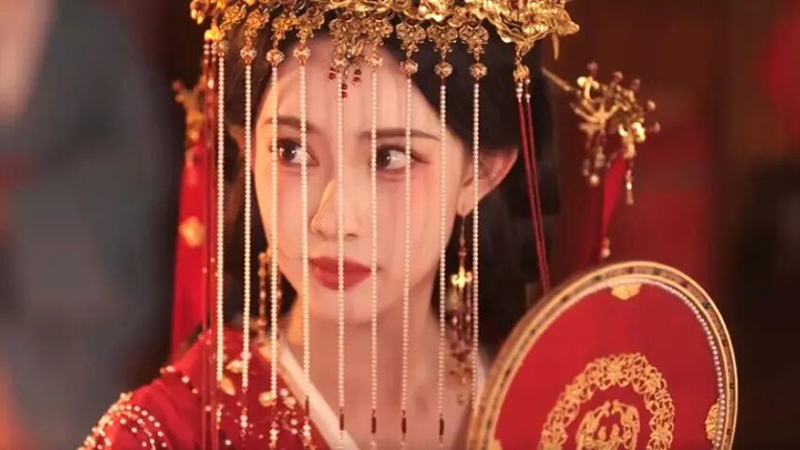
What if everything you thought you knew about ancient Chinese weddings was just half the story? In the new period drama Blossoms of Power (百花杀), actress Meng Ziyi (孟子义) steps into the bridal chamber not under a crimson veil, but behind a delicate round fan. That single image—no red cloth, no hidden face—pokes a fascinating hole in our collective memory of every TV wedding we have ever watched. Why did the production team choose a fan over the iconic red head-covering?
The answer takes us on a journey through a thousand years of marital rituals, where a bride’s face was not always a secret to be unveiled, but a poem to be earned. This is not a mistake in period styling; it is a deliberate nod to a forgotten tradition called Que Shan Li (却扇礼), or the “fan-avoiding ceremony,” that once defined elegance in matrimony. And as we trace its rise, reign, and eventual replacement, we might just realize that the red veil we take for granted is actually the newcomer—a latecomer that overshadowed a far more poetic past.
The Fan That Ruled the Altar
From the chaotic brilliance of the Wei and Jin dynasties through the golden echo of the Tang (唐), the round fan was not a prop—it was the protagonist of the wedding ceremony. In those eras, a noble bride would leave her home with her face wholly concealed by a circular silk fan, and she would not lower it until the final bow was completed at her husband’s house. It was a fixed protocol among the aristocratic clans, a mark of refined upbringing. The poet He Xun (何逊) of the Southern Dynasties captured this vividly in his Poem on Watching the Newlywed of Lord Fu (看伏郎新婚诗), where he describes a light fan veiling a shy countenance. This was not mere modesty; it was a performative art.
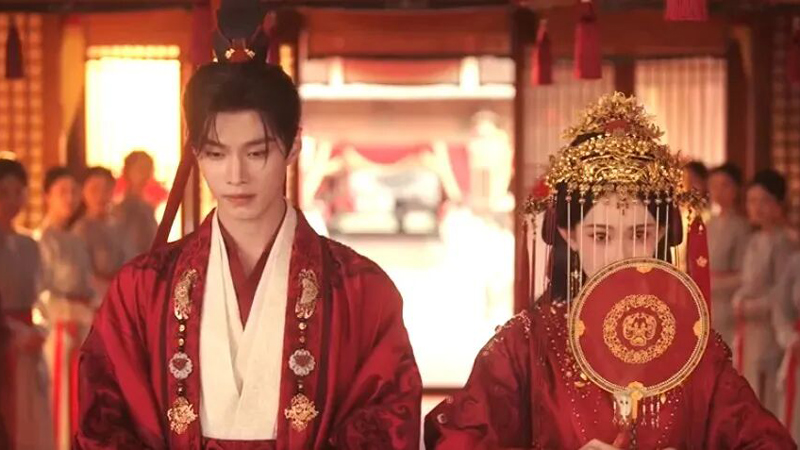
By the Tang era, Que Shan Li reached its zenith. Emperors’ daughters and peasants’ daughters alike participated in this ritual. The Dunhuang manuscript The Bridegroom’s Verses (下女夫词) documents it in detail, but more intriguingly, the ceremony birthed a sub-genre of poetry: the “fan-dropping verse.” The groom had to improvise a poem on the spot, praising his bride’s beauty or celebrating their union. Only if she found his words sincere and graceful would she slowly, deliberately, slide the fan aside. Poets like Li Shangyin (李商隐) and Lu Chang (陆畅) left behind such verses, turning a wedding ritual into a literary duel. It was a moment of vulnerability and power—she judged, he proved, and the fan was the judge’s gavel.
When the Veil Silenced the Fan
But nothing lasts forever, and the fan’s reign began to crack in the Song dynasty . The social climate shifted toward stricter controls on women’s visibility and behavior. A round fan, elegant as it was, only covered the front; side glances and moving steps could easily expose a bride’s face—a risk that became unacceptable in a society that demanded absolute concealment for unmarried ladies. The solution arrived in the form of a simple red square of gauze: the hong gaitou (红盖头). Draped over the head and falling past the shoulders, it offered total enclosure. No accidental peeks, no poetic negotiation—just a wall of red silk.
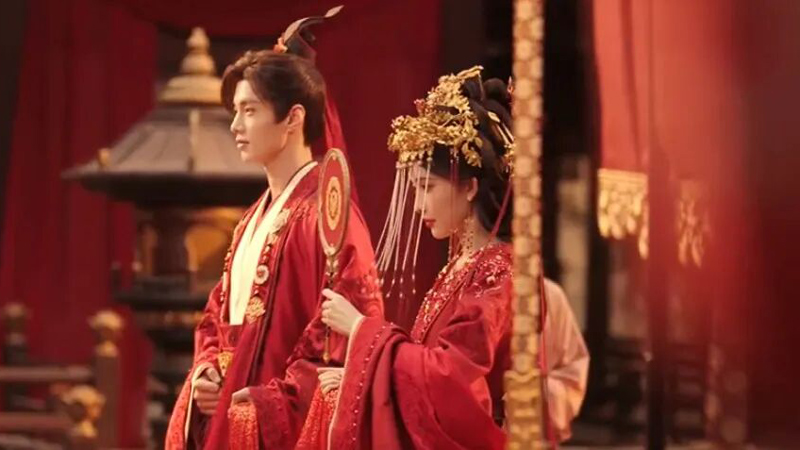
For a time, both customs coexisted. Some traditionalist families kept the fan out of respect for ancient rites, while pragmatists chose the veil for its foolproof modesty. But by the Southern Song, the veil was winning the popularity contest. It was cheaper, easier, and required no literary talent from the groom—a practical advantage for commoners. The fan, once a symbol of aristocratic elegance, began to look like an archaic luxury. By the time the Yuan, Ming, and Qing dynasties rolled in, the red veil had become the default for folk weddings. The fan-avoiding ceremony retreated into the mansions of a few antiquarian officials, surviving as a curiosity rather than a living custom. It is ironic: the tradition we now consider “ancient” (the red veil) is actually the disruptor, while the fan we find exotic is the true elder.
Three Reasons the Fan Outshone the Veil
Why did the fan hold such sway for over seven centuries? First, it was a shield for shyness. In an era when gentlewomen rarely appeared before strangers, a wedding hall packed with unfamiliar faces—including the groom himself—was a crucible of anxiety. The fan gave her a temporary sanctuary, a breathing space to compose herself before the world saw her fully. It was not about hiding; it was about pacing her exposure, a gesture that aligned perfectly with the reserved dignity expected of a well-bred lady.
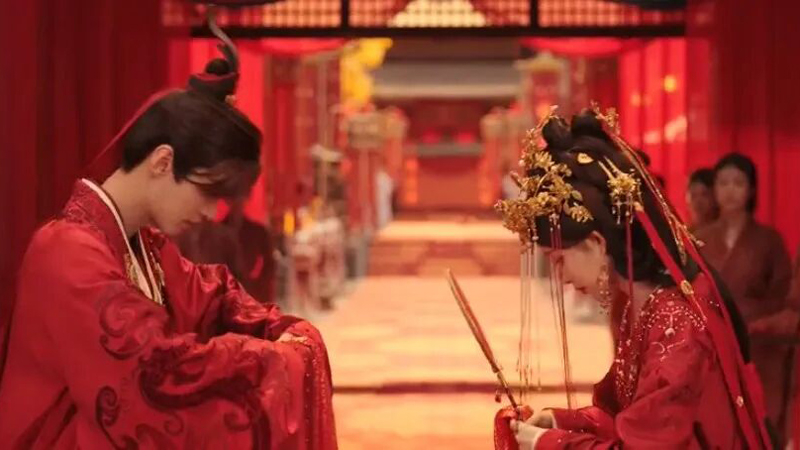
Second, the fan’s circular shape was no accident. The round surface mirrored the ancient yearning for a complete, harmonious marriage—a full moon, an unbroken cycle. Holding that fan before her face was a silent prayer for wholeness and mutual protection. It was a talisman, not a barrier. Third, and perhaps most decisively, the fan carried the prestige of the scholar-official class. The Wei-Jin era prized elegance and wit; the round fan was already a beloved accessory among literati, often inscribed with poetry or painted with landscapes. Integrating it into the wedding ceremony infused the event with intellectual charm, transforming a mundane rite into a showcase of cultural capital. The red veil, by contrast, had no such pedigree—it was purely functional, stripped of metaphor and artistry.
So when Meng Ziyi stands in Blossoms of Power, fan in hand, she is not breaking tradition—she is resurrecting a deeper, more sophisticated one. The production team did not invent this; they researched it. It is we, the audience, who have been conditioned by decades of red-veil dramas to forget that marriage was once a stage for poetry, not just for reveal. The next time you watch a period wedding, ask yourself: is that veil authentic, or just convenient? And if you had to choose—a fan that demands a verse, or a veil that demands only silence—which would you rather hold? As for her look in that crimson gown, with that ivory fan? It is not just beautiful. It is historically louder than any red cloth could ever be.