
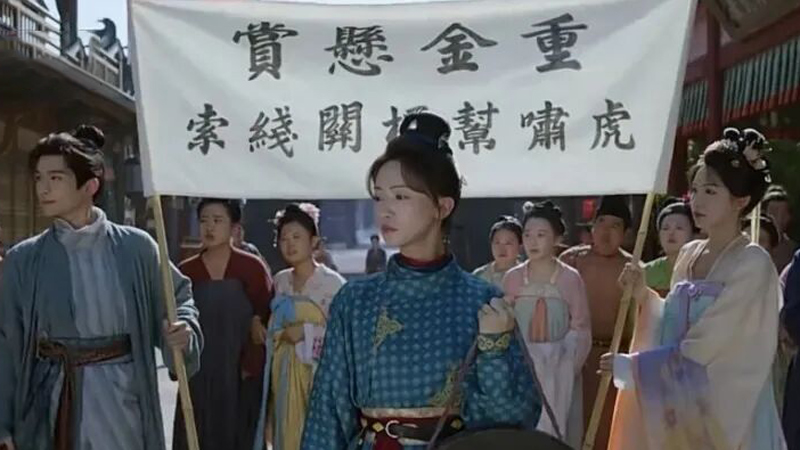
Royal Betrothal (御廷谣)– throws a simple but explosive question at its audience: why does a ruler lock up his most determined official for doing what any decent person would call justice? The story drops us into a restless capital where a new investigative body, the Cha Wen Yuan (察闻院), has just been born. It is independent, underfunded, and led by a woman named Meng Tinghui (孟廷辉). She is out on the streets one day, drumming up business for her fledgling agency, when she stumbles upon a family crushed by the local terror gang, the Hu Xiao Bang (虎啸帮). She arrests one of their thugs, Lü Er (吕二), on the spot. But before she can even get him to her office, the Ministry of Justice swoops in and takes him away. Three days later, Lü Er walks free.
When Meng Tinghui runs into him again, he is beating a helpless man and insulting his wife. She intervenes, gets roughed up herself, and finally orders her men to seize him. This time, she does not hand him over. She has him publicly flogged until he is unconscious, and he later dies from his injuries. For this, the court officials flood the emperor with complaints. And the emperor himself shows up at her door, calls her reckless, and sends her straight to the very ministry she despises – the Ministry of Justice prison. The obvious question hangs in the air like a drawn sword: she killed a monster, so why is she the one behind bars?
A New Agency with No Muscle
The Cha Wen Yuan was a bold idea on paper. Independent from the six established ministries, it was supposed to be the emperor’s own eyes and ears, free from bureaucratic rot. In practice, it had no money, no reputation, and no real power. Meng Tinghui was not just it-s head; she was its entire public face, and a female one at that in a world where common folk trusted neither women nor newfangled offices. So she took to the streets with her aides, banging gongs and shouting announcements like a traveling merchant. That was how she found the terrified family. That was how she caught Lü Er red-handed. She was doing exactly what the agency was created to do – act swiftly where the lumbering ministries would not.

But the ministry men arrived with legal papers and procedural demands. They cited regulations. They spoke of jurisdiction. And because the Cha Wen Yuan had no formal protocols to fight back, she had to let them take her prisoner. It was a humiliating lesson in institutional reality. A brand-new agency cannot win a paperwork war against a centuries-old bureaucracy. The emperor had given her a title, not a fortress.
Then came Lü Er’s release. That was not just a defeat – it was a provocation. He walked out with a smirk, and within a day he was back to his old games. The ministry had not reformed him; it had shielded him. So when Meng Tinghui saw him again, savagely beating a man named A Cheng (阿成) in broad daylight and taunting his wife, something inside her snapped. She tried to stop it with words, but Lü Er turned on her too, shoving her aside. One of her men, Yin Qing (尹清), had to physically throw himself in front of her to prevent worse. That was the tipping point. She no longer cared about ministry protocols or legal handovers. She gave the order to beat him right there on the street.
Why the Emperor Said No
The emperor’s reaction seemed harsh. He called her rash and imprudent. But his reasoning was colder than personal displeasure. First, the Cha Wen Yuan had just been established – it had no allies, no defenders, and no track record. An open clash with the Ministry of Justice would bury it before it could grow. By making Meng Tinghui a scapegoat, he was buying time for his own pet project. Second, Lü Er was never the real target; he was a loud, brutish signpost pointing to someone higher up. By killing him publicly, she had burned the signpost, making it harder to trace the gang’s real mastermind inside the court. The emperor did not care about one thug’s death. He cared about the network that thug served.

Third, and most brutally, her act of street justice had turned a secret investigation into a public spectacle. Every official in the capital now knew that the Cha Wen Yuan was a threat to the old order. They would close ranks. They would destroy evidence. The real villain – the one who controlled the Hu Xiao Bang from a comfortable office – would slip away clean. In the emperor’s eyes, Meng Tinghui had won a small battle but lost a war. He put her in prison not to punish her moral outrage, but to isolate her from the political storm she had unleashed. He needed her alive, but out of the way, until he could pull the strings without interference.
Justice in the Eye of the Beholder
Yet for all his political logic, the emperor’s decision leaves a bitter taste. What would any sane person do in Meng Tinghui’s shoes? She saw a man beaten, a woman humiliated, a thug who had already been freed by the system once. To demand that she wait, that she file paperwork, that she trust the same ministry that had released Lü Er – that would be a betrayal of every victim still bleeding on the streets. Her flogging was not a calculated move; it was a human reflex. And in that reflex, she represented a raw, unfiltered version of justice that institutions are designed to suppress. The ministry hated her for it. But the common people? They saw her raise her hand against the bully. They remembered.

It is easy for rulers to talk about strategy. It is harder for them to look a grieving family in the eye and explain why due process matters more than their pain. The emperor had his reasons, but they were the reasons of a chess player, not a human being. Meng Tinghui had her flaws, but she had something rarer – the courage to act when action was the only moral choice. That tension between political survival and moral instinct is what makes Royal Betrothal so magnetic. It asks us whether we would trade our conscience for stability, and whether a ruler who punishes decency can still call himself just. The show never gives a clean answer, and maybe that is the point. Some questions are not meant to be solved. They are meant to linger, like the echo of a gavel hitting stone in an empty street.