
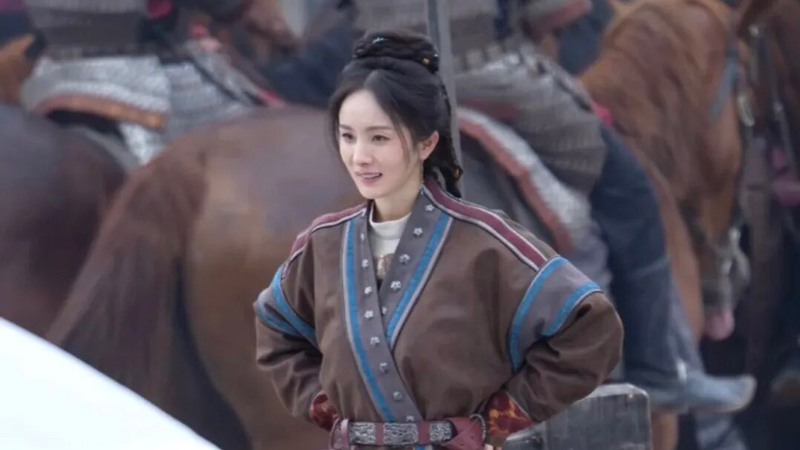
Is This Ancient Coat the Original Biker Jacket? A Northern Wei Dynasty Fashion Mystery in Jiangshan Datong (江山大同).
When paparazzi shots surfaced of Yang Mi (杨幂) as a young Empress Dowager Feng (冯) in the upcoming historical drama Jiangshan Datong, she wasn’t wearing flowing silks. Instead, she was clad in a rugged, spliced leather coat adorned with studs. The internet erupted. Critics called it an anachronism, a cheap nod to modern punk aesthetics. But is it? This isn’t a stylist’s fantasy; it is a meticulous recreation of a 1,600-year-old tradition from the arid steppes.
Before dismissing it, we must unlearn the myth that leather fashion is a Western import. The coats of the Northern Wei tell a story of survival, resourcefulness, and a surprisingly modern sense of style rooted in the very soil of northern China. This is not a costume; it is an archaeological statement.
Unearthing the Ancient Wardrobe
To understand the coat, we must look to the sands of Xinjiang and Inner Mongolia, where time has preserved the truth. At the Hami Wubao Cemetery (哈密五堡墓地), archaeologists discovered a 3,000-year-old sheepskin coat. It is startlingly intact. The construction is clever: the woolly side faces the body for insulation, while the smooth, tanned hide faces the wind and sand. This “fur-in, hide-out” logic was the gold standard for surviving the Gobi Desert’s brutal climate. It was a matter of life and death, not just vanity.
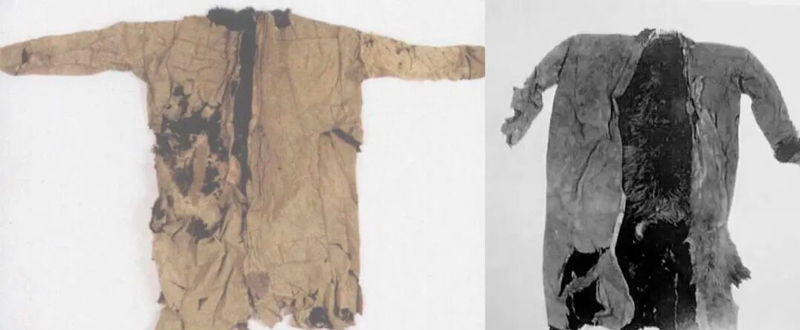
Further proof lies in the Northern Wei tombs along the Silk Road. Museum collections in Xinjiang and Taiyuan (太原) display these garments in various forms—round-necked or cross-collared. They are the ancestors of the coat Yang Mi wears. The specific style in the drama, a left-lapel cross-collar (a distinct marker of non-Han cultures), is a classic Xianbei (鲜卑) design. The narrow sleeves and tailored fit allowed for riding and combat. Therefore, the “biker jacket” look is actually a functional artifact of equestrian life. It is a direct inheritance from nomadic tribes, not a borrowed idea from a biker subculture.
The Science of Splicing
Why does the coat look pieced together? Modern fashion calls it “patchwork” or “splicing” and charges a premium for it. In ancient times, it was simple pragmatism. Hunting yielded pelts of varying sizes and qualities. A single, massive hide was a luxury reserved for the nobility. For ordinary herders, a complete coat required creativity. They cut the available sheepskin or rawhide into rectangles and trapezoids. Using animal sinew or leather strips as thread, they stitched these pieces together, offsetting the seams.
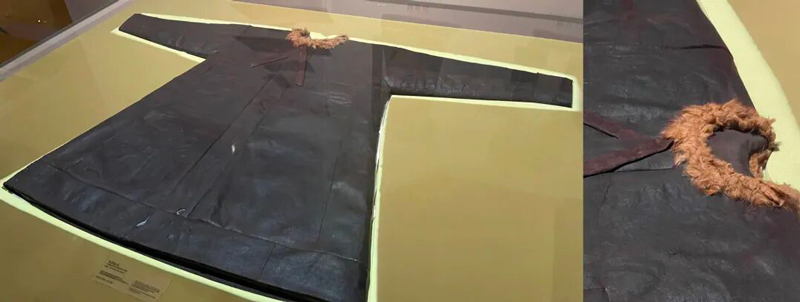
This technique was highly skilled. The craftsman would deliberately stagger the joints. If the seams aligned, the coat would become stiff and uncomfortable, rubbing against the body during movement or riding. By splicing, they distributed the bulk, creating a flexible garment that didn’t restrict motion. The studs present on Yang Mi’s costume are not metal, but decorative leather or bone rivets used to reinforce these stress points. So, the “studded” look wasn’t rebellion; it was the result of meticulous engineering. It is a masterclass in functional design, demonstrating that the ancient Xianbei prioritized comfort and durability just as much as appearance.
Aesthetic Hierarchy and Modern Legacy
However, splicing also became a canvas for social status. The era saw a clear aesthetic stratification. Commoners wore dull, monochromatic patches of sheepskin with no embellishment. Their focus was purely survival. Yet, for the Xianbei aristocracy, the coat became a symbol of power. They used scraps of fox, snow leopard, and sable for the borders and collars, while the main body remained a smooth, softly tanned hide. This color-blocking is precisely what Yang Mi’s costume replicates. The central body is plain, while the edges feature distinct, contrasting spotted fur trim.
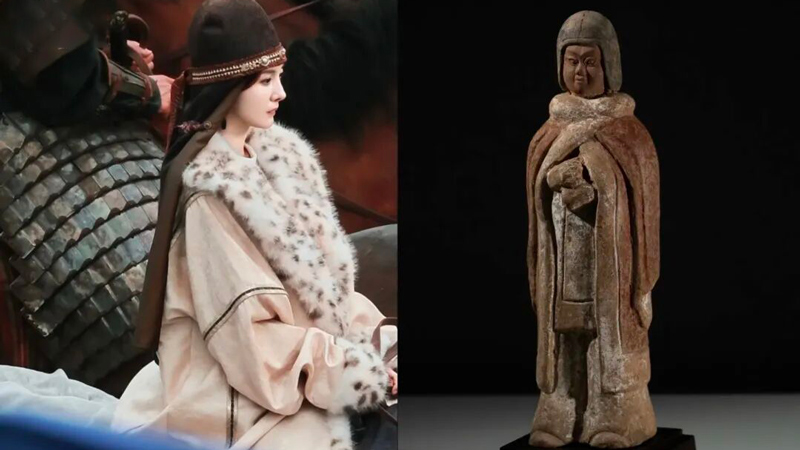
This was not mere decoration. This design rule perfectly matches the painted pottery figurines of fur-clad warriors unearthed in Datong, the capital of the Northern Wei. These figurines feature the exact same detail: a plain robe with luxurious fur only at the cuffs and collar. It was a visual shortcut to identify a person’s rank. Therefore, the aesthetic was not about random embellishment; it was a regulated code. The dominant colors—earthy browns, creamy whites, and deep grays—reflect the natural landscape of the steppe. This minimalism, grounded in the concept of “harmony between man and nature,” is a cornerstone of traditional Eastern aesthetics. It proves that the current “quiet luxury” trend is not new; it is an ancient Chinese concept.
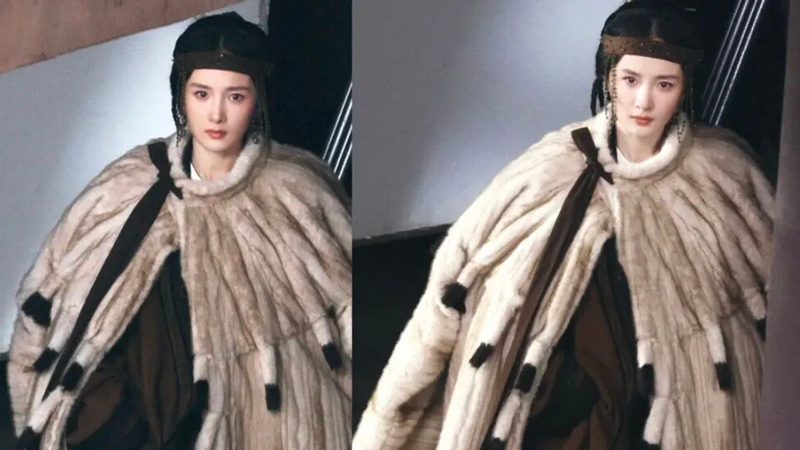
Far from being a “lifestyle,” the coat is proof of continuity. The character for “fur coat” in ancient oracle bone script is actually a pictogram of multiple hides stitched together. It is one of the oldest recorded garments in Chinese history. Today, the fashion industry often looks to the West for vintage inspiration, replicating western tube silhouettes and high-shine finishes. Jiangshan Datong challenges this. It reveals that the authentic “vintage” look is already native to China. The splicing, the layering, the functional studs—these are the true origins of our leather heritage. To ignore them is to ignore the wealth of inspiration hiding in the tombs along the Silk Road. The fashion source we seek has always been right under our feet, waiting to be rediscovered.