
The Hechang (鹤氅), or “crane cloak,” takes its name from a single character that began life not as a garment at all but as an item of imperial regalia — a canopy woven from bird feathers. In modern usage the word carries three meanings: a coat made by plaiting feathers, a general term for windproof cape-style outerwear, and a classic garment of Daoism, an honored title for the Daopao (道袍). Of all the forms in the Hanfu system, the Hechang is the one with the fewest dedicated references: it has never received a full feature on this site, and this guide is the first. It reconstructs the cloak’s long career — from feathered regalia, to the byword of Wei-Jin (魏晋) elegance, to the Ming scholar’s statement of personal cultivation.

Word and Origin: Feathers of Imperial Regalia
The earliest records of the character chang (氅) describe not a robe but an honorific parasol: a canopy stitched from bird plumes carried in the processions of emperors and high ministers. The Kangxi Dictionary (康熙字典) glosses it: “Chang is bird plumage; written with the bird radical it is bie. Plumage may also be split and made into fur garments.” The Cihai (辞海) adds the sartorial sense: an overcoat worn over other clothing to ward off wind and cold, of varying cut, made from the feathers of various birds and dyed in various colors.
The earliest Hechang, then, was simply a shoulder cape of crane feathers, draped over the back and fastened at the neck with a knot or button — close to a modern shawl. Crane plumage was hard to come by, so weavers soon substituted silk and other fabrics, embroidering crane motifs to keep the name honest. The decorative grammar centered on two elements: cranes in varied poses and cloud patterns, the latter refined over successive dynasties until, in the Song, they reached a compact, refined style that balanced substance and void. Embroiderers worked the cranes in line stitch or in gold-wrapped thread (线外包金箔).
The “Immortal Among Men” in Classical Texts
The compound hechang appears in texts as early as the Jin dynasty. The Book of Jin (晋书), in the biography of Xie Wan (谢万), records the scholar “in a white silk headwrap and crane-feather robe.” The Shishuo Xinyu (世说新语), in its chapter “Admiration and Aspiration” (企羡), preserves the most famous scene: Meng Chang (孟昶), before he rose in the world, was living in Jingkou when he saw Wang Gong (王恭) ride past in a high carriage wrapped in a crane-feather robe, a light snow falling; watching through a hedge, Meng sighed, “This is truly an immortal among men.” The phrase stuck, and the Hechang became the emblem of Wei-Jin aristocratic bearing.
Later records multiply. The History of the Five Dynasties (五代史), in the biography of Lu Cheng (卢程), shows the minister “in a Huayang headwrap and crane robe, settling cases from his desk.” Xu Hao (徐灏), annotating the Shuowen Jiezi (说文解字), wrote: “A garment of bird-of-prey feathers, called a crane robe — the name beautifies it.” Poets returned to the image again and again: Li Bai (李白) in “Answering Cui Xuancheng on the River” wrote “the sable coat was no Ji Zi, the crane robe resembles Wang Gong”; Wu Renbi (吴仁璧) in “Spring Snow” wrote “after the sable coat wears through, the crane robe frays, and from then on elegance is not worth viewing”; Bai Juyi (白居易) in a poem on a newly made padded gown observed “the crane robe is thin and flimsy in fact, the kapok coat cold and merely famous”; Lu You (陆游) in “Evening Composition, the Ninth Day of the Eighth Month” described himself “idly descending the thatched hall at dusk, in headwrap and crane robe, playing with autumn light”; the Southern Song poet Yao Mian (姚勉), in a birthday ode, praised “jade-dust spirit, jade-forest charm, a small immortal’s cloak in the snow”; and the Ming writer Song Lian (宋濂) in “Notes on the Pine-Viewing Hermitage” pictured his host “in his leisure from poetry and calligraphy, in a crane robe, leaning on a nine-jointed staff.”

Cut and Construction: Sewn or Not?
The Hechang’s cut evolved slowly, and the crux of its history is a single question: were the sleeves sewn? The earliest form was a sleeveless feathered cape — a rectangle folded in half, opened with a vertical slit down the center front to the collar, the bottom edge left unsewn, fastened at the neck, with an optional waist sash. Folk names for this sleeveless style were “one-mouth-total” (一口总) and “arhat robe” (罗汉衣).
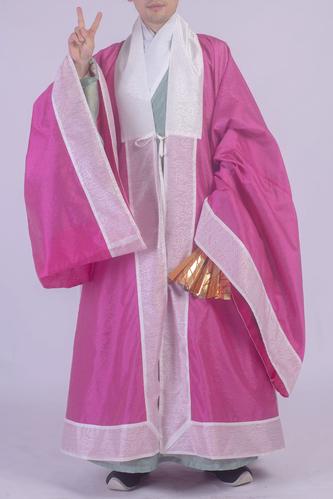
Once scholar-officials adopted it, the Hechang became a wide-sleeved, straight-collar robe open at both sides, with no edge binding, fastened with a sash at the waist. The Ming eunuch Liu Ruoyu (刘若愚) described the form most precisely in his Records of the Ming Palace (明宫史), in the entry on the changyi: “Variants with Daopao-style sleeves are a recent degenerate fashion. The old form did not sew sleeves at all, and that is why it is called a chang — a robe that hangs open. It could be colored or plain.” The Zhozong Zhi (酌中志), in its section on palace retainers, repeats the same text. Worn unsewn, the robe hung on the shoulders like a crane with folded wings; from the mid-Ming a sewn-sleeve variant appeared, sometimes called a “moon robe” (月衣). Ming examples were close in cut to the Pifeng (披风) overcoat, though more heavily edged and with a closer collar, and with sleeves wider than a Beizi’s (褙子).
Archaeology confirms the old sleeveless form. A Jin-dynasty Hechang excavated in excellent condition is a collarless, sleeveless rectangle fastened at the neck with buttons, its entire surface embroidered with 104 cranes amid cloud patterns — 234 centimeters long and 135 centimeters wide, worked in fine silk embroidery whose crane poses resemble those in the Song painting Auspicious Cranes (瑞鹤图). It is the hard physical evidence for the “no sewn sleeves” tradition.
Daoist Vestments: Crane Robes of the High Priests
The Daoist connection runs deep. Immortality was called “feathered transformation and ascent to heaven,” the crane was a standard Daoist emblem, and the Hechang accordingly became a classic garment of the religion — in effect an honorific title for the Daopao. Zhu Quan (朱权), seventeenth son of the Ming founder and a Daoist scholar, wrote in his Taishang Calendar of the Great Dao (天皇至道太清玉册), in the chapter on vestments: “All Daoists use it; the color is unrestricted, but those of great virtue use black, and ordinary Daoists dare not.” The Yuan-dynasty ritual manual Daoshu Yuanshen Qi (道书援神契) traces the lineage: “The Book of Rites has the broad-sleeved robe, a large-sleeved garment; the Daoist robe is of that kind… the straight collar expresses the ideal of unfettered ease.” A cloud-and-crane silk gauze changyi (罗地丝绣云鹤纹氅衣) has been rated a national first-class protected cultural relic. The robe belonged chiefly to high-ranking celebrants: the top grades were purple or blue, the next rank yellow.
In fiction and opera, the Hechang marks the immortal. In wuxia and supernatural novels, the Daoist master Ziyang (紫阳道人) makes his entrance “white-haired and child-faced, in a crane robe, holding a horsetail whisk” — the look of transcendent refinement at a glance. Ziyang is Zhang Boduan (张伯端), a devotee of alchemy and self-cultivation who passed away seated in meditation at Linhai at the age of 98. He also appears in Journey to the West (西游记): when the demon king Sai Taishui, lusting after Lady Jinsheng of the Zhu Zi kingdom, spirits her into his cave, Ziyang transforms an old palm-fiber coat into a new rainbow garment and tells the queen to wear it as protection — the moment she puts it on, a coat of poison thorns covers her body, and for three years the demon king cannot touch her.

Wei-Jin Style: Wushisan, Talk, and Loose Robes
The Wei-Jin scholars who wore the Hechang favored metaphysical talk and fine dress, and many swallowed the mineral elixir wushisan (五石散). The dose sent heat surging through the body and steam rising from the head; the sufferer had to keep walking to dissipate the inner fire, and a wide, loose crane robe aided the ventilation — and looked magnificent doing it. By this point the Hechang was not always made of feathers. In the Song, the fur version disappeared entirely; robes of cloth or hemp were simply called Hechang after the crane’s purity and its airborne, Daoist air. The Southern Song envoy Zhao Gong (赵珙), in his Notes on the Mongols (蒙鞑备录), reported that among the Mongols there was a “patterned-sleeve garment like the Chinese crane robe, so wide and long it trailed on the ground, with two female slaves holding up the hem as the wearer walked” — a measure of how far the silhouette had traveled.
Song Dynasty: A Three-Season Scholar’s Garment
The Song fixed the changyi’s form. By then the word denoted a full robe, stabilized into a symmetric style open at both sides of the chest. Among the garments excavated from the tomb of Huang Sheng (黄升墓), a Song woman’s grave, a wide-sleeved outer robe with edged cuffs and a neck-fastening placket is precisely the Song changyi. The occasions for wearing it widened: no longer tied to heavy fur-lined winter sets, it became a three-season garment for scholars — a robe for spring, autumn, and the milder stretches of winter.
Ming-Qing Divergence and Dream of the Red Chamber
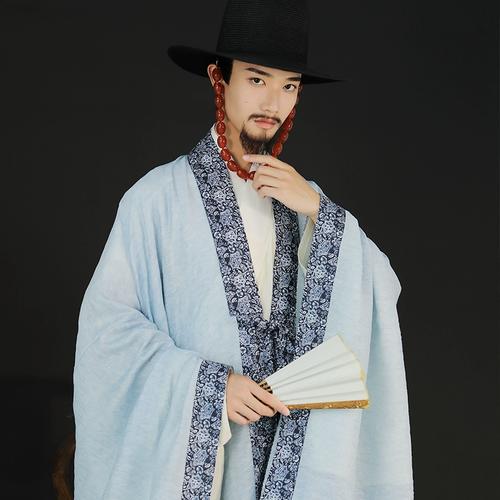
In the Ming and Qing the Hechang and the changyi went separate ways. The Ming Hechang branched toward the Daoist ceremonial robe on one side and, on the other, spread through society until men, women, and children all wore it as an outer cloak; toward the end of the Ming the wide Daopao-style sleeves came into fashion, in colors plain or bright. Before the Qing, changyi was largely a men’s term. In the late Qing it became the name of a specific Manchu women’s informal robe: under the influence of banner dress the front closure shifted from center to side, the style peaked during the regency of Empress Dowager Cixi, and it became the most frequently worn at-home dress of the Qing palace concubines. Qing changyi came mainly in five color families — red, yellow, blue, purple, and green — decorated with flowers and birds, dragons and phoenixes, and auspicious motifs of a hundred children, peace, and longevity, finished with techniques of braiding, rolling, and appliqué.
Dream of the Red Chamber (红楼梦), chapter 49, gives the Hechang its most famous literary costumes: Lin Daiyu wears a crane robe of crimson feather cloth lined with white fox fur, while Xue Baochai wears one of lotus-blue brocade woven with cloud motifs and foreign woolen thread — in the snow scene of Grand View Garden, the two cloaks are at once garments against the cold and portraits of their wearers’ characters.
On the Opera Stage: Immortals and the First-Rank Crane
Peking opera fixed the Hechang in costume convention. Since “feathered transformation” meant riding a crane up to heaven, characters in crane robes are almost always immortals or Daoist masters, and they carry a feather fan. The canonical examples include Zhuge Liang in Inviting Zhuge Liang Thrice (三请诸葛) — the strategist living in seclusion at Wolong Ridge in Longzhong, called out only after Liu Bei, Guan Yu, and Zhang Fei made three visits — and in the same figure in Lamenting at Wolong (卧龙吊孝), where he crosses the river to mourn Zhou Yu; well-funded productions design a special costume for the scene, often a gray-white crane robe. The crane also carried rank: the bird symbolized longevity and refinement, and the rank badge (Buzi, 补子) of a first-rank civil official was embroidered with a crane — a motif known as “the first rank of the court” (一品当朝).
Wearing Hechang Today
The Hechang’s simple cut and easy on-off drape keep the sleeveless-cape idea alive today. In modern Hanfu styling it works as an autumn-winter outer layer over a Jiaoling long robe or a Zhiduo (直裰); the wide sleeves and side slits catch the air as the wearer walks, carrying the airborne, transcendent poise the name promises. When choosing one, the differences from neighboring forms matter: the Hechang is sleeveless or extremely wide-sleeved and usually straight-collared, the Pifeng is a sleeved outer robe, the Beizi is straight-collared and open at the underarms, and the Daopao has sleeves and edged borders. Reading those distinctions correctly is what lets a modern wearer carry the ancient poise — rather than a costume — into the street.