

We often romanticize the past. We imagine our ancestors drifting off to sleep as the sun set, free from the glaring blue light of smartphones and the anxiety of unanswered emails. It seems like a golden age of rest. However, this idyllic image crumbles under historical scrutiny. The reality is that achieving a peaceful night’s rest was a formidable challenge, fraught with legal perils, physical discomfort, and psychological turmoil.
From enforced curfews to rock-hard pillows, the battle for a good night’s sleep is not a modern invention; it is a timeless human struggle that our forebears knew all too well. They would likely look at our memory foam mattresses with envy, even as we envy their lack of digital distractions.
1. The Curfew’s Clamp
If you think your bedtime is dictated by a boss or a deadline, consider the ancient Chinese curfew. The desire for an early night wasn’t always a choice; it was often a matter of survival. From the Shang and Zhou dynasties, a strict curfew system was in place.
The Rites of Zhou (周礼) even mentions a specific officer, known as Si Wu Shi (司寤氏), whose sole duty was to enforce the night ban. Under the Tang dynasty’s Palace Guard Regulations, anyone caught on the streets without good reason between the evening drum and the morning drum faced twenty lashes for “violating the night curfew.” This wasn’t a minor inconvenience; it was a serious offense.
During the Han dynasty, a young official named Cao Cao (曹操), who would later become a legendary warlord, demonstrated the law’s severity. He executed his own uncle for breaking the curfew. For the average person, the evening wasn’t a time for leisure; it was a time to stay indoors, whether they were tired or not. The law forced a “rest” that was more about social control than personal well-being.
2. The Pillow’s Plight
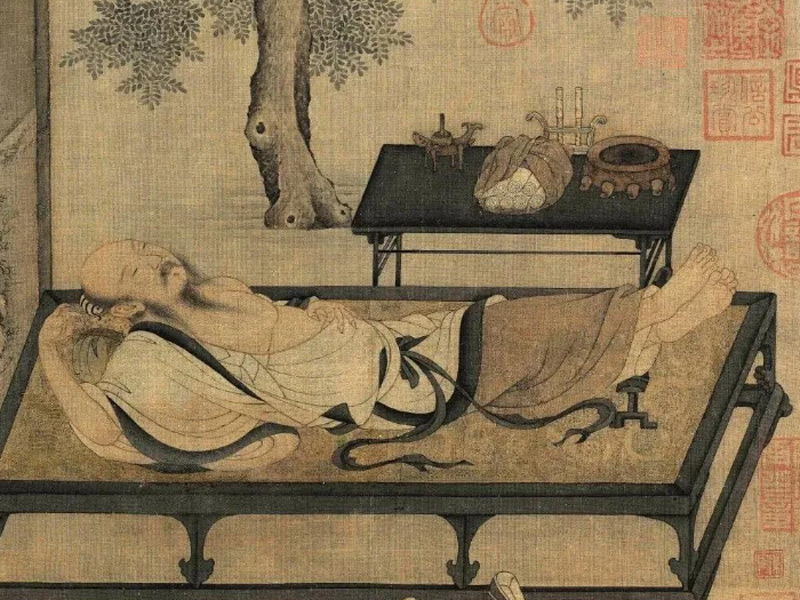
After successfully navigating the dangers of the night patrol, a new ordeal awaited: the bed itself. Forget the plush, ergonomic pillows we take for granted; ancient sleepers rested their heads on objects that seem designed for torture. These were often made of stone, wood, jade, or porcelain. The ceramic pillow, which gained immense popularity during the Sui, Tang, and Song dynasties, was a particularly common choice. These weren’t soft or yielding; they were unforgivingly hard. Imagine trying to find comfort on a cool, smooth block of fired clay.
For a modern sleeper, this sounds like a recipe for a stiff neck and a miserable night. Yet, for centuries, these were the standard, often crafted with a hollow base to allow for a slight breeze in the summer heat. The goal wasn’t comfort, but function.
3. The Logic of Hardness
The preference for such rigid sleeping surfaces wasn’t arbitrary. It was rooted in a combination of practicality and traditional medicine. The primary reasons were threefold. First, the hollow design of a ceramic pillow was a clever engineering solution for cooling; it allowed air to circulate and wick away heat, a crucial feature in a time before air conditioning. Second, it served a social function: protecting the elaborate hairstyles that were a mark of status and dignity. A hard pillow ensured that one’s hair remained perfectly coiffed upon waking, avoiding the “bed head” that plagues us. Finally, there was a belief in its health benefits.
The famed Ming dynasty physician Li Shizhen (李时珍) wrote in his Compendium of Materia Medica (本草纲目)) that long-term use of a ceramic pillow could “clear the mind and sharpen the eyes, allowing one to read fine print even in old age.” However, from a modern medical perspective, this “therapeutic” choice likely led to a host of neck problems, from muscle stiffness to reduced blood flow to the head.
4. The Watchman’s Wake-Up Call

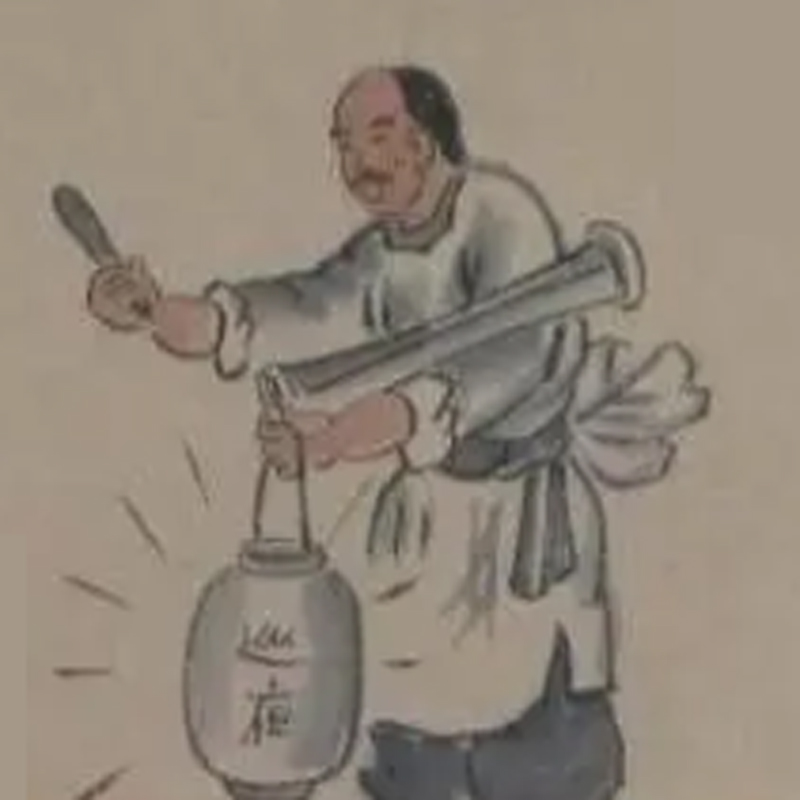
Just as the body began to succumb to the unyielding pillow, the night watchman arrived to shatter any hope of deep sleep. Lacking clocks, ancient cities relied on these men to mark the passage of time. Starting at 8 p.m., they would patrol the streets, striking wooden clappers or gongs every two hours throughout the night. From the first watch to the fifth, the rhythmic sound would be a constant interruption.
The first few watches were marked with a gong, but from the third watch onwards, the beat would switch to a quieter wooden clapper to avoid being overly disruptive. Yet, every two hours, like a relentless alarm clock, the sound would echo through the streets. It is difficult to imagine maintaining a continuous, restful sleep cycle when you are jolted from your slumber six times a night.
For many, however, this noise wasn’t just an irritant; it was a reassurance. The sound of the watchman meant the city was safe, free from fire and bandits. It was their only source of security, a sonic reassurance in the dark that all was well, providing a strange kind of comfort—an ancient lullaby of safety that was as much a disturbance as it was a necessity.
5. The Emperor’s Grind

If you think waking up early for work is a modern curse, imagine the life of a court official. The coveted “eight hours of sleep” was a luxury no one in the imperial court could afford. Court sessions for the emperor and his ministers began in the middle of the night, around 3 to 5 a.m. For officials living far from the palace, this meant rising even earlier, often at 1 a.m., to make the arduous journey through the dark, unpaved streets. This was not an occasional event but a daily ritual.
An official’s journal from the Song dynasty recounts the grueling schedule, and records show that Emperor Taizong (太宗) himself would “go to bed late and rise with the morning drum.” The legendary phrase, “Ministers await the dawn in the cold of the fifth watch,” paints a vivid picture of exhausted, shivering courtiers standing outside the palace gates in the pre-dawn hours. This relentless schedule led to chronic sleep deprivation and burnout, with many officials begging to retire simply to catch up on their rest.
6. The Heart’s Unrest

Ultimately, the ancients understood a profound truth that we often forget: the real obstacle to sleep is not the pillow, the noise, or the schedule, but a troubled mind. The sleepless nights of famous historical figures are legendary. The great poet Du Fu (杜甫), whose life was marked by war and displacement, wrote hundreds of poems about his insomnia, a testament to his anxieties.
On a night of failure and disappointment, the scholar Zhang Ji (张继) lay awake on a boat, his restless mind composing the immortal poem that would make Hanshan Temple (寒山寺) famous for a millennium. Su Shi (苏轼), a giant of literature, would drag his friend Zhang Huaimin (张怀民) out for a midnight walk, unable to sleep.
Even Ruan Ji (阮籍), a poet of the Wei and Jin dynasties, would simply get up and play the lute, caring little for his neighbors’ sleep. They knew that their insomnia wasn’t about their surroundings but was a symptom of a deeper unease. The ancient adage, “First calm the heart, then close the eyes,” is a philosophy that recognizes the mind’s dominance over the body. This wisdom, imparted by the Song dynasty scholar Cai Jitong (蔡季通) and the physician Sun Simiao (孙思邈), remains as relevant today as it was a millennium ago.