
The Ruqun is among the most fundamental and longest-lived garment structures in Hanfu. It belongs to the classic “upper garment, lower skirt” (shang yi xia chang) system: the upper body wears a short jacket or blouse called the Ru, typically ending above the knee; the lower body binds a skirt that falls to the ankle. The Ruqun first appeared during the Warring States period, initially popular in the Zhongshan state founded by the Bai Di people, then became the most common everyday dress of Han women for millennia. Across more than two thousand years, though its length and width shifted with the times, its basic structure never lost its original shape.
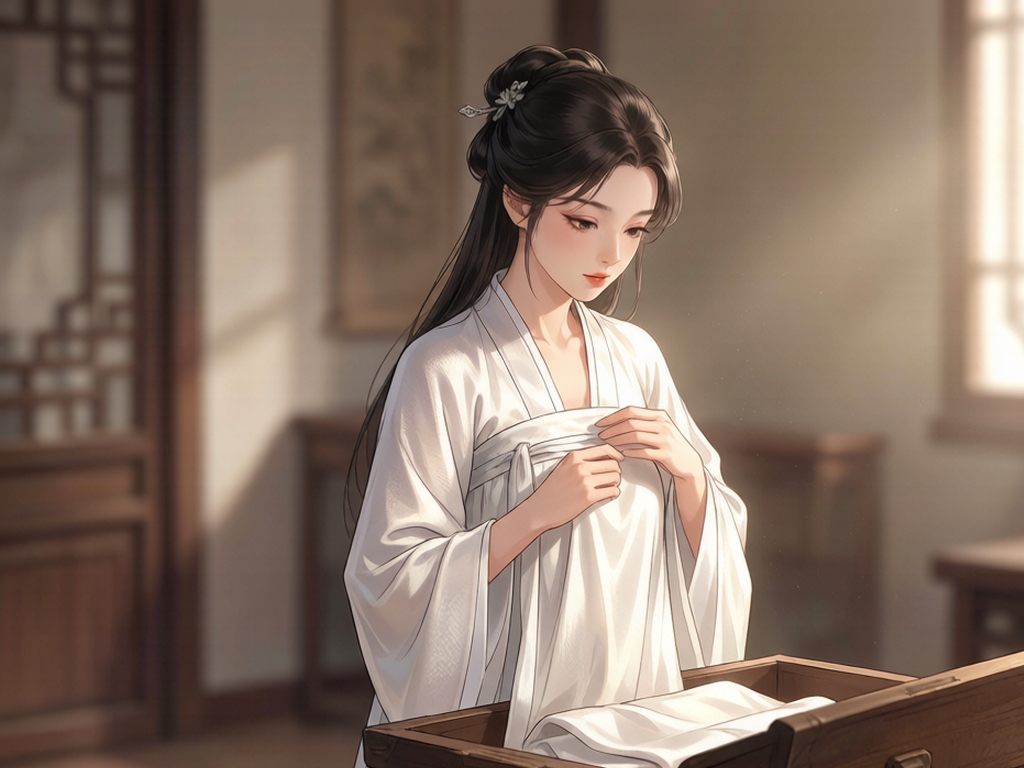
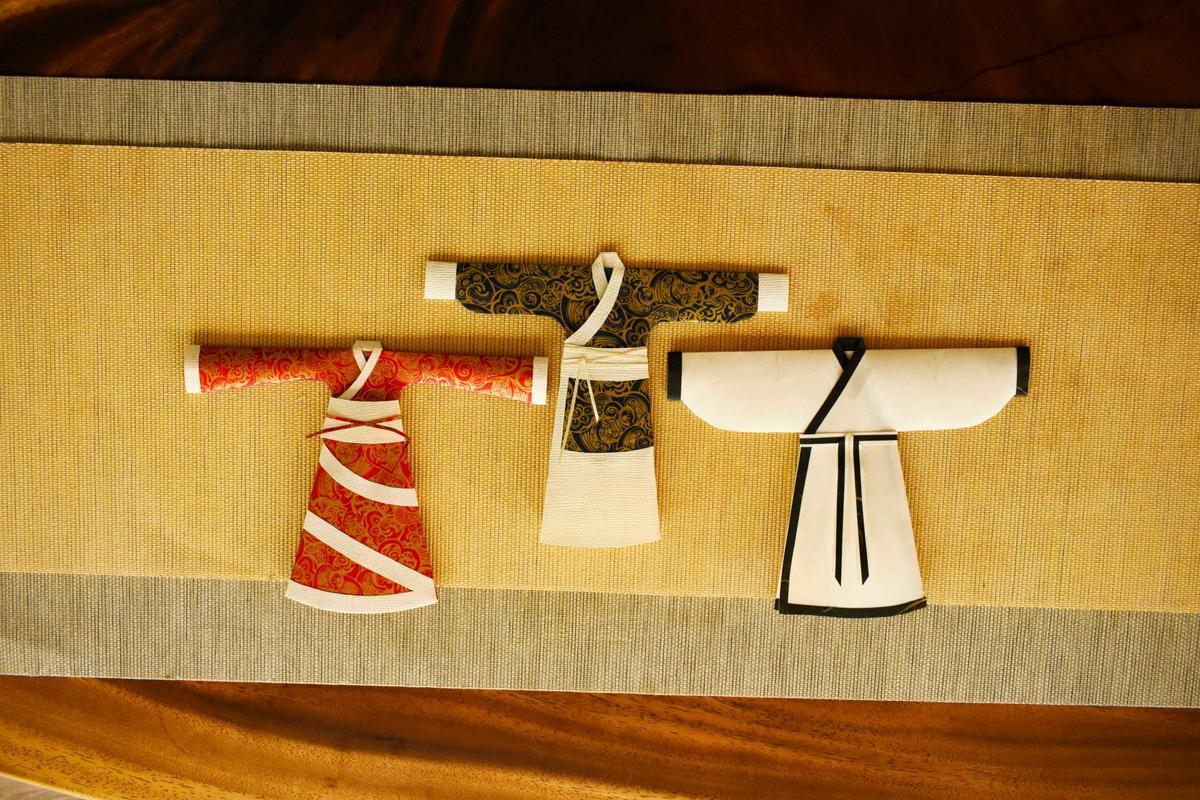
By waist height, the Ruqun divides into three types: the qi yao (waist-level), the gao yao (high-waist), and the qi xiong (chest-level). By collar style it splits into the Jiaoling (cross-collar) Ruqun and the zhiling Duijin (straight-collar parallel-opening) Ruqun. By lining, the Ru is either a dan ru (unlined, close to a shan) or a fu ru (lined, close to an ao). A defining aesthetic trait: the upper garment is short, the lower skirt long, and the proportion between them satisfies the golden ratio — a richness of visual meaning encoded in the cut itself.
Han Dynasty: Ruqun Survives Beneath the Shenyi Dominance
In the Han era, the shang yi xia chang Shenyi was the prevailing fashion and fewer women wore the Ruqun, but the form was never abandoned — texts record it throughout. In 1957, a Han-period Ruqun was excavated from the Mozuizi tomb in Wuwei, Gansu: the upper Ru used pale-blue silk as facing with silk floss padding inside, and a strip of white silk at the cuff; the skirt, also floss-padded, was made of yellow silk. During the reign of Emperor Xian of Han, women favored the high-waist Ruqun, proving that even under Shenyi dominance the Ruqun persisted in court and common life. The Han Ruqun’s basic features: narrow-sleeved right-opening upper garment with a rectangular cross-collar; the lower skirt joined from four panels of plain silk, narrow at top and wide at bottom, with pleats at the waist and a silk tie at the waistband.
Wei-Jin to Northern and Southern Dynasties: Revival and Reinvention
By the Wei-Jin years the Ruqun regained prominence and became the dominant dress of the time. It inherited Han conventions, but the upper Ru now favored the Duijin (similar to a modern cardigan), with embroidery added to collar and cuffs, sleeves either narrow or wide; a waist wrap called the bao yao (modern people call it a small apron) was tied outside with silk ribbon. With Buddhism’s rise, lotus and honeysuckle motifs flooded onto clothing. Women’s skirts prized vivid material, color, and pattern; plain white skirts without flowers also found favor. Late Jin saw the habit of wearing a liang dang (a vest-like inner garment) over the Jiaoling Ruqun. The Northern and Southern Dynasties produced the Ruqun with the garment worn outside the skirt and a waist belt on top; the lower skirt was mostly a jian se qun (color-blocked skirt), later transmitted to the Korean peninsula and Japan.
Across the Wei-Jin period the skirt waist rose, the upper garment shortened, the sleeves narrowed — then the trend swung to the opposite extreme, sleeves broadening to two or three chi. This flux reveals the Ruqun’s flexibility and variety, laying the groundwork for the Tang flourishing.
Tang Dynasty: The Ruqun’s Golden Age
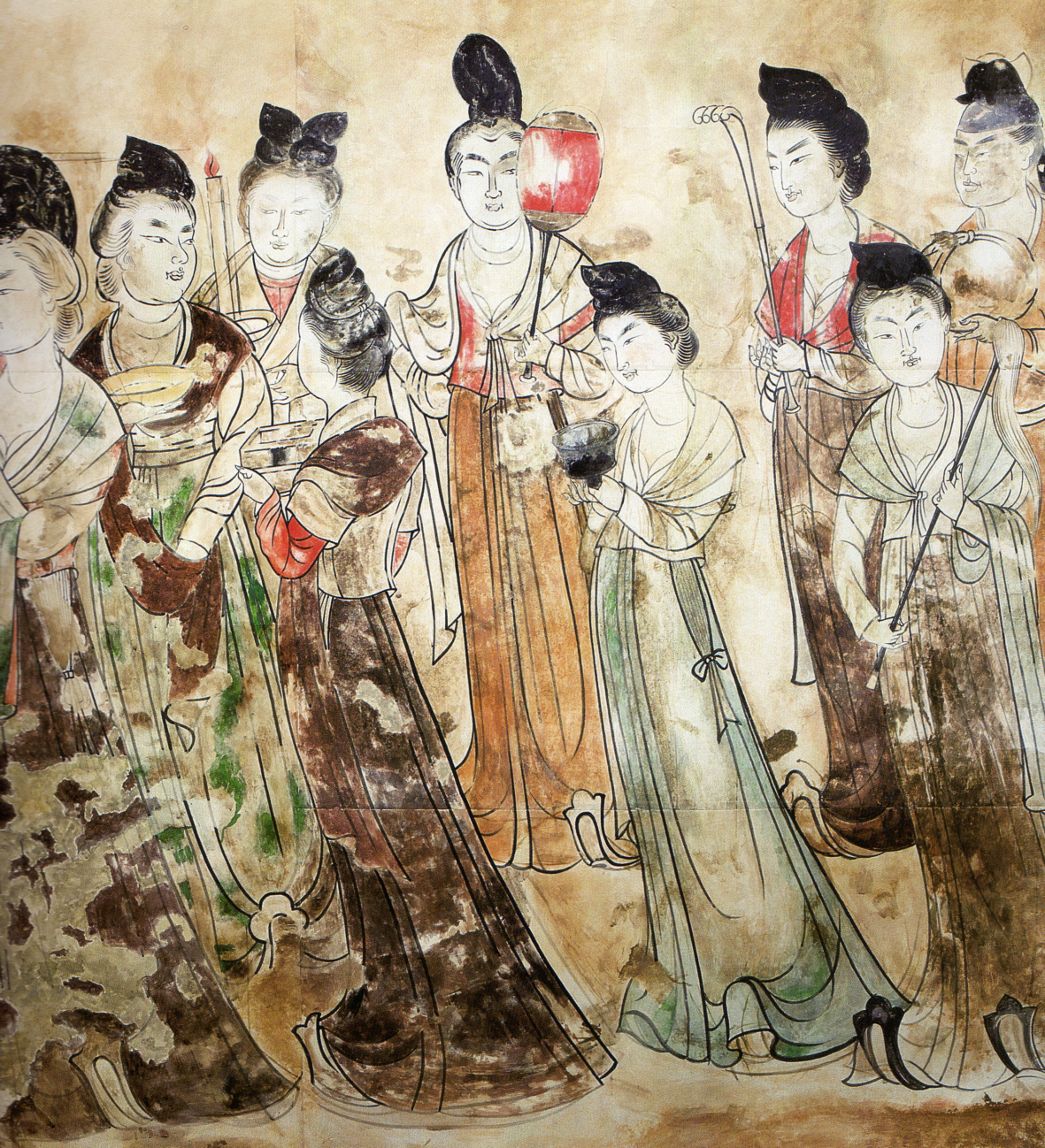
The Tang was the Ruqun’s golden period. The qi xiong and gao yao Ruqun became the fashion mainstream, usually paired with a Pibo (silk shawl). Sui-era upper Ru favored small sleeves. The Tang wore small-sleeve short Ru with floor-length skirts for long stretches, though after the High Tang the aristocracy turned toward voluminous, trailing garments. The skirt used four panels sewn together, narrow at top and wide at bottom, falling to the floor without edging. The waistband used silk strips with tie-ends sewn at both sides.
The most striking Tang Ruqun change was at the collar — the tan xiong da xiu shan (low-cut large-sleeve blouse) briefly trended, showing the liberated spirit of the High Tang. The Pibo evolved from a narrow long shawl into flowing ribbons draped over both arms and danced front and back — the quintessential dress of ancient Chinese court ladies, most popular in the High Tang and Five Dynasties. Lower skirts were mainly silk, best in multiple panels, with the waist raised. Skirt colors were vivid — deep red, dark purple, moon-blue, grass-green — with the pomegranate-red skirt enjoying the longest run. Princess Anle, daughter of Emperor Zhongzong, owned a hundred-bird skirt that ranks among masterworks of Chinese weaving history; the Xiang Ling qun of Wu Zetian’s time hung twelve bells at the skirt’s four corners, ringing with every step in a thousand postures of beauty. Late Tang to Five Dynasties also saw the Hezi qun — a Hezi worn under the Ru, with a large-sleeve outer coat or Banbi over it; the large-sleeve skirt Ru was then women’s formal dress.
Song Dynasty: Ruqun in Rational Elegance
Under the Cheng-Zhu Neo-Confucian ideal of “preserve heavenly principle, extinguish human desire,” Song dress rejected Tang’s gorgeous colors for a quiet, refined style. Song Han women’s dress centered on the Ruqun — most commonly the Duijin Ruqun, or a combination of innerwear and skirt with a Beizi outside; some wore the Duijin upper Ru as a Jiaoling. The overall Song Ruqun leaned minimal and restrained, a stark contrast to the Tang pursuit of lush opulence.
Yuan, Ming, Qing: From Ruqun to Aoqun
From late Yuan into Ming, Han women’s dress centered on the Aoqun. The key difference from earlier Ruqun: the upper garment is not tucked into the skirt, though working women often tucked it in or tied an apron outside. Under the Qing change-of-dress decree, early Qing Han women still wore Ming garments. By at latest the Yongzheng reign, some Qing Han women’s dress absorbed Manchu influence — the cross-collar shifted to a “chang-shaped” (factory-shaped) large lapel, pipa lapel, and others, but the large lapel kept the Han tradition of right-opening (you ren). The Aoqun stayed popular into the early Republic.
Ruqun Classification and Wearing Etiquette
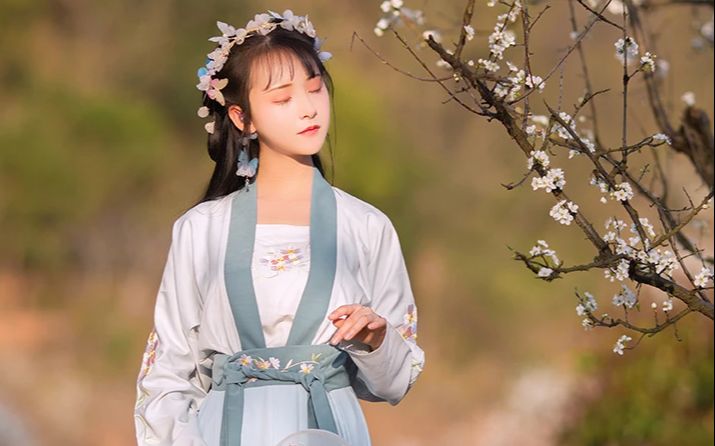
The Ruqun classification system is rich. By collar: Jiaoling Ruqun, zhiling Duijin Ruqun, xie ling Duijin Ruqun, yuan ling Ruqun. By waist height: qi yao Ruqun (also called zhong yao, waist at normal position), gao yao Ruqun (waist below the chest), qi xiong Ruqun (waist above the chest, the most typical Tang style). By lining: dan ru (unlined, close to a shan) and fu ru (lined, close to an ao).
The Ruqun differs from the Quju in that the Quju has the left lapel continuing and wrapping around the back, the skirt inside the garment, the lapel passing at least the knee; the Ruqun’s lower skirt has no wrap-around style. Versus the shan qun: in Wei-Jin the Ru meant a padded short garment, while the shan had no padding. In etiquette, the Ruqun can be worn with just the Ru, or with a Hezi or chest-wrap underneath; outer layers may be Banbi, Beizi, or Bijia; a wei chang (skirt-apron) can be added outside the skirt; Pibo or gong tao (decorative cords) finish the look.
Men also wore the Ruqun, called the nan shi Ruqun. Compared to women’s, the male version was plainer in pattern and ornament. Though the Shenyi and Zhiduo later appeared, the highest-spec official men’s ceremonial dress remained the upper-garment-lower-skirt system, continuing until the Ming fell.
The Ruqun is defined by flat cutting, frequent edge-binding, and silk-ribbon ties. The upper Ru varies mainly at the collar and opening; the lower skirt reaches the shoe surface. As a rule: when the garment is short the skirt is long, when the garment is long the skirt is wide — garment to the waist, skirt below the ankle bone; garment to hip or below-knee, skirt showing only inches. Never split top and bottom evenly.