
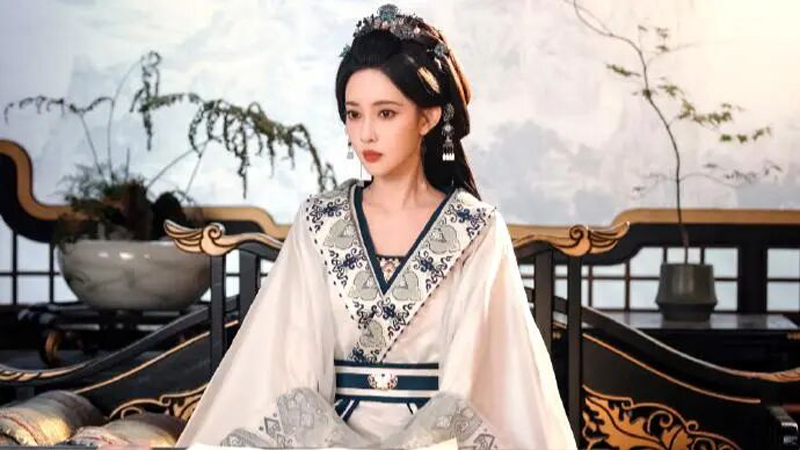
Was the swirling ornament on Meng Ziyi’s costume in the historical drama Blossoms of Power (百花杀) a modern print, or did it actually belong to ancient China? When the first stills dropped, audiences spotted a familiar spiral motif running along the collar and cuffs of her pale silk robe. It looked exactly like the “neo-Chinese” trim that now floods streetwear and red-carpet looks. Some netizens called it a lazy shortcut—digital printing masquerading as heritage. But a closer look at textile archaeology tells a different story.
That pattern is no invention of today’s fashion houses. It is the direct descendant of a design lineage that began on Neolithic pottery, matured on Shang dynasty bronzes, and flourished on Han dynasty silks unearthed from Mawangdui (马王堆). What Meng Ziyi wears is not a gimmick; it is a visual echo of millennia, subtly tweaked for the camera. To understand it, we must trace how a simple curved line became one of China’s most enduring decorative vocabularies—and why it still feels so startlingly current.
Ancient Roots
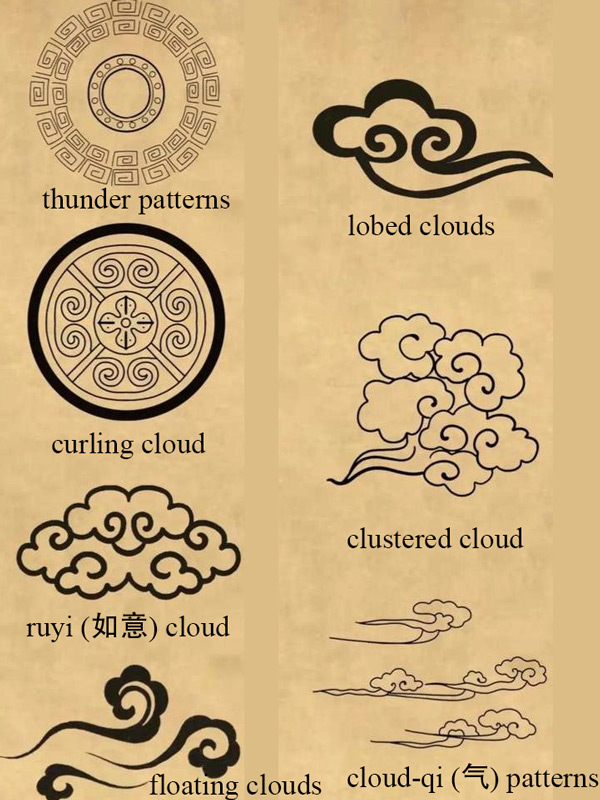
The story of the cloud pattern starts not on fabric but on clay. At the Majiayao (马家窑) and Yangshao (仰韶) cultural sites, potters of the late Neolithic period incised swirling, spiral lines onto their vessels—spontaneous loops that mimicked drifting mist or flowing water. These were not yet formalized motifs, but they held the genetic code for everything that followed. By the Shang and Zhou dynasties, the swirls had straightened into disciplined geometry. Cast onto ritual bronze vessels, they appeared as tightly coiled “thunder patterns” (云雷纹), filling the gaps between fierce animal-mask faces. They were background noise, but essential noise—filling emptiness with motion.
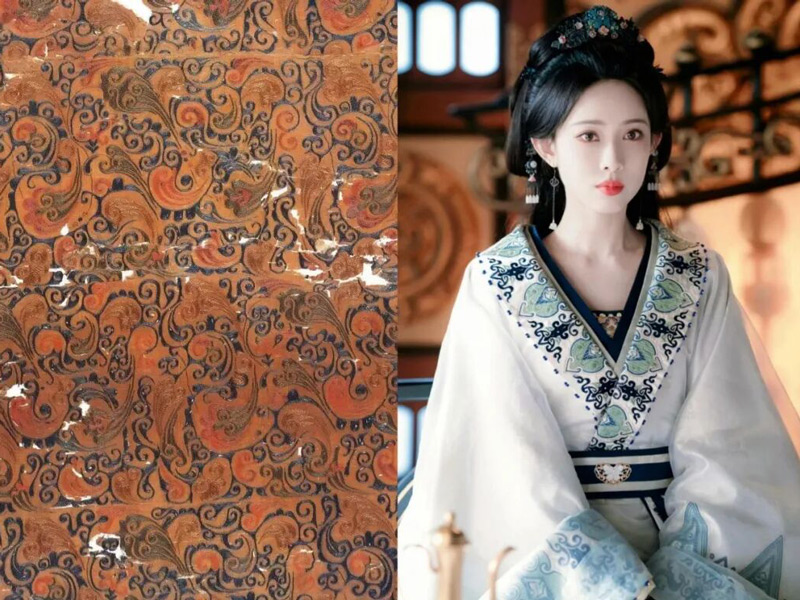
The real breakthrough came during the Warring States and Han periods. As lacquerware, jade carving, and silk weaving advanced, the cloud pattern shed its rigid corners. It became the “curling cloud”—soft, flowing, almost calligraphic. But it was the Han dynasty that turned it into a sensation. Royal robes and aristocratic gowns featured “cloud-qi patterns” along every edge: collars, hemlines, cuffs. The excavated silks from Mawangdui in Changsha show nearly identical border designs to what Meng Ziyi wears in Blossoms of Power—elongated wisps and curled tails that seem to breathe. This was not mere decoration; it was a statement of cosmic connection, linking the wearer’s body to the heavens’ breath.
After the Han, the cloud motif never disappeared. It adapted. In the Wei-Jin and Northern-Southern dynasties, Buddhist influences lightened its mass into “floating clouds” and “ribbon clouds”—ethereal, almost airborne. The Tang dynasty, with its taste for opulence, compressed clouds into round, plump “lobed clouds”, while the “ruyi cloud” began to emerge, named after the scepter-like auspicious symbol. Dunhuang’s murals are filled with these puffy shapes, floating behind celestial musicians. Each era rewrote the visual grammar, but the core—a curved, spiraling line that suggests upward movement—remained intact.
Why Cloud Patterns?
Why did ancient artisans and their patrons cling to this motif for over four thousand years? First, meaning. In pre-imperial cosmology, clouds were messengers of rain, fertility, and imperial favor. A robe trimmed with cloud patterns carried a silent prayer: may the wearer rise as swiftly as vapor, may fortune drift in like a summer storm. Placed at the collar—near the face—or at the hem—where the garment touches the earth—it framed the body with auspicious intent. It was wearable poetry.
Second, status. During the Shang and Zhou, only noble ritual vessels could bear cloud-thunder patterns. By the time textile sumptuary laws matured in later dynasties, the density, material, and craftsmanship of cloud trims directly signaled rank. A court official’s embroidered cloud border was finer and more intricate than a common merchant’s printed version. Even the spacing of the curls could betray one’s place in the bureaucracy. It was a visual code, legible to anyone who knew the system.
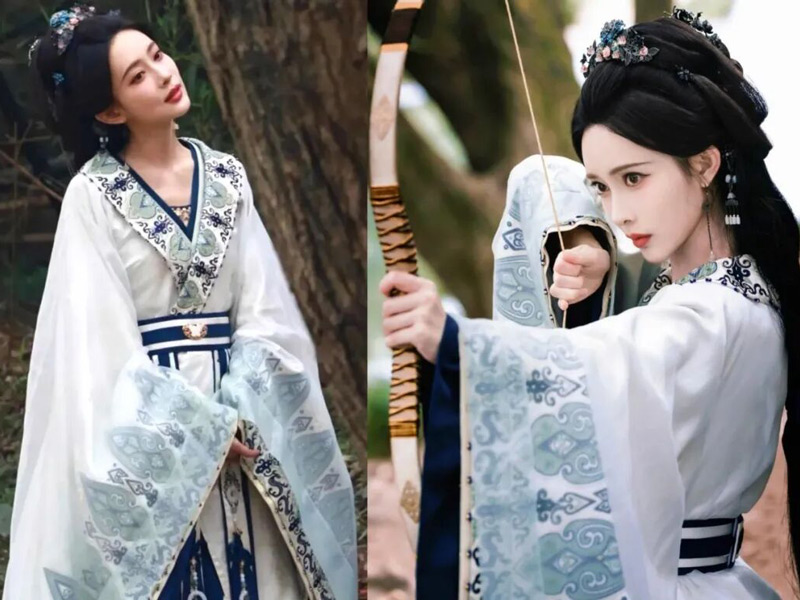
Third, and perhaps most practically, the cloud pattern performed a structural function. Placed along seams, plackets, and edges, its flowing lines accentuated the garment’s silhouette. It defined the shoulder, drew the eye down the lapel, and softened the transition between fabric and empty space. In an era without darts or complex tailoring, this graphic border was the primary tool for shaping how a robe fell and moved. Each dynasty adjusted the curve to match its ideal of beauty—Tang plumpness, Song restraint, Ming formality—but the edge remained the stage.
Modern Revival, Ancient Soul
Fast-forward to today. Walk into any mall in Shanghai or Beijing, and you will see cloud motifs on hoodies, qipao, and even sneakers. Their clean, spiraling lines translate effortlessly to modern silhouettes. Designers love them because they are instantly recognizable yet flexible—they can be minimal, maximalist, embroidered, or digitally printed. This familiarity is exactly why some viewers dismissed Meng Ziyi’s costume as “modern.” They have seen the pattern so often on contemporary streetwear that they assumed it was a recent invention.
But the production team of Blossoms of Power did their homework. They directly referenced Han dynasty cloud-qi patterns from Mawangdui, then adjusted the scale, color contrast, and repetition rate for high-definition cameras. On screen, a straight historical replica would read as muddy or chaotic; the tweaks make the swirls pop without betraying their origin. It is not a forgery or a shortcut—it is a considered adaptation, much like how Tang artisans reinterpreted Han motifs, or how Ming weavers updated Song designs.
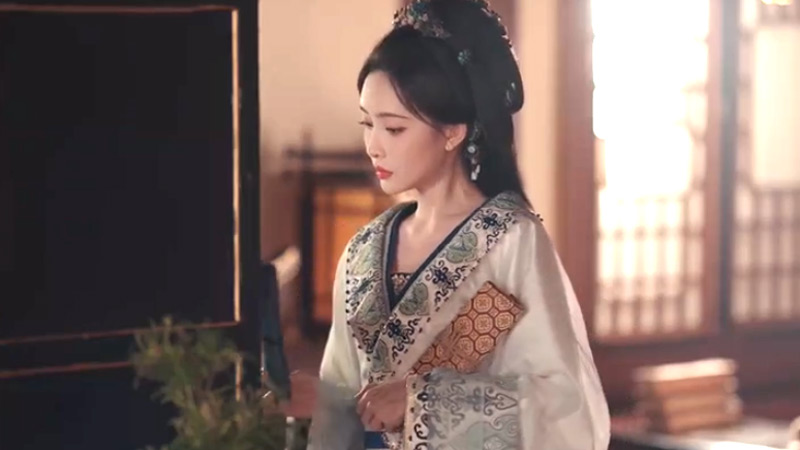
So when you watch Meng Ziyi’s character glide through the palace in that pale robe, remember: the swirls at her wrists are not a trend. They are a conversation across two thousand years. The Han dynasty weaver who packed those curves into silk would recognize the intention, if not the exact pixel-perfect sharpness. And the modern viewer who finds them “familiar” is responding to a visual language that never really went away—it just waited for the right lighting to come back.