
The Feiyu Fu — literally “flying fish garment” — occupies a unique place in Ming dynasty costume history. Often depicted in film and television as the standard uniform of the Jinyiwei (Imperial Guard), the historical reality is more nuanced. Far from a daily uniform, the Feiyu Fu was a ceremonial award garment, granted only by the emperor to signal extraordinary favor.
What’s the Feiyu Fu?
The Feiyu Fu belonged to the Ming “bestowal garment” system, a hierarchical set of honorific robes that the emperor granted to meritorious officials, trusted eunuchs, and important foreign envoys. Within the Jinyiwei, only high-ranking officers — the commander, deputy commander, and chief clerk — qualified for the award. Most on-screen depictions of entire guard units in Feiyu Fu are creative liberties.
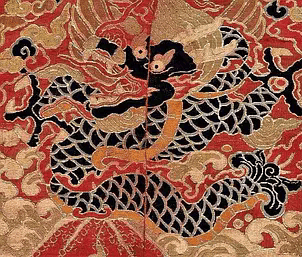
The “flying fish” pattern derives not from an actual fish but from the Wenyao, a mythical winged creature recorded in the Shanhaijing (Classic of Mountains and Seas). The Feiyu motif combines multiple beast features: a dragon head with horns and elongated snout, a serpentine body covered in scales, sharp claws, and most distinctively — a wide carp tail and wing-like fins on both sides of the torso.
Construction and Rank in the Bestowal System
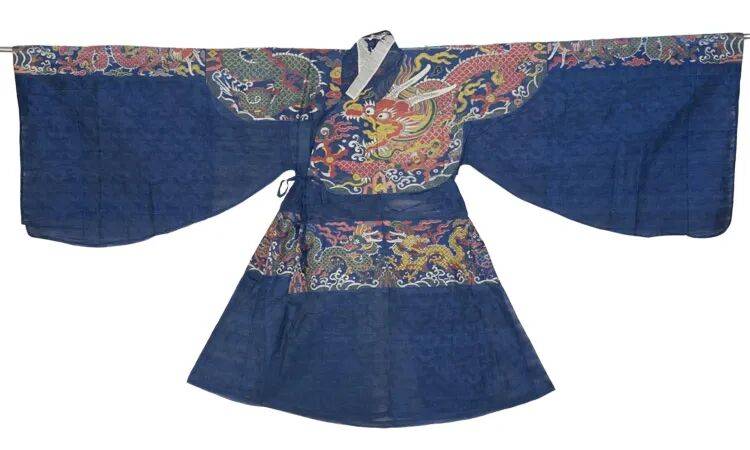
The Feiyu Fu had no fixed cut, but the Yesa style — a tunic with an attached pleated skirt section — was most common. This design allowed the full Feiyu motif on the chest, back, and knees to remain visible while accommodating movement. The Confucius Mansion in Qufu houses a surviving Ming dynasty Feiyu Fu in incense-color hemp fabric. Excavations at a Ming prince’s eunuch tomb in Changde, Hunan also yielded archaeological evidence of a Feiyu award robe.
According to the Ming History — Vehicle and Garment Records, in 1518 CE the Zhengde Emperor conducted a large-scale garment bestowal: first-rank officials received Mang (python) robes, second-rank received Feiyu, third-rank received Douniu, fourth- and fifth-rank received Qilin, and sixth- and seventh-rank received tiger-and-leopard patterns. The Feiyu Fu thus ranked second in the Ming award garment hierarchy, below the Mang robe and above the Douniu.
Feiyu Fu were woven from Yunjin brocade materials — Zhuanghua luo gauze, Zhuanghua sha silk, and Zhuanghua juan silk — placing them among the most technically demanding textiles of Ming China.
The Broader Jinyiwei Wardrobe
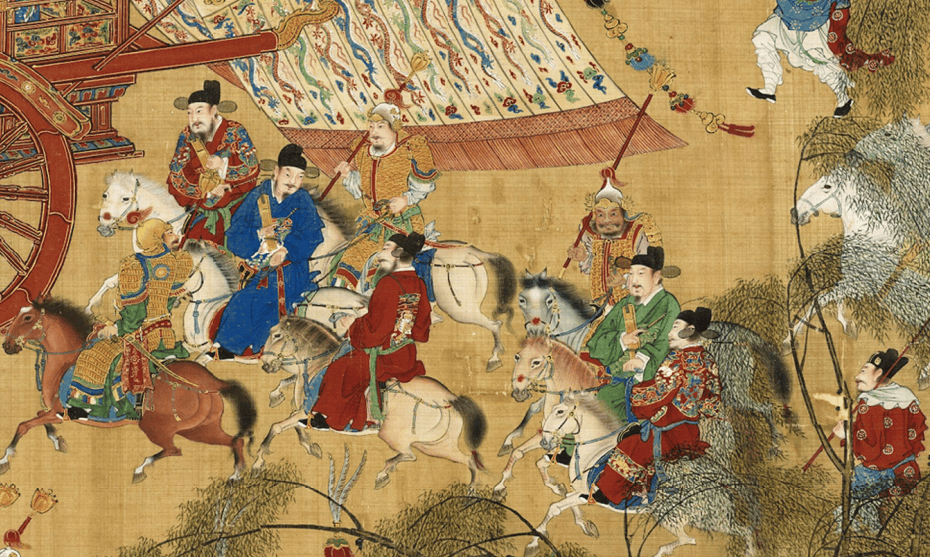
Above the Feiyu Fu sat the Mang robe, whose python (mang) pattern closely resembled the dragon but used four claws instead of five. Below it sat the Douniu robe, whose motif depicted a horned ox-like mythical beast. For daily duties, ranked Jinyiwei officers wore standard cross-collar rank-robes with buzi (rank badges), black gauze caps, and leather belts. Unranked guards wore green-blue robes with soft caps or broad hats. The Ming painting Departure and Entry Procession shows guards in armored vests and phoenix-wing helmets during ceremonial duty.
Popular films such as Brotherhood of Blades reintroduced the Feiyu Fu to contemporary audiences. Modern hanfu designers have begun extracting Feiyu motifs and Jinyiwei silhouette elements into wearable pieces, bridging Ming dynasty ceremonial dress with 21st-century fashion.