
No single garment defined Song dynasty fashion more than the Beizi. Worn by empresses and market vendors alike, this straight-collared, side-slit robe appeared in nearly every scene of daily life across the 300-year dynasty. But the Beizi did not stay the same through those centuries — its silhouette shifted from loose Northern Song casual wear to a fitted, narrow Southern Song statement piece, tracking a broader transformation in Chinese aesthetic sensibility. The Beizi was not merely a garment; it was a marker of class, gender, and evolving taste across two distinct political eras.

Origins
The Beizi traces its earliest form to the Banbi (half-sleeve garment) of the Sui and Tang periods. The Song-era encyclopedia Gujin Shiwen Leiju records: “Beizi originated as a half-sleeve, a warrior’s garment.” Palace guard duty uniforms described in the Zhenghe Wuli Xinyi confirm this — guards wore short-sleeve Beizi over brocade robes. A second origin theory, preserved in Zhu Xi’s Zhuzi Yulei, claims the Beizi began as a servant’s uniform, worn behind the mistress, hence the name (bei = back).
Gao Cheng’s Shiwu Jiyuan (1085 CE) adds technical detail: “In the Daye reign of Sui, palace officials favored half-sleeves, later extended to long sleeves. Emperor Gaozu of Tang shortened the sleeves and called it Banbi — today’s Beizi.” By the time the Song dynasty consolidated power, the garment had settled into its basic form: a straight-collar, open-front robe worn over inner layers.
Northern Song
Early Northern Song Beizi remained a half-sleeve outer layer, worn over a shorter top and floor-length skirt. The Nanjing Changgan Temple underground palace yielded a gold-painted silk robe with bird-and-flower motifs — its cut matches the early Northern Song half-sleeve Beizi described in written records. A painted silk fragment from the Ganzhou Ciyun Pagoda, dated to 1014 CE (the seventh year of the Dazhong Xiangfu reign), confirms the silhouette: the woman painted wears a short top, a high-waist long skirt, and a sheer half-sleeve outer robe over both. The combination of inner and outer layers created a layered look that would define Song fashion for centuries.
By the mid-Northern Song, long-sleeve Beizi appeared alongside the older half-sleeve style. The Fan Tongzhi family tomb excavations yielded stone figurines carved with meticulous fashion detail — female attendants wear long-sleeve Beizi with an uneven front-and-back hemline. The front hem reaches the ankle; the back hem trails to the floor. Sleeves are tailored narrower than the early Northern Song broad profile. Yet contemporaneous murals from the Bai Sha Song tomb in Yuzhou, Henan show women in Beizi with an even hemline. Regional preferences and individual taste produced real variety; Song fashion was not monolithic.
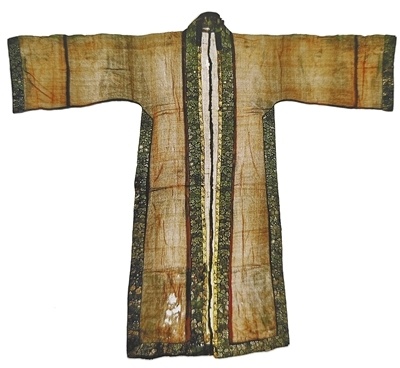
The transition from half-sleeve to long-sleeve did not erase the old look overnight. A Jiyuan Song tomb mural still depicts loose, wide-sleeve Beizi on female figures. The Nanling Iron Crutch Song tomb yielded a physical wide-sleeve Beizi measuring 149 cm in total sleeve span — dramatically larger than the Changgan temple find at 109 cm. Northern Song fashion tolerated multiple coexisting styles, an eclecticism that would give way to stricter norms in the Southern Song.

Southern Song
After the court relocated south of the Yangtze River in 1127 CE, Song aesthetics shifted decisively. The Beizi shed its loose volume and became narrow, fitted, and lightweight. This is the silhouette most people recognize today as “Song-style hanfu.” The change was not merely aesthetic — it reflected a broader turn toward restraint, refinement, and scholarly elegance that defined Southern Song visual culture.
Brick carvings from the tomb of Southern Song general Peng Gao show female musicians in tightly fitted red Beizi, the body skimming close, side slits cut high — nearly identical to the court ladies in the Song of Music painting scroll. The Five Hundred Arhats painting draws a clear class distinction: noblewomen wear floor-length fitted Beizi with narrow sleeves, while maids appear in practical jacket-and-trouser sets. By this point, the Beizi had become a mark of social standing as much as a fashion choice.
The Huang Sheng tomb in Fuzhou offers the most complete Southern Song Beizi archive. Huang Sheng, daughter of a scholar-official and royal in-law, was buried with over 300 silk artifacts, including four Beizi. Measured against her estimated height, the Beizi hemlines fell between 112 and 131 cm — reaching just below the knee. Sleeves followed the wrist closely. Fabrics were predominantly lightweight luo and sha gauze, decorated with woven floral patterns and gold trim. The nearby Chayuan Shan Song tomb produced Beizi of nearly identical proportions, confirming that by the late Southern Song, the garment had standardized into a lightweight, fitted wardrobe staple worn by women across the social spectrum.
Construction Details and Modern Styling
Three structural features define the Beizi: a straight collar worn open at the front — never buttoned or tied closed; long side slits spanning from underarm to hem, allowing freedom of movement; and sleeve width that narrowed progressively from the Northern to Southern Song. Collar trim was often woven or embroidered in a contrasting color, a decorative focal point visible in nearly every surviving portrait.
Fabrics ran to luo gauze, sha silk, and occasionally thin silk with lining for cooler months. Decorative techniques included woven patterns, Suzhou-style embroidery, gold foil stamping, and painted trim — all concentrated on the collar band, sleeve edges, and lower hem. Floral scroll patterns dominated; peony, lotus, and plum blossom motifs appear most frequently in excavated examples.
In modern hanfu styling, the Beizi remains the most popular Song-style piece. The classic layering formula pairs a Beizi outer robe with a crossed-collar inner top and a Baidiequn (hundred-pleat skirt). Color combinations follow the Song principle of “no more than three hues” — moon white, bean green, bamboo green, and lotus root pink are common. Luo and sha fabrics keep summer wear breathable, while brocade and thicker silks work for autumn and winter. The Beizi’s clean lines also make it one of the most accessible entry points for newcomers to hanfu — it requires no complex wrapping or tying, just a straight drape over the shoulders.
The Beizi did not disappear with the Song dynasty. Its straight-collar, side-slit structure directly influenced Ming dynasty women’s jackets and, through tributary networks, Korean jeogori and Ryukyuan court attire. The fundamental concept — an open-front, lightweight robe worn as the outermost layer over skirted clothing — has proven remarkably durable across East Asian fashion history. For modern hanfu enthusiasts, the Beizi represents the Song dynasty’s most accessible and versatile contribution to traditional Chinese clothing.