
The Daxiushan, also known as Dashan or wide-sleeve robe, is one of the most iconic garment types in traditional Han Chinese clothing. It is characterized by sleeve openings without trimmings, exceptionally broad and loose sleeve cuffs, and a relaxed body fit. Originating during the Tang Dynasty (618–907), this garment evolved through the Song and Ming dynasties, transitioning from aristocratic ceremonial wear to official court attire for noblewomen, and has now been revitalized through intangible cultural heritage (ICH) preservation and contemporary design innovation.
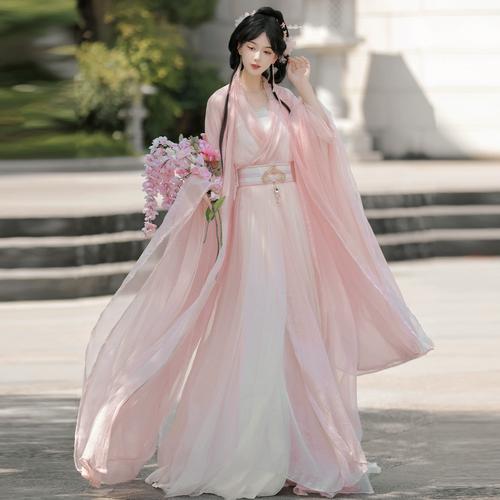
The Evolution of Sleeve Width from High to Late Tang
The Tang Dynasty was the formative period for the Daxiushan. After the High Tang era, women’s clothing grew increasingly voluminous. By the mid-to-late Tang period, sleeve widths could exceed four chi (approximately 133 cm). In 828 CE (the second year of the Taihe reign of Emperor Wenzong of Tang), the emperor issued an edict requiring princesses to wear traditional Han Chinese clothing when attending court, pushing back against the prevailing Hu-style (Central Asian) fashion. Subsequently, voluminous women’s attire surged in popularity, with sleeve and skirt dimensions nearly doubling from early Tang proportions. According to the Xin Tang Shu – Chefu Zhi (New Book of Tang – Vehicle and Garment Regulations), the rank, form, and color of the “Huachai Daxiushan” (floral hairpin wide-sleeve robe) worn by aristocratic women at weddings were strictly regulated.
The renowned Tang poet Bai Juyi captured the opulence of late Tang attire in his poem Liaoling: “Wide-cut sleeves and long skirts, gold-ironed waves and knife-cut patterns. Exotic colors and intricate designs shimmer, shifting side to side like drifting flowers.” Daxiushan garments were made from lightweight, translucent silk gauze, aiming for a “gossamer-thin revealing glossy skin” visual effect. The typical styling involved loosely draping the skirt with the chest partly exposed, with women often wearing only a chest wrap instead of a full undergarment beneath the wide, sheer Daxiushan. This style was usually paired with a high-waisted floor-length skirt, reflecting the open and cosmopolitan social atmosphere of the Tang Dynasty.

Evolution Through Dynasties
The Daxiushan continued to develop during the Song Dynasty, with its form becoming increasingly standardized. Archaeological finds reveal remarkable dimensions: a round-collar plain silk Daxiushan unearthed from the Huangyan Song tomb measures 115 cm in body length, with a full armspan of 230 cm and sleeve width of 95 cm. Wearers often crossed their hands in front of their chests to prevent the massive sleeves from dragging on the ground. The garment was widely used among Song upper-class women as formal attire.
By the Ming Dynasty, the Daxiushan (also called Dashan) had become even more refined. According to the Ming Huidian (Collected Statutes of the Ming Dynasty), the garment featured a straight-collar, duijin (center-front closing) design with side slits, a shorter front hem and a longer back hem — “it lifts when walking and spreads when bowing.” Archaeological evidence confirms this: the plain satin Dashan excavated from the tomb of Lady Wu, wife of Prince Ningjing of Ming, is a straight-collar duijin style with open, untrimmed wide sleeves. The front is shorter while the back hem trails on the ground. When aligned at the front opening, the front hem forms an inverted bud shape, while the back hem is wide in an A-line. Its form inherited the Song-Yuan Beizi and was designated as court attire for noblewomen, worn with Xiapei (a formal sash), continuing through the end of the Ming Dynasty.
The Tang painter Zhou Fang’s classic work Court Ladies Adorning Their Hair with Flowers depicts aristocratic women in sheer long-sleeved garments, representing one of the most iconic artistic presentations of the Daxiushan. Yuan Dynasty figures in the Yongle Temple murals, such as the Pilgrimage to the Supreme Being, also wear wide-sleeved robes. Multiple Song Dynasty tomb excavations have yielded such garments, including five silk wide-sleeve robes from the 1975 excavation of Huang Sheng’s tomb in Fuzhou, two from the 1988 excavation of Madame Zhou’s tomb in De’an, Jiangxi, and one peony-and-lotus patterned silk Daxiushan from the 2003 Huashan Song tomb in Gaochun, Nanjing. The 1986 excavation of Lady Wu’s Ming tomb produced a plain satin Dashan whose form matches the Ming Huidian records exactly.
Luoyang Tang-Style Daxiushan Craft
In the modern era, the Daxiushan has found new life through ICH preservation. The Tang-style Daxiushan making technique has been listed as an intangible cultural heritage item in the Chanhe District of Luoyang, Henan Province, with Zhang Zhixiao as the fourth-generation inheritor. Zhang, who serves as deputy secretary-general of the Luoyang Intangible Cultural Heritage Association, founded the Luoyang Daxiushan Restoration Workshop in the Luoyi Ancient City. Having learned tailoring skills from her family from an early age, she has inherited the traditional Daxiushan cutting techniques and nine traditional stitching methods, while also introducing innovations based on the classic forms.
Zhang’s team spent nearly two years hand-restoring 12 sets of Tang Dynasty costumes from the famous Tang painting Court Ladies Preparing Newly Woven Silk. Their restoration work has appeared on national and provincial media and has been invited to New York’s Times Square, Shanghai’s Yuyuan Garden, the Luoyang Museum, and multiple universities. The Daxiushan ICH workshop has also contributed to rural revitalization, opening a community workshop in the Xusheng neighborhood of Chanhe District where the public can learn these traditional garment-making techniques.
Modern Design Innovation
The Daxiushan form and elements have been incorporated into contemporary fashion design, yielding modern Hanfu-style outerwear. For example, the Bailuyunge 2.0 Daxiushan jacket emphasizes fine embroidery combined with modern tailoring, preserving traditional aesthetics while meeting everyday wear needs. In costume dramas, the Daxiushan frequently appears as a historically accurate restoration element. The television series The Female Judge of the Tang Dynasty featured Daxiushan-style garments, and Donghua University’s Shanghai Textile and Fashion Museum held an exhibition titled “A Thousand Years of Costume Dreams — Tang and Song Costumes in TV Dramas,” displaying drama costumes alongside historically restored garments.
In cultural tourism, the Daxiushan has become a popular choice at Hanfu experience stores and historical scenic spots. At Luoyang’s Luoyi Ancient City, Zhang Zhixiao’s Hanfu experience shop attracts large numbers of visitors. This “Hanfu + cultural tourism” model has driven local economic growth and promoted the everyday popularization of Hanfu culture.
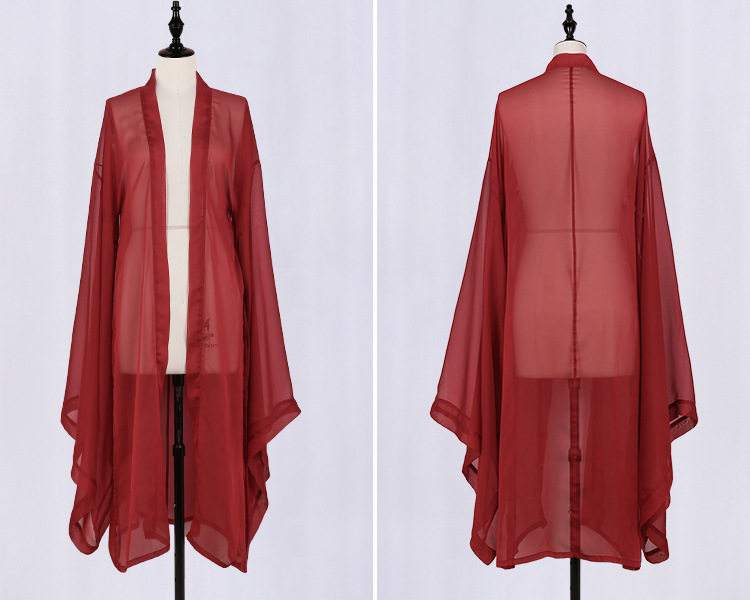
How to Identify Authentic Daxiushan
An authentic Daxiushan should have the following characteristics: sleeve openings without trimmings, extremely wide and open cuffs, a loose body fit, high-quality fabrics such as silk or gauze, and period-specific collar styles — Tang-style versions are typically duijin (center-front closing), Song-style versions come in round-collar and straight-collar types, and Ming-style versions are straight-collar duijin. Tang-style Daxiushan is usually paired with a high-waisted long skirt and Pibo (long silk sash), Song-style with Xiapei, and Ming-style worn as court attire with Xiapei. Consumers should be aware of inferior imitations on the market. The Chanhe District Procuratorate in Luoyang has issued a prosecutorial recommendation to relevant administrative authorities, and the Luoyang Market Supervision Bureau has released a special action notice on intellectual property protection for intangible cultural heritage.
As a key garment form in Hanfu culture, the Daxiushan embodies ancient wisdom and aesthetics. From the splendor of the Tang Dynasty to contemporary ICH preservation, this wide-sleeve robe has traversed over a thousand years, leaving its mark across different eras. It stands as a living testament to the continuity of Chinese civilization.