
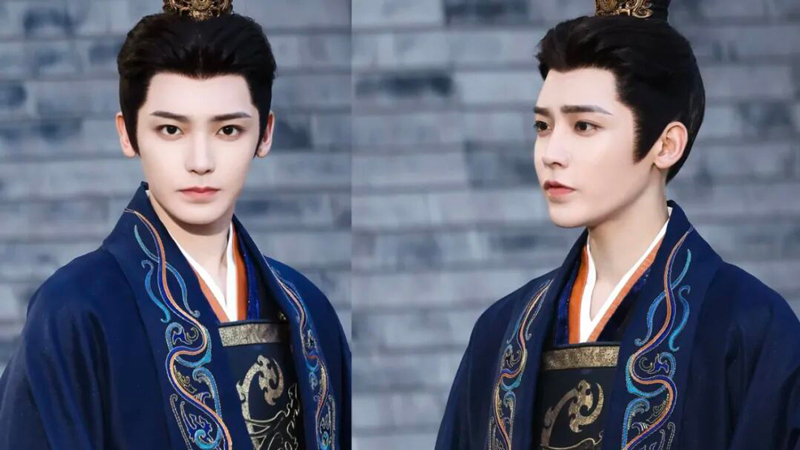
In the period drama Key to the Phoenix Heart (雀骨), actor Hou Minghao appears in court wearing a formal official’s robe. But viewers quickly noticed something strange—a peculiar flap of fabric sitting squarely on his chest, connected by straps over his shoulders. It looked uncannily like a corset. Social media buzzed with a single question: did ancient Chinese men really wear these?
The answer is more fascinating than a simple yes or no. His costume is actually a recreation of a garment known as the Liangdang (裲裆), a unisex piece of clothing that blurs the line between underwear, outerwear, and military armor. To understand why this “chest vest” exists, we have to travel back through centuries of war, fashion, and pragmatic design.
The Great Inner Debate
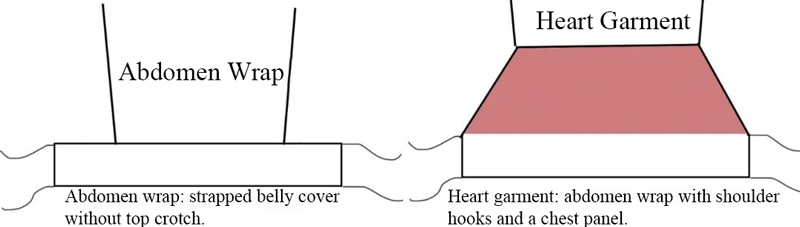
Let’s clarify one thing immediately: ancient Chinese men did not wear what we call a corset. However, they did have undergarments. Depending on the coverage area, these were named differently. A heart garment covered the chest, while a abdomen wrap covered the abdomen. The Liangdang is distinct from these. Its name literally means “one piece for the chest, one for the back,” as recorded in the Han dynasty text Shiming (释名). It consists of two panels of material connected by straps over the shoulders.
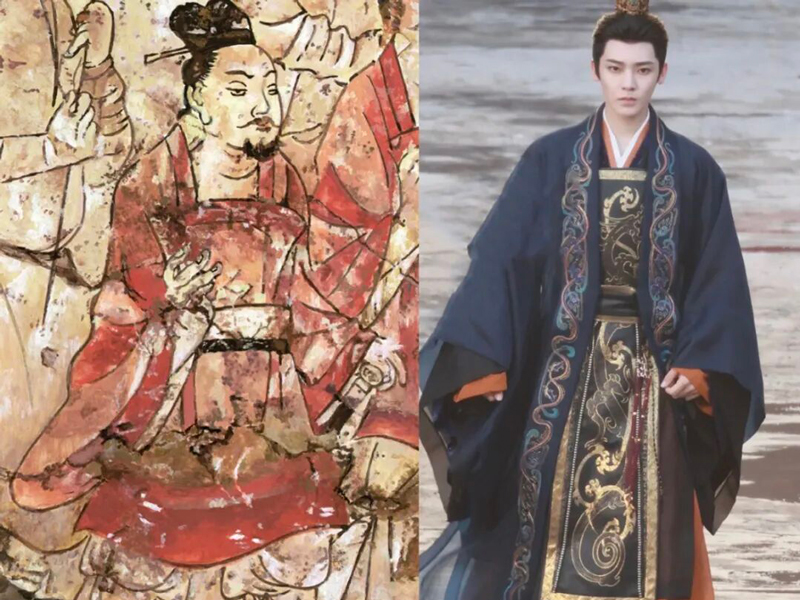
In the show, it is made of soft cloth, worn inside the official robe. This specific iteration served a practical purpose for bureaucrats. It wasn’t about aesthetics; it was a functional layer that protected the stomach from cold drafts and reduced friction against the outer robe when leaning over a desk.
It is important to note that while it looks intimate, the Liangdang was not always an undergarment. Unlike the heart garment that Lin Xue (林雪) wore in the film The Litchi Road (长安的荔枝), the Liangdang was often worn on top of other clothes. It is a square, robust structure that served a different social function, acting as an early form of practical outerwear.
Cloth vs. Iron
This is where the story of the Liangdang gets fascinating. It has a split personality, determined entirely by its material. The first type is the cloth Liangdang, which reached its peak popularity during the Wei and Jin dynasties. It was a universal garment, worn by men and women, rich and poor. Peasants favored hemp and coarse silk for breathability in summer and added silk floss for warmth in winter. Aristocratic women adorned theirs with embroidered flowers and birds, using it as a fashionable inner layer. The terracotta figurines from that era commonly feature the distinctive strap marks on the shoulders.
The second type is the iron Liangdang, which has a much grittier origin story. During the chaotic wars of the late Han dynasty, soldiers needed lightweight protection. Thus, the Liangdang armor was born. It swapped cloth for forged iron plates, replaced cloth straps with leather fastenings, and left the underarms open for mobility. Unlike the cumbersome zhajia (札甲) or sleeve armor, it allowed soldiers to swing swords and draw bows with ease. While cloth and iron share the same structural origin, they lead vastly different lives.
One weighs a mere few ounces and offers warmth; the other weighs up to ten kilograms and offers survival. It is the ultimate study in adaptation. The cloth version is for comfort and propriety, while the iron version is the brutal reality of ancient warfare. They are, in fact, two sides of the same coin, defined by the user’s situation rather than gender or class.
One Shape, Many Uses
The most intelligent feature of the Liangdangis its versatility. In a highly practical approach to design, ancient soldiers often wore both versions simultaneously. They would wear the padded cloth version against the skin, then put the iron armor on top. The cloth layer absorbed sweat and cushioned the impact of blows, a simple yet effective combination of comfort and defense. This approach eliminated the need for separate design systems for civilians and soldiers; the base shape was the same, only the material changed to suit the environment.

As history progressed into the Sui and Tang dynasties, the cloth Liangdang became a standard inner lining for official uniforms. On the battlefield, the iron version was gradually phased out in favor of the more advanced mingguang armor (明光铠), but it survived as a backup for light cavalry. Meanwhile, among the common people, the Liangdang simplified further. Its shape slowly evolved over generations, eventually becoming the modern waistcoat or vest that we recognize today.
So, is the Liangdang underwear or armor? The answer is both, neither, and precisely what the wearer needs it to be. Hou Minghao’s character, Xiao Wuyi (萧无衣), wears it under a robe with a bixi (蔽膝), a traditional knee covering. While it is a product of dramatic recreation, it has succeeded in its cultural mission: it has introduced a forgotten, yet iconic, component of traditional fashion to a modern audience.