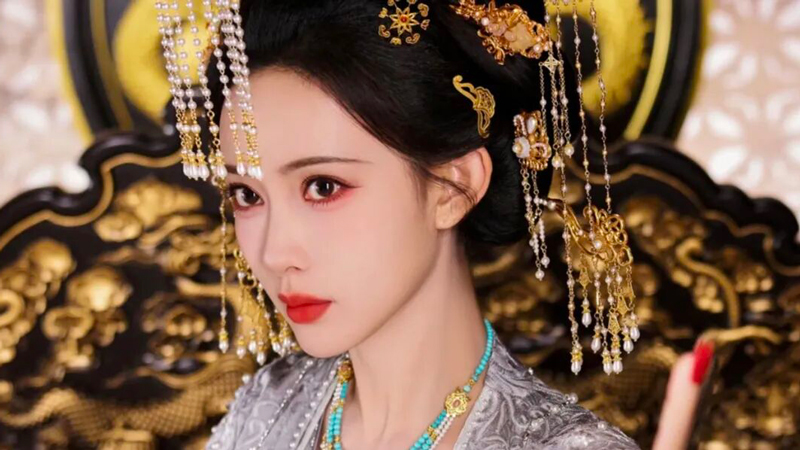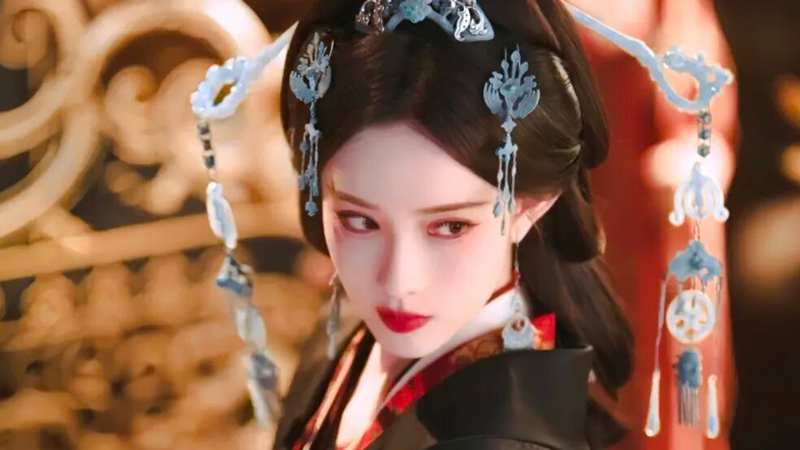
Did Ancient Royals Really Wear That Towering Headpiece? A Look at the Bu Yao (步摇) That Defies Modern Drama Logic. When Meng Ziyi appeared in the historical drama Blossoms of Power (百花杀) wearing an exaggerated headpiece that towered above her coiffure, the internet collectively gasped. The comments section flooded with questions: “Did ancient people actually wear something that ridiculous?” and “I thought the Bu Yao was just a small, delicate hairpin with a few beads that jiggled when you walked?” It is a fair question.
Modern television has conditioned us to view this accessory as the “basic” of ancient hair ornaments—a subtle, tasteful whisper of movement. However, the historical reality is a heavy-metal scream. Particularly during the Han-Wei and Northern and Southern Dynasties, the Bu Yao was not a dainty trinket; it was a monumental piece of wearable architecture. It was a symbol of supreme status, but it also functioned as a physical reminder for the wearer to slow down. To wear it was to be constrained by it; every step had to be deliberate, or risk a catastrophic tangle of gold and jade. It was less about decoration and more about discipline.
The Definition of Movement
The name itself is deceptively simple. “Bu Yao” literally translates to “step and shake,” defining its core function as a kinetic ornament. Unlike a static hairpin whose only job is to hold a bun in place, the Bu Yao was engineered for motion. A simple turn of the head would send ripples of light cascading through the room. The crucial distinction lies in the structure: it has a moveable element suspended from a rigid base. While modern dramas often depict it as a single chain of pearls, the ancient versions were far more complex. The Han dynasty took this concept to a literal extreme, creating what can only be described as a “micro-landscape” for the hair.

During the Jin dynasty, the scale of this headgear was quantifiable. It was not just a female accessory; it was a unisex status symbol among the Xianbei (鲜卑) nobility, worn for both daily and formal occasions. The evidence in museums is stark. The Feng Sufu (冯素弗) tomb, excavated in 1965 in Liaoning, yielded a golden crown that stands 26 centimeters tall. This is not a fragile piece; it is a massive framework of gold branches and suspended leaves. To put that in perspective, the average adult palm is about 18 centimeters long. Imagine that—a solid gold structure nearly the length of your face—wobbling precariously atop a person’s head.
Standards of Extravagance
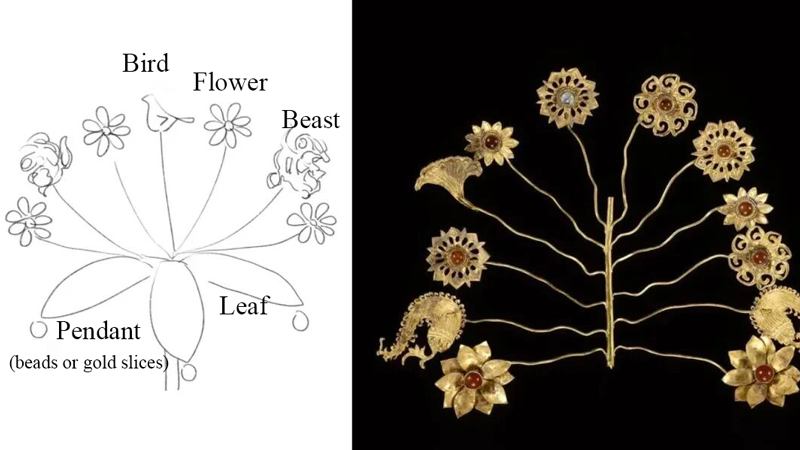
The sheer opulence of the Han and Jin period Bu Yao is not the stuff of poetic license; it is codified in official historical records. The Book of Later Han (后汉书) provides a precise, almost industrial, specification for the empress’s ceremonial attire. The base was a golden “mountain” plate, intertwined with branches of white pearls to simulate a laurel tree. To this framework were added nine golden flowers, one golden sparrow, and six sacred beasts, all colored with jadeite. It was not a piece of jewelry; it was a military-grade display of imperial power, a stark contrast to the tiny bead chains seen on streaming platforms today.
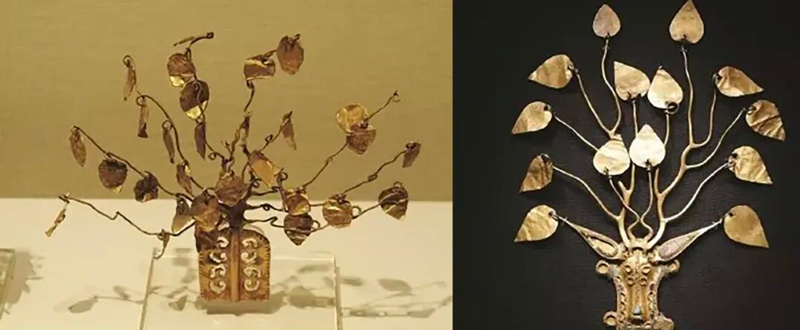
This trend peaked in the Wei and Jin dynasties, where the “exaggeration” became physically measurable and socially regulated. The iconic artifact from the Beipiao (北票) tomb, dating to the Jin dynasty, stands at 27.3 centimeters. It features a cloud-patterned base that splits into sixteen winding branches, each meticulously crafted. This is the “illegal architectural structure” of the ancient world, as modern internet users have aptly joked. The sheer weight and height meant that wearing one was a physical challenge. It required a strong neck just to stay upright, and the fine gold leaves were so delicate that they would sway with the faintest breath, creating a mesmerizing, if not dizzying, effect of shimmering light.
Such magnificent headgear was also a strict symbol of social hierarchy. The Book of Jin records that after the Bu Yao crown became a fashion trend, the court issued an immediate ban. It was decreed that no commoner, regardless of their wealth, could wear such ornaments. It was a highly visible, quantifiable measure of one’s rank. The height, the material, and the craftsmanship were all regulated. To wear it was to broadcast your identity to the world, and to misstep was a serious breach of etiquette. It was a beautiful, burdensome, and brutally exclusive marker of class.
A Return to Balance
By the Tang dynasty, the aesthetic shifted. The era moved away from the “contraband” bulk of the Northern and Southern Dynasties towards a more refined, graceful elegance. The emphasis transitioned from sheer size to fluidity. The massive golden frameworks were replaced by smaller, more delicate structures that complemented the famously towering hairstyles of the period. Ornaments shaped like flowers, phoenixes, and butterflies became popular, often ending in long, slender chains of jade and pearl that hung beside the cheeks or on the temples.
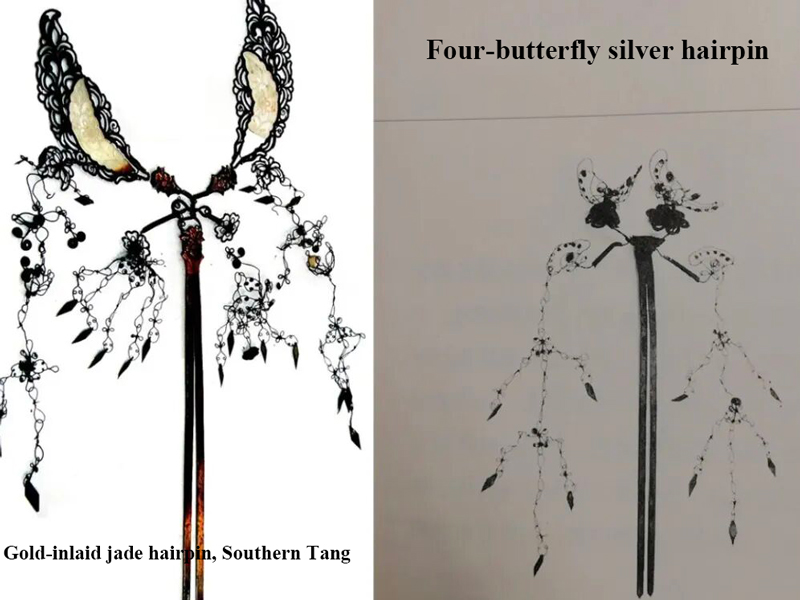
This evolution marked a return to the fundamental meaning of “step and shake.” The movement was no longer a heavy, lumbering sway but a gentle, rhythmic dance. It was an upgrade in comfort without sacrificing luxury. The weight was distributed differently, reducing the strain on the wearer while retaining the visual magic of shimmering gems. It was a perfect synthesis of practicality and aesthetics, a far cry from the neck-straining monuments of the past.
So, when we watch period dramas and mock the “over-the-top” props, we should reconsider. The historical truth is that reality was often more extravagant than fiction. The Bu Yao was never a simple “little decoration.” It was a complex intersection of craftsmanship, status, and even physical discipline. It was a statement—not of fashion, but of power. Next time you see a small, delicate pin in a drama and think it is accurate, remember the 27-centimeter gold and jade structure that once made empresses and nobles move with grave, deliberate, and utterly breathtaking grace.