
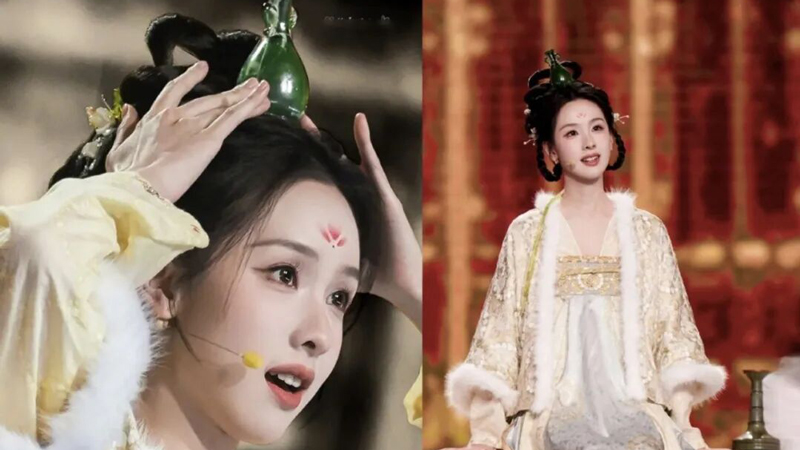
Chen Duling (陈都灵) recently appeared on a Chinese television program dressed as a broken, nameless artifact. She played a Tang Dynasty (唐代) jade glass ewer from the Palace Museum. The relic was so damaged it had no name, only the code 3054. Her performance, paired with the host’s historical explanation, moved the audience to tears. The question is not just about an actress in a costume, but about a nation’s painful history of loss and the battle to reclaim its identity. Why did this simple act of dressing up become such a powerful symbol?
The Weight of a Name
The power of the performance lay in its detail. On the show, Chen Duling wore a traditional chest-high ruqun (齐胸衫裙) and a duijin piao (对襟披袄). Her forehead was decorated with a Tang-style huadian (唐风花钿). The soft, fluffy texture of her costume and her innocent acting made her look like a relic that had been “well protected.” But the irony was sharp. The pearl roundel patternson her clothes are a symbol of cultural fusion, reflecting the Silk Road’s influence. Even her hairstyle, the huanji (鬟髻), mimicked the ewer’s double handles. She was a walking, breathing artifact.
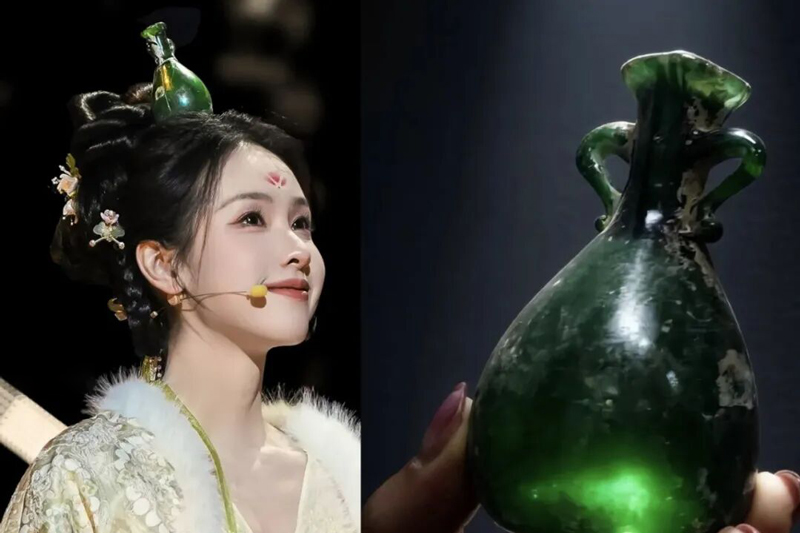
Her most heartbreaking line was, “I was once locked in a dark box, drifting from place to place.” It was a simple statement. Yet it triggered a deep emotional response because it was rooted in truth. The artifact she represented had indeed been displaced. It spent eight long years moving with the Palace Museum collection to escape war. This historical fact, explained by host Ni Ping (倪萍), transformed a costume into a witness of history. The audience was not just seeing an actress; they were seeing the spirit of an object that had endured unimaginable hardship.
This moment forced a reckoning. It made people ask: How many more artifacts, like this fragile bottle, have stories just as painful? The “jade glass” itself is a metaphor. In Chinese, its pronunciation is a homophone for “displaced” The name of the material embodies its fate. When Chen Duling asked a restorer, “What kind of relic takes generations to repair?” the reply was simple: “It is their mission.” It is a mission to give a voice to objects that cannot speak for themselves.
From the Silk Road to a Dark Box
The history of “jade glass” is a history of global connection and national sorrow. The term first appeared in the Discourses on Salt and Iron (盐铁论) from the Western Han Dynasty (西汉), where it was listed alongside jade and coral as a national treasure. It is not a single material but a category of opaque or translucent glass. The technology likely originated in West Asia and traveled along the Silk Road, becoming a testament to cultural exchange. By the Warring States period, China had its own glassware. We even have relics to prove it.
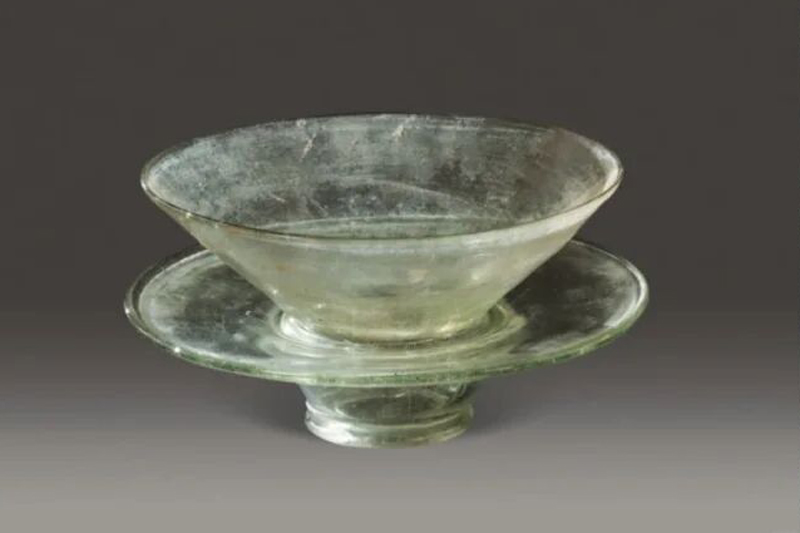
Through innovation, China developed its own lead-barium glass, a high-quality product. The Famen Temple underground palace, for instance, has yielded over twenty pieces of these glass artifacts. It shows how this foreign technique was adapted and evolved in the Central Plains. This is a story of cultural appropriation in the best sense—taking something from abroad and making it distinctly Chinese. It is proof of a civilization that has always been open to the world, absorbing new ideas while maintaining its core identity.
However, the story of the ewer is a stark contrast to this history of exchange. It shows the fragility of cultural preservation. In 1933, to protect the Palace Museum collection from war, a group of guardians began a long journey from north to south. They protected the artifacts for fourteen years. The ewer was one of the lucky ones. It survived. But its 8-year journey and the 14-year protection project were a painful reminder that even when artifacts are safe, their very existence is a testament to trauma. It highlights the fragility of peace and the immense cost of war.
The Guardians of Memory
Huang Jue’s (黄觉) comment, “You look like you’ve been well protected,” is a heart-wrenching understatement. It encapsulates the collective trauma of a nation. It speaks to generations of hardship and the immense effort it takes to preserve a culture. The actor’s costume, which looked so beautiful and serene on stage, was a mask for a history of suffering. The audience’s tears were not just for an actress or a relic; they were for the generations of keepers who sacrificed their safety to protect these treasures.

The story of this artifact on television directly led to thoughts of other lost treasures. Viewers began to share memories of seeing artifacts in foreign museums, like the famous small green pot now held in the British Museum. These items remain “homeless.” One viewer’s comment was particularly poignant: “I saw it as a child, and it was still there when I grew up.” This simple sentence asks a question that has no easy answer: When will these cultural relics come home? The question shows that the protection of culture is not just about physical repair but about returning pieces of the national soul to their rightful place.
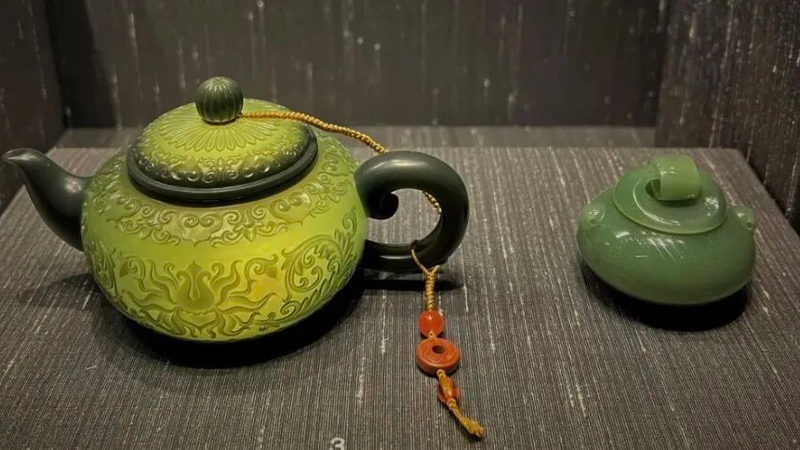
Finally, Chen Duling’s question to the restorer was the climax. It underlined the concept of a legacy of mission. The restorer’s answer was not about individual genius, but about a collective, generational duty. This is the true heart of cultural preservation. It is not a single act but a continuous process. It is a promise to the past and a gift to the future. The true protection of a culture does not lie just in the museum vaults. It resides in the hearts of the people. As long as we remember, these artifacts are not just objects; they are living witnesses to our shared history.