

When a global luxury titan takes the country’s top trademark authority to court, the public often expects a David-versus-Goliath spectacle. Yet the upcoming hearing between Louis Vuitton and the China National Intellectual Property Administration (CNIPA, 国家知识产权局) scheduled for July 16, 2026, reveals a more routine—yet equally fascinating—legal reality.
This is not a reckless brand rebellion but a calculated administrative appeal that could reshape how we view traditional patterns in modern commerce. The case, filed by Louis Vuitton Malletier against the CNIPA, with a Guangdong garment worker named Huang Minyao listed as the third party, seems to have emerged from a simmering debate over who truly owns the visual symbols of a culture.
Can a Brand Really Sue the Government?
At first glance, taking a state administrative body to court appears audacious, but in the realm of intellectual property, it is a standard procedure. Under Chinese administrative and trademark law, if a trademark owner disagrees with the CNIPA’s decision—such as upholding a rival’s trademark registration—they have a statutory right to seek judicial review. This is exactly what LV is doing: appealing to the Beijing Intellectual Property Court to overturn or modify the administration’s previous ruling. It is a legal pathway, not a confrontation.
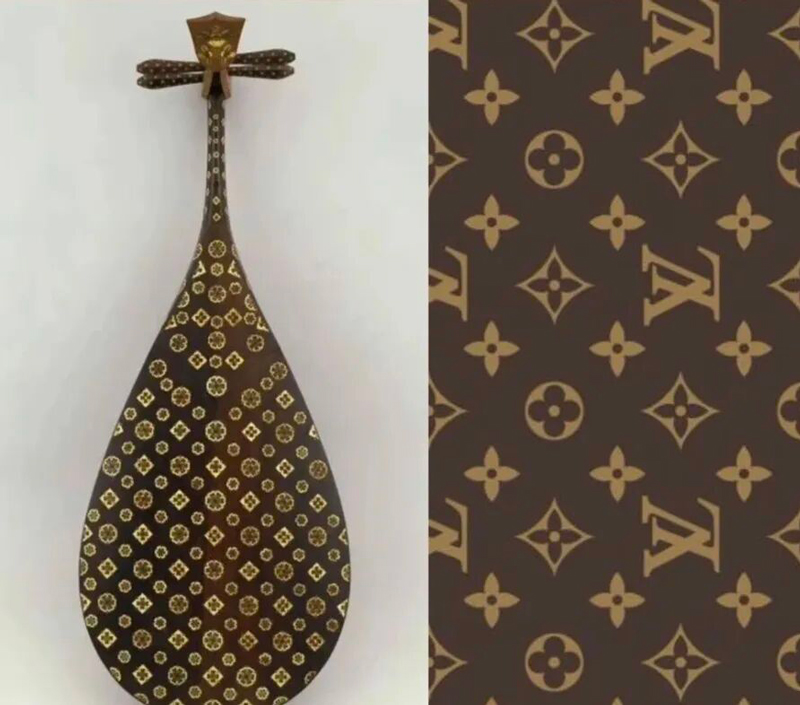
The confusion in public perception often stems from conflating this administrative lawsuit with the brand’s concurrent civil litigation against the trendy tea brand Molly Tea. The CNIPA lawsuit was officially published months earlier, but it is the impending court date that has reignited public outrage online. The issue is not the legal procedure itself—which is a standard corporate tactic to defend trademark exclusivity—but the deep-seated cultural anxiety it triggers about who has the right to use designs rooted in shared history.
For LV, this is simply about tightening the net around its commercial identity. The company wants to ensure that no other business can get too close to its iconic graphic layout. Yet, for the everyday observer, the move feels like an overreach of corporate power over public heritage, especially when it occurs alongside the much-publicized infringement claims against smaller domestic brands.
The Real Battle Over a Floral Pattern
The core of the conflict is not the lawsuit’s technicalities but the origin of the disputed imagery. The classic LV Monogram, particularly its four-pointed flower motif, is widely traced back to traditional Chinese decorative patterns such as the Bao Xiang Hua (宝相花) and persimmon calyx. These are patterns found on Dunhuang (敦煌) murals, ancient brocades, and historic artifacts—treasures considered part of the global public domain. The brand’s take on it, while creatively commercialized, is perceived by many as a privatization of a collective visual language.

Because the brand registered this combined pattern as a trademark decades ago, it now holds the legal right to pursue enforcement. However, the law makes a critical distinction: it protects the specific combination and arrangement of these elements that have gained distinctiveness through commercial use, not the individual traditional motifs themselves. This means a brand can own its specific floral layout, but it cannot claim ownership of the fundamental, centuries-old petal or leaf shapes that appear in Chinese art.
This distinction is why a Hangzhou cultural brand that used a simple, standalone Bao Xiang Hua pattern was previously cleared of infringement—it did not replicate LV’s specific arrangement of letters and shapes. The ongoing legal tussle is therefore a high-stakes negotiation on where this boundary lies. LV is pushing to broaden its exclusive territory, pressuring the CNIPA to adopt stricter examination standards that would leave less room for domestic brands to use similar traditional motifs without triggering infringement claims.
Who Owns the Public Heritage?
Questions often arise about whether foreign brands are uniquely favored or targeted in China. The answer is clear: LV is not alone. The history of administrative litigation in China includes many foreign entities. A classic example is the Dior perfume bottle case, where the French luxury house fought a lengthy legal battle to protect its three-dimensional bottle design in China. It lost at the initial and review stages but eventually won recognition for the shape’s distinctiveness at the Beijing High People’s Court, completing the standard judicial review cycle for foreign companies.

This points to the real issue: this is not about special treatment but about the evolution of legal standards. How does the system differentiate between a protected private trademark and a free public cultural resource? The upcoming trial in the LV case will be a crucial test for how China’s intellectual property system handles this tension. The legal community is watching closely for refinements in the criteria for “similar patterns,” seeking a clearer demarcation line between traditional public ornamentation and brand-exclusive graphics.
Ultimately, the controversy goes far beyond one brand’s litigation strategy. It forces a broader societal reflection on how we can preserve the legacy of traditional culture while fostering a healthy, competitive market. The challenge is to craft rules that prevent a single commercial entity from monopolizing symbols that have been a shared heritage for a thousand years. This is about balancing legal rights with cultural sentiment, ensuring that tradition remains a source of inspiration for everyone, not a legal landmine for the unwary. The real judgment will not be the one handed down by the court, but the one formed in the court of public opinion on how a society values its own visual memory.
What’s interesting is that when you compare the designs on the historical artifact (pipa?) to the LV patterns, even the colours match.
Exactly, the resemblance is undeniable.