
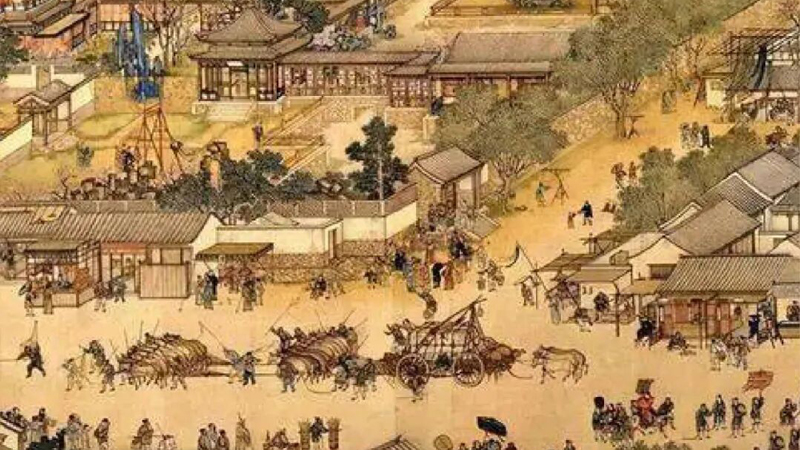
You know the drill: dial 119, and within minutes, red trucks scream down the street with firefighters in full gear. But what if you lived in ancient China? Would anyone come to save your thatched roof from a stray spark? The surprising answer is yes—though they didn’t call it a fire brigade. They called it fire governance, and it dates back over three millennia.
Long before the word “fire” became a borrowed term from Japan in the early 20th century, Chinese dynasties had already built sophisticated systems to watch, warn, and extinguish. From watchtowers that never slept to water-squirting bamboo pumps, the ancestors of today’s firefighters were more organized than you might imagine. This is the story of how ancient China mastered the flame—without a single siren.

Early Fire Stewards
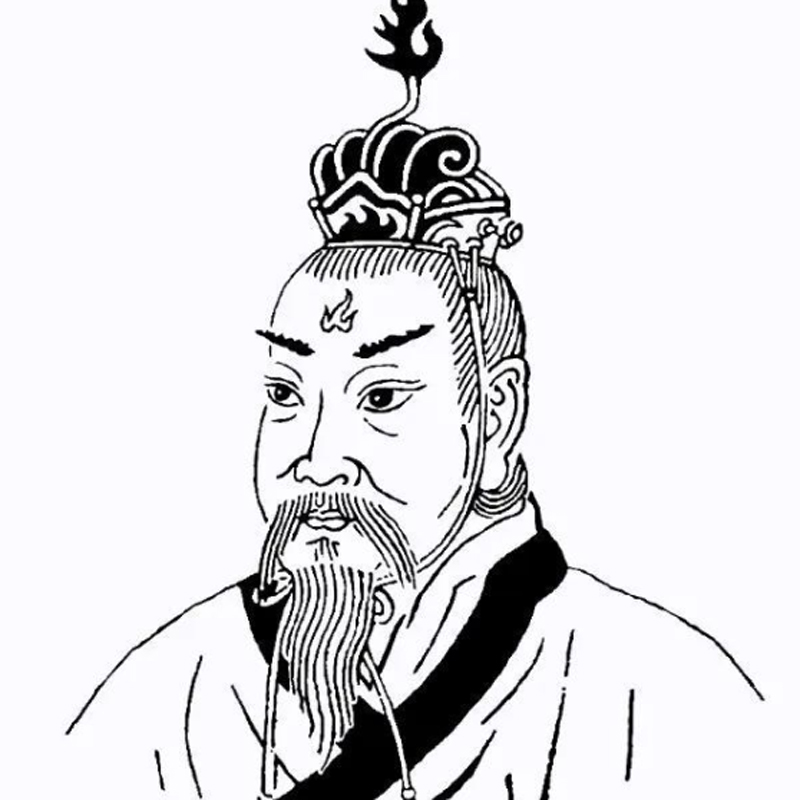
The roots of fire control run deep into China’s earliest records. During the Zhou Dynasty (c. 1046–256 BCE), the Rites of Zhou (周礼) already named specific officials for fire duties—the Si Guan (司爟) and Si Xuan (司烜)—who not only fought fires but also regulated seasonal firewood rituals. Even earlier, the legendary Yellow Emperor supposedly appointed a “fire officer” to manage domestic flames. These were not part-time volunteers; they were state-appointed stewards with clear responsibilities.
By the Han Dynasty, the capital’s security and fire control fell under the Zhi Jin Wu (执金吾), a high-ranking official who commanded a network of street pavilions called Jie Ting (街亭) for localized patrols. This early framework proved that fire prevention was never an afterthought—it was a pillar of imperial governance. The idea of a centralized fire authority, though primitive, had taken root more than two thousand years ago.
What drove this ancient obsession? Wooden cities, crowded markets, and the simple truth that a single candle could erase a neighborhood. So they built rules, appointed watchers, and prepared for the worst—because in a world without insurance, prevention was the only policy.

Tang’s Urban Watch
When Chang’an became the world’s largest metropolis in the Tang Dynasty, with over a million residents, fire safety turned into a logistical nightmare. The solution was the Wuhou Pu (武候铺)—a citywide network of police-fire posts. Large city gates hosted 100 guards, major wards had 30, smaller gates 20, and minor alleys 5. This patchwork of watchmen formed a dense surveillance grid that covered every corner of the capital.
Their gear was surprisingly advanced. The star tool was the Jian Tong (溅筒)—a bamboo tube over three meters long, with joints removed and a leather water bag attached. Fill it, squeeze hard, and water shot out like a primitive pressure washer, reaching high flames and distant roofs. It was the ancient equivalent of a fire hose, and it worked.
Yet Chang’an never saw a catastrophic blaze. Why? The city’s rigid ward-and-market system enclosed residential blocks and commercial zones with high walls, so fires couldn’t jump from one ward to another. Add a humid climate and ample rainfall, and the Tang had no urgent need for a full-time fire force. Their system was effective—but still a part-time gig.

Song’s Professional Turn
The Song Dynasty changed everything. As cities swelled with merchants, migrants, and wooden tenements, fires became a weekly terror. In Hangzhou alone, records show devastating conflagrations almost every year, with four separate fires each destroying over 10,000 homes. The old part-time wardens could no longer cope. The demand for a dedicated, professional fire brigade had never been more desperate—and the Song delivered.
They created the world’s first known public, professional firefighting corps. No longer were these soldiers pulled from other duties; they were trained, equipped, and stationed specifically for fire response. This shift from “fire as a side job” to “fire as a career” marked a turning point in urban safety. The Song didn’t just improve tools—they reinvented the entire concept of fire service.
Why did it happen here? Because Song China was the most urbanized society on earth at the time. With density came risk, and with risk came innovation. The professional firefighter was born not out of theory, but out of sheer necessity—and the streets of Hangzhou and Kaifeng (开封) became the testing ground for a model that would influence generations.

Northern Song Watchtowers
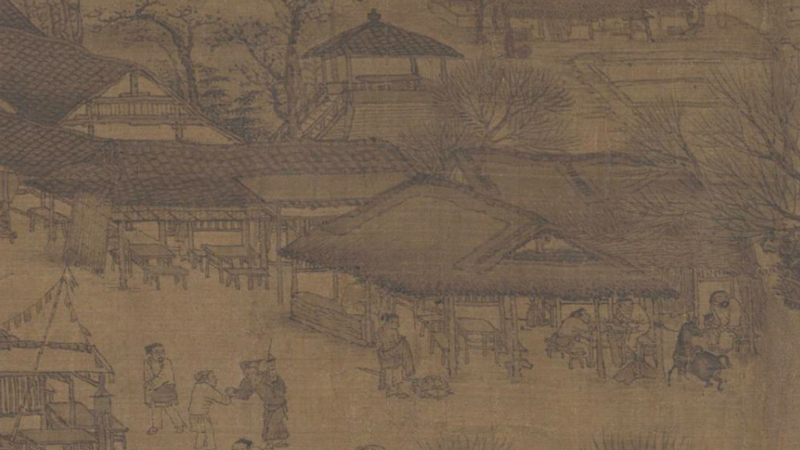
According to the Dreams of the Eastern Capital (东京梦华录), Kaifeng placed a Junxun Pu (军巡铺) every 360 meters along its main streets. Each post had five Pu Bing (铺兵) who patrolled at night. But the real innovation was the Wanghuo Lou (望火楼)—a wooden tower about 16 meters high (roughly five stories) with round-the-clock lookouts. Below each tower, a garrison of over 100 soldiers stood ready with buckets, axes, ladders, ropes, and iron hooks.
When a lookout spotted smoke, he signaled instantly—daytime with flags, nighttime with lanterns—and the Qianhuo Bing (潜火兵) rushed to the scene. The rule was simple: extinguish before civilians even knew there was a fire. One famous anecdote tells of Di Qing (狄青), a top general during Emperor Renzong’s (宋仁宗) reign, who held a nighttime ritual with hundreds of candles at his mansion. The watchtower lookout mistook the glow for a blaze, alerted the ward chief and the mayor, and a full company of firefighters descended on Di’s gate—only to find a peaceful ceremony. The sheer speed of that response tells you everything about their efficiency.
This system was the blueprint for modern fire stations—centralized observation, rapid dispatch, and specialized teams. The Northern Song didn’t just fight fires; they anticipated them, turning passive reaction into active surveillance.

Southern Song Elites
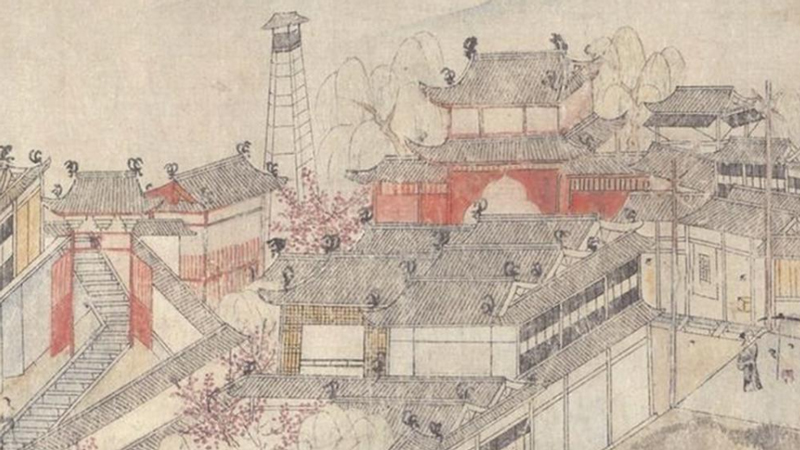
After the fall of the north, the Southern Song relocated to Lin’an (临安, today’s Hangzhou), where tightly packed wooden houses and narrow alleys made fire a constant companion. The court responded by dividing the city into 23 fire districts called Yu (隅) or Huo Yu (火隅). Each district housed 100 to several hundred Qianhuo Bing—full-time fire soldiers. Every Yu had its own watchtower, with coded flag and lantern signals to indicate the exact direction of the fire.
Beyond the districts, Lin’an stationed additional patrol posts every 200 meters in commercial zones, each with three to five night guards. But the crown jewel was the seven mobile reserve teams under the city’s direct command: the water squad, the construction squad, the guard squad, and four numbered strike teams. Each had 100–200 members, specializing in different tasks—some pumped water, others set up ladders or demolished buildings. There was even an elite unit of 300 imperial guards trained as firefighters—think of them as the SWAT team of fire control.
By rough estimates, Lin’an—a city of over a million—employed 5,000 to 6,000 fire officers. That’s a ratio that would impress any modern metropolis. The Song had turned firefighting into a massive, disciplined, and highly specialized public service.

Ming and Qing Guards
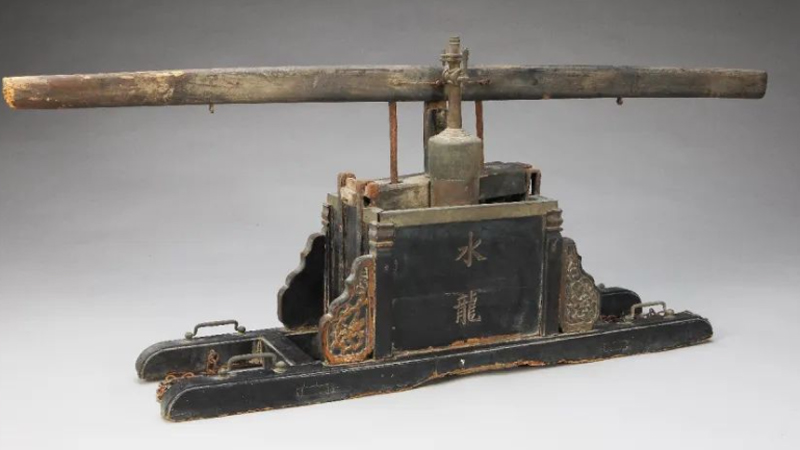
The Ming Dynasty carried the torch forward. In Beijing, they established 112 Hongpu (红铺) fire posts, each with ten soldiers. Provincial cities also formed their own Huo Bing (火兵) units. But the Qing Dynasty took it a step further inside the Forbidden City itself. In the early Shunzhi (顺治) period, the Eight Banners Fire Squads were created—eight stations, each manned by Manchu, Han, and Mongol banners, with 91 soldiers per banner. When a fire broke out, half fought it while the other half guarded the palace.
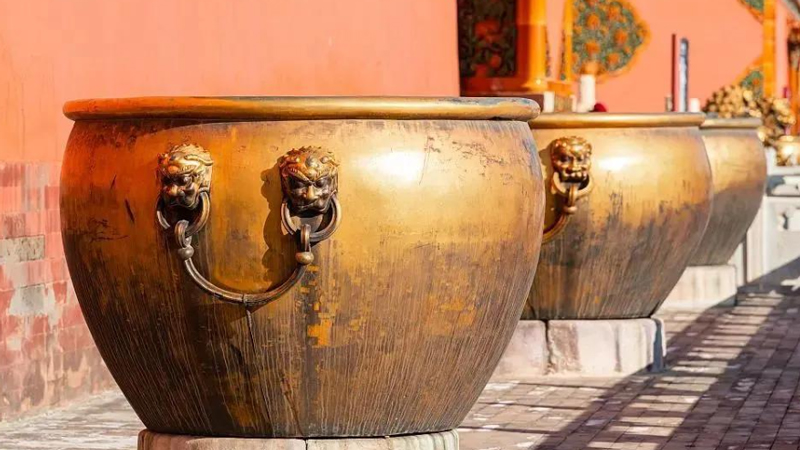
The Forbidden City also featured massive bronze water vats called Taiping Gang (太平缸) or “gate seas,” each holding over 3,000 liters of water. In winter, they were covered and even heated with charcoal to prevent freezing. These vats were the empire’s most visible firefighting icons—still standing today as silent witnesses to centuries of vigilance.
In 1902, the Qing government established the Tianjin Southern Patrol Fire Brigade—China’s first modern fire department, complete with Western equipment and organization. That moment closed the ancient chapter and opened a new one, but the legacy of the old systems never faded.

Firefighting Tools
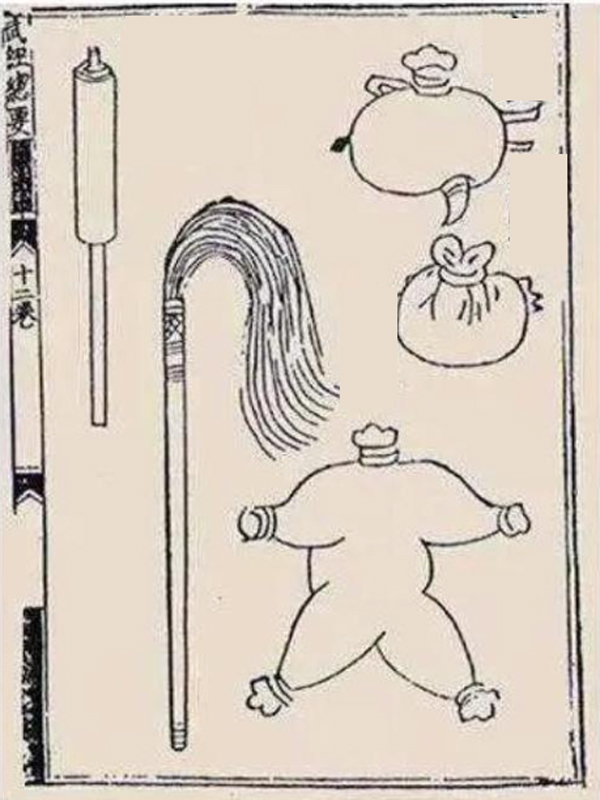
Without engines or hoses, how did they actually put out fires? The first line of defense was the watchtower-plus-patrol network—a 24/7 early warning system that mimicked today’s fire stations. Once alerted, the Qianhuo Bing grabbed their arsenal. The Shui Nang (水囊) was a leather or oilcloth bag filled with water—throw it at the blaze, and it burst on impact. More sophisticated was the Ji Tong (唧筒), a bamboo pump that used human force to push a piston and shoot a stream of water—exactly the same principle as a modern fire pump.
For stopping fire spread, they used the Ma Da (麻搭)—an eight-foot bamboo pole wrapped with hemp, dipped in mud, and slapped onto nearby walls or beams to create a fire-resistant barrier. If flames grew too fierce, they resorted to demolition: axes, saws, ropes, and iron hooks tore down buildings in the fire’s path to create an empty gap—the classic firebreak tactic. Remarkably, the Song code even allowed homeowners to claim compensation from the government if their houses were razed for firefighting purposes.
And don’t forget the Taiping Gang—those enormous bronze vats that dotted the Forbidden City. They were not decorative; they were emergency reservoirs, placed strategically so that no one had to run far for water. From mud-soaked hemp to pressurized bamboo, ancient firefighters improvised, adapted, and saved countless lives. Their tools may seem crude, but their logic—surveillance, rapid response, containment, and compassion—remains the bedrock of fire safety today.