
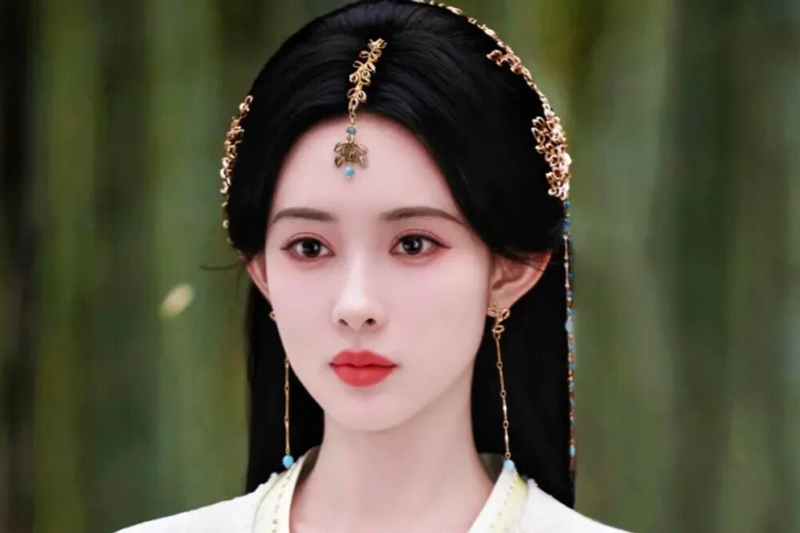
Maang Tikka (印度传统眉心坠) in every period drama – has Chinese costume design lost its own roots? From Blossoms of Power (百花杀) to countless Xinjiang (新疆) bridal photos, that dangling forehead pendant keeps popping up. But here is the uncomfortable question: why does a sacred Indian bridal ornament now define “exotic” for every Hunnu warrior, Sogdian trader, and Uyghur dancer on Chinese screens? The answer is not about beauty – it is about a lazy, profit-driven shortcut that erases millennia of real diversity. And it is time we called it out.
One Pendant, Many Lies
That long chain parting the hair, with a single jewel hovering between the brows – it has a proper name: Maang Tikka. In India, it is never just a decoration. It is tied to religious rituals, weddings, and the belief that the forehead centre holds wisdom and spirit. It has a complete, independent cultural system. Yet in Chinese dramas, it gets slapped onto every “foreign” female character – whether she is a Persian dancer, a Huihe (回鹘) whirler, or a steppe nomad. Costume designers rarely consult historical records. They do not distinguish between Northern Asian, Central Asian oasis, or West Asian civilisations. So they grab the one thing audiences recognise – that Indian-style chain – and call it a day.

Worse, this mistake has spread beyond TV. It now infests ethnic minority photoshoots, wedding gowns for Uyghur couples, Tibetan inspired studio portraits, and even Hui (回族) bridal looks. Many young people genuinely believe that ancient Western Regions women wore bare-shoulder wrap skirts and forehead danglers. That is not a small error – it is a cultural memory hijack. Real archaeology tells a very different story.
Facts Buried in Dust
Let us start with the Hunnu nobles. Excavated tombs show their headpieces were sewn firmly onto crown-like caps – sturdy, practical for horseback life, adorned with jadeite beads, but never dangling down the middle part. Their famous step-shakes and geometric patterns share roots with Scythian and Sarmatian steppe civilisations, not with South Asian temple jewellery.
Meanwhile, Sogdian murals in Dunhuang (敦煌) caves depict fitted front-button robes and structured silhouettes. Uyghur noblewomen wore turn-down collar brocade gowns, with pillar-shaped or peach-shaped crowns, and silk ribbons trailing behind – no forehead chain. Persian attire favoured round-collar long robes, turbans, or pointed hats. None of them used that single vertical pendant.
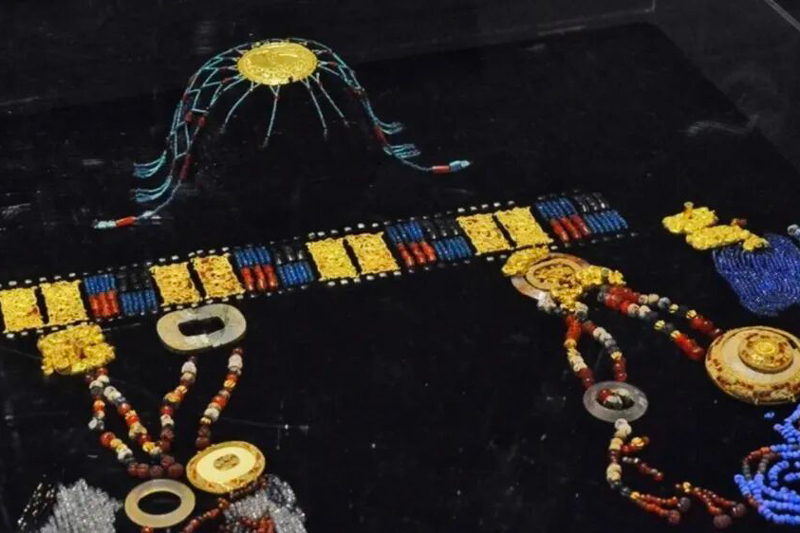
What about ancient Han (汉) Chinese women? From Song (宋) to Ming (明) dynasties, they did wear forehead ornaments – but these were pearl tassels called “golden comb curtains” or “surrounding buns”, pinned along the hairline, at the temples, or around the back bun. Never did they split the top parting with a single drop. Check any major Chinese museum – not one unearthed piece matches the TV version. So where did that ubiquitous chain come from? It is purely modern invention, copied from Bollywood clichés and sold as “ancient exotic charm”.
Why Greed Wins Over History
The real culprit is not ignorance – it is economics. Costume rental shops, photo studios, and drama production teams all want cheap, flashy, instantly recognisable “ethnic flair”. Making authentic Hunnu headgear or Sogdian crowns requires research, skilled craftsmanship, and time – none of which fits a tight budget or a 10-day shoot. So they order mass-produced Maang Tikka from online suppliers, pair it with a sheer dupatta and a choli-style top, and call it “Western Regions style”. Audiences have seen it in a hundred dramas, so they accept it without question. The cycle feeds itself: AI models trained on these images now generate more “authentic” ethnic looks that are pure fantasy.
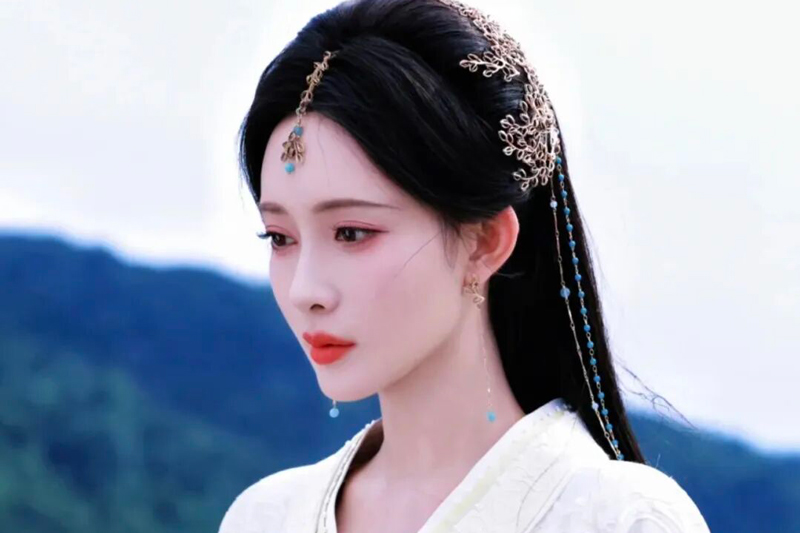
Some defenders point to Peking opera or period-film headdresses as precedent. But those are stage art – exaggerated for visibility, not historical documentation. Even then, they are rooted in real ceremonial jewellery. The modern Maang Tikka has no such root. It is a cultural transplant with no passport. And when it gets used for Xinjiang wedding photos or Tibetan studio portraits, it does real harm. It flattens dozens of distinct traditions into one homogenised “Indian-lite” stereotype. Young people growing up with these images will genuinely believe their own ancestors looked like that – a form of self-erasure more damaging than any outside misrepresentation.
The solution is boring but necessary: go back to primary sources. Read Dunhuang mural records, study Astana (阿斯塔那) tomb textiles, examine Khitan and Jurchen metalwork. The diversity is staggering – and far more photogenic than that tired chain. Real beauty lies in accuracy, not in lazy fusion. We are a multi-ethnic nation with millennia of cross-cultural exchange, but exchange is not replacement. Respect means knowing the difference. Next time you see that forehead dangler, ask: whose story is it really telling? And why are we so afraid to tell our own?