

p>The latest episode of the Xianxia (仙侠) drama The Eternal Fragrance (千香) has finally landed, and for anyone who suffered through the anxiety of yesterday’s preview, it delivers one massive sigh of relief. The promotional clip that sent the fandom into a frenzy—showing the male lead seemingly slaughtering the heroine’s master—turned out to be nothing more than a cleverly edited piece of misdirection.
Episode 19 is a chaotic, multi-layered narrative that deliberately disorients the viewer, only to pull the rug out from under our expectations in the most satisfying way. It dares to ask: are we watching reality, or are we simply drowning in the projections of our own deepest fears?
The Fog of War
The storytelling in this episode mirrors the very affliction that plagues its characters. A mysterious miasma sweeps through the sect, trapping disciples in their own personal dreamscapes where their most obsessive desires or regrets play out in excruciating detail. The plotline is anything but linear. It jumps from Jiang Lifei’s (姜黎非) desperate search for her lost master to Ji Tongzhou’s (纪桐周) fantasy of marrying her, with other disciples caught in their own loops of suffering. For the first time, the viewer is forced to navigate this labyrinth without a guide, making it feel like a genuine descent into psychological chaos rather than a simple television plot.

It was a bold choice to use this structural disorder to mirror thematic depth. The showrunners intentionally make us feel the same panic that the characters feel. We are not given a clear anchor, so we latch onto the most dramatic moments—like the so-called “master murder”—only to discover that it’s a projection of the heroine’s worst nightmare. She is so terrified of her mentor’s fate that her mind conjures the worst possible outcome, and the preview used that fear against the audience. This approach effectively weaponizes the audience’s own anticipation, making the eventual reveal that it was all a fantasy infinitely more relieving.
Yet, this reliance on visual chaos is also a critique of the characters’ internal states. The stronger the obsession, the more difficult it is to break free. This is not just a test of power, but of emotional resolve. While the technique provides a rich tapestry for character development, one can’t help but wonder if the show is leaning too heavily on the “it was all a dream” trope to resolve conflict. It is a get-out-of-jail-free card, but in this context, it serves the narrative because it directly ties into the core theme of perception versus reality.
Love in the Ruins
Amidst the emotional wreckage of the dreamscape, the relationship between Lei Xiuyuan and Jiang Lifei emerges as the unexpected anchor of sanity. When the black mist forces him to switch into his “big boss” alter-ego, he loses all sense of reason and nearly turns on her. It is a terrifying moment that solidifies the fragility of his condition. However, Jiang Lifei’s reaction is what truly elevates this scene. Instead of running away or preparing for a fight, she stands her ground, calling his name over and over until he returns to his senses. Her optimism and unwavering faith act as the antidote to the poison of the miasma.

The aftermath of this crisis is where the episode shines brightest. Jiang Lifei does not interrogate him about his identity or scold him for his violent potential. Instead, she playfully chides him with a feigned threat: “If you get possessed again, I won’t want you anymore.” It sounds childish on the surface, but it is a masterful display of emotional intelligence. This simple, intimate banter—him asking if she truly still wants him—redefines the tension. It transforms a potential disaster into a moment of sweet relief, proving that their bond is strong enough to weather even the violent storms of his hidden bloodline.
This interaction feels particularly clever when contrasted against the grand, epic scale of the episode’s supernatural conflicts. While the world demands sweeping gestures of sacrifice and revenge, the protagonists find solace in the mundane and the personal. They aren’t solving the problem of the miasma with a new spell; they are solving it with trust. It grounds a fantasy narrative in a very human reality. It reminds us that while the external world may be filled with curses and prophecies, the internal world of the relationship is what provides the real salvation.
Seeds of Suspicion
While the dream sequences are resolved for most, the episode cleverly leaves a dangerous thread hanging. Qin Yangling (秦杨灵), a senior disciple who has consistently harbored ill will toward Lei Xiuyuan (雷修远), lingers in the background. His final gaze at the male lead is piercing, suggesting he witnessed something he shouldn’t have during the confusion of the dreamscape. The show heavily implies that he saw Lei Xiuyuan’s bloodline activate, catching a glimpse of a secret that could unravel everything. This is not a random detail; it is a planted landmine for the episodes to come.
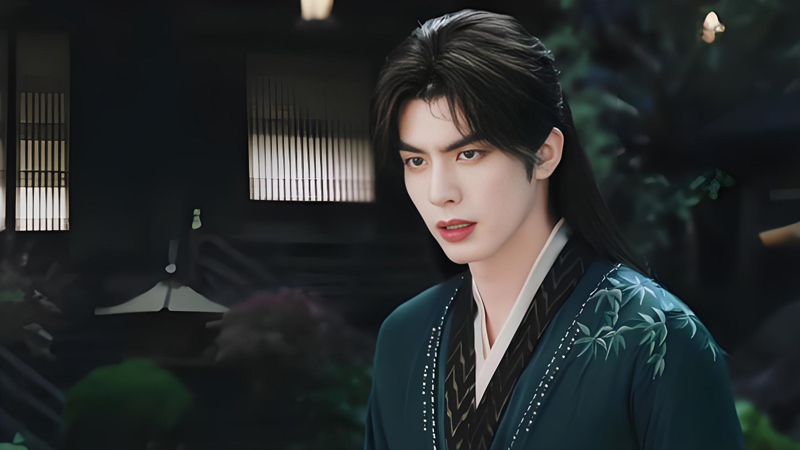
Qin Yangling’s character functions as the antagonist who operates within the rules of reality, unlike the monsters of the miasma. His suspicion is more dangerous than any physical attack because it threatens exposure. The episode makes a point to remind us that if it weren’t for the interference of their masters, Lei Xiuyuan would have already dealt with him permanently. This sets up a classic thriller dynamic: the villain doesn’t need to win; he just needs to share what he knows. His knowledge turns him into a ticking time bomb waiting for the right moment to explode.
By shifting the conflict away from the immediate threat of the dreams and onto the political and social consequences of a revealed identity, the series raises the stakes significantly. The dream was the starter; the main course is the persecution that follows. We are reminded that the true tragedy here isn’t a magical betrayal, but the societal rejection of what is different. The “killing the master” was a phantom pain, but the hatred Qin Yangling represents is very real. The series wisely uses the resolution of the fantasy conflict to pivot toward the crueler, more grounded conflicts of identity and prejudice that await.