
From June 26 to August 23, 2026, the “Silk Road Nichang — Hami Ancient Costume Exhibition” is open to the public at the Guangxi Museum of Nationalities in Nanning. Co-hosted by the Guangxi Museum of Nationalities and the Hami City Museum, this touring exhibition displays over 80 sets of Hami’s archaeological treasures across four thematic chapters, tracing the full arc of Hami’s dress history from the Bronze Age through the Qing dynasty to contemporary ICH transmission.
Hami, strategically positioned at the eastern gateway to the Silk Road into Xinjiang, has served as a cultural convergence zone where Central Plains silk techniques traveled west and Western Region wool and leather crafts moved east. The exhibition uses costume artifacts to present this dual-flow cultural exchange as visual evidence of a pluralistic yet integrated Chinese civilization.

3,200-Year-Old Textile Evidence
The first chapter, “Weaving Origins,” presents artifacts excavated from Wubao, Yanbulake, and Aisikexiaer sites. A striped wool cloth, a leather coat, a felt hat, and ancient spinning wheels — all dating back approximately 3,200 years — demonstrate that sophisticated weaving, dyeing, and leather-tanning skills existed in Hami well before the Han dynasty Silk Road was formally established. The exhibit’s oldest item, a Bronze Age leather coat with mysterious surface patterns, has become a visitor favorite for its visceral proof that textile culture in the region predates written records.
Pattern and Color: Qing Dynasty Robes
The second chapter, “Pattern and Color,” showcases Qing-era Uyghur long robes, short jackets, and vests. These garments fuse Central Plains tailoring conventions with Western Region aesthetics — peony, pine-crane, dragon-phoenix, pomegranate, and swastika motifs interlock across boldly clashing red, blue, and green surfaces. Hami embroidery reached its peak during the Qing period, absorbing Suzhou and Beijing embroidery needlework techniques including flat stitch, gold-wrapped stitch, and rush-stitch embroidery. Each thread combination reflects multi-ethnic aesthetic negotiation.
The third chapter, “Custom and Ritual,” displays artifacts with unmistakable Central Plains dress-code characteristics:pankou fasteners, mamianqun (horse-face skirts), pipajin (lute-front) vests, and Qing official rank badges with flying-bird (civil) and beast (military) motifs. Eight-treasure, standing-water, and sea-cliff wave patterns appear clearly, providing tangible proof that Qing-era central governance extended into Hami and that Central Plains dress codes took root in the borderlands.
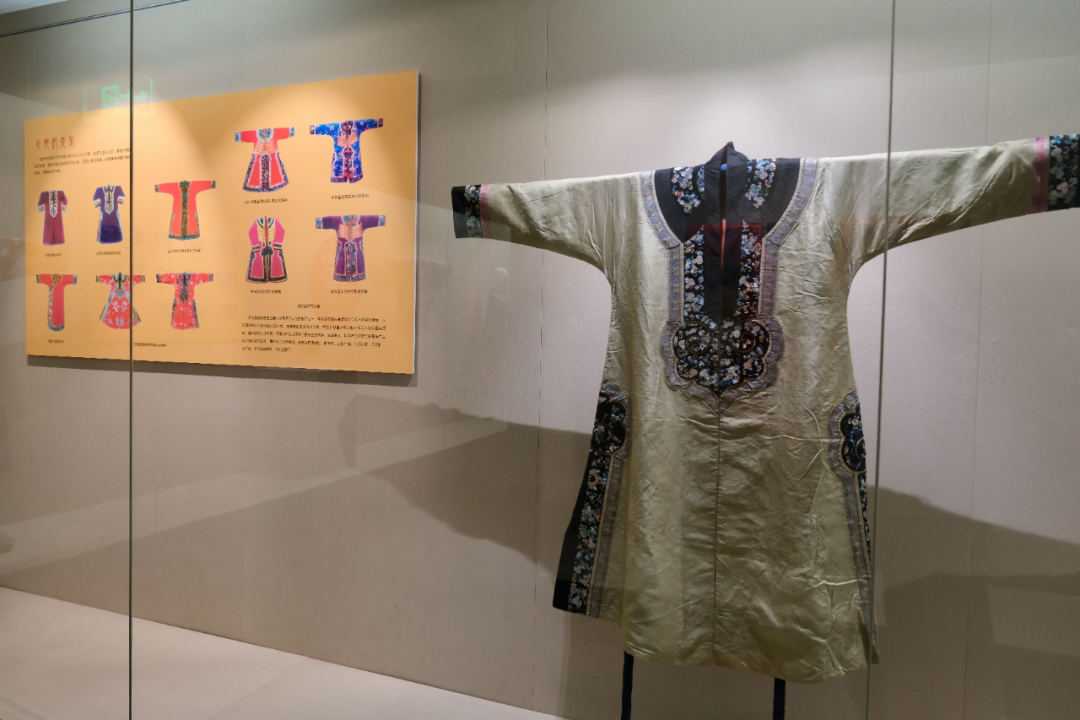
The fourth chapter, “ICH Blooming,” focuses on Hami Uyghur embroidery — a national-level ICH craft. Traditional embroidery tools, needlework diagrams, and modern innovation pieces are displayed together, mapping the full arc from embroidery frames and silk threads to contemporary designers’ updated garments and cultural-creative products. This chapter makes visible the pathway from museum artifact to daily-life application, showing how a thousand-year craft adapts without losing its core identity.
The exhibition runs through August 23 at the Guangxi Museum of Nationalities’ D2 temporary gallery on the second floor of the main building. Admission is free. A companion set of exhibition stamps and sticker sheets is available at the museum shop. After Nanning, the exhibition will continue to the Beijing Art Museum and Jinan Museum as part of its national tour.