
On June 30, 2026, the “Splendid China” Zhuangjin Brocade Innovation and Entrepreneurship Competition launched its national call for entries at Beijing Garden Expo Park’s EVE Castle. Operated by EVE China Handcraft Workshop, the competition offers a total prize pool of CNY 124,000 and accepts submissions through August 20, with an awards ceremony planned for late October.

Zhuangjin brocade, one of China’s four legendary brocades alongside Songjin, Yunjin, and Shujin, has been woven by the Zhuang ethnic group for over a millennium. In 2006, Zhuangjin weaving was inscribed on China’s first national intangible cultural heritage list. The competition aims to bridge this ancient craft with contemporary markets through four design tracks: cultural-creative design, clothing and accessories, IP visual identity, and digital products.
All entries must adhere to five guiding principles. Originality requires every submission to be the creator’s own work with no copyright disputes. Cultural depth demands that designs integrate Xincheng Zhuangjin’s ICH heritage and Zhuang ethnic character while embodying a shared Chinese national identity. Innovation calls for breaking stereotypes associated with traditional ICH and aligning with modern aesthetics and guochao trends. Practical viability ensures designs can be manufactured within Xincheng’s existing silk weaving and cocoon-silk processing supply chains. Finally, standardization requires all submissions to follow a unified template for fair evaluation.
The competition introduces a four-dimensional jury system combining museum and ICH experts, academic scholars from universities, brand and industry professionals, and local manufacturing representatives. This panel evaluates entries across cultural fit, design innovation, market viability, and brand communication potential. The stated goal is “award equals launch, entry equals empowerment” — winning designs will move directly from concept sketches to commercial production through EVE China Handcraft Workshop’s retail and manufacturing networks.
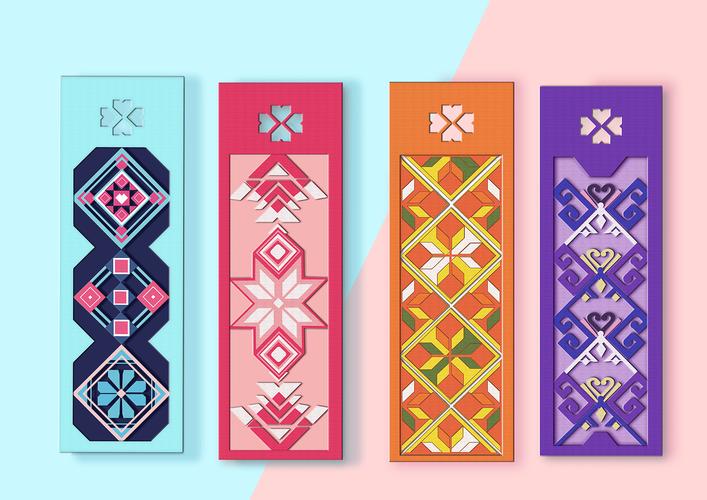
Xincheng Zhuangjin AIGC Pattern Database
The launch event simultaneously unveiled the Xincheng Zhuangjin AIGC Pattern Database, the first-ever AI-powered digital archive of Zhuangjin’s traditional geometric patterns. This database consolidates centuries of Zhuangjin textile motifs into standardized, commercially licensed design assets available to all competition participants. By converting hand-woven patterns into machine-readable formats, the AIGC system allows designers to generate new variations rooted in authentic Zhuangjin aesthetics without manually replicating each geometric unit.
The database represents a significant shift in how ethnic textile heritage enters the digital economy. Rather than simply photographing archival textiles, the AIGC approach deconstructs pattern logic — the repetitive geometric grids, color sequences, and structural rhythms that define Zhuangjin’s visual identity — and makes them computationally remixable. Designers working in the IP visual and digital product tracks can directly draw from this library, while those in the clothing and accessories track can use AIGC-generated patterns as print or embroidery source files.
The competition is not a standalone design contest. Li-Ning, EVE, and Jiaduobao anchor the brand partnership network, providing manufacturing capacity, retail channels, and marketing platforms for winning entries. National university think tanks, ICH industry associations, and Xincheng’s local weaving and cocoon-silk industries form the production backbone. The organizing principle — “attract talent through competition, attract commerce through talent, promote production through commerce” — positions the event as an end-to-end industry conversion channel rather than a trophy-only exercise.
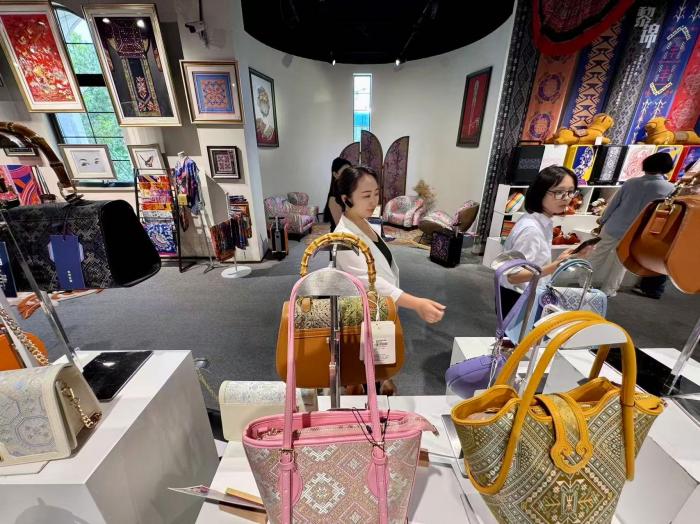
Expert Dialogue and Policy Context
Huang Hui, member of the Xincheng County Standing Committee and deputy county head, presented Xincheng’s Zhuangjin industry foundation and ICH development roadmap at the launch. A salon discussion featured experts from the University of International Business and Economics, Tsinghua University, Central Minzu University, and the ethnic costume heritage standardization field, covering topics from Zhuangjin preservation and commercialization to industry-wide quality standards.
Xincheng County in Laibin City, Guangxi Zhuang Autonomous Region, has positioned Zhuangjin as a pillar of its cultural-industrial strategy. The cocoon-silk processing chain already operates at scale locally, and the AIGC database plus the competition’s four-track structure are designed to inject new design intelligence and market demand into this existing production infrastructure.
Understanding the competition’s ambition requires understanding the craft it seeks to modernize. Zhuangjin, literally “Zhuang brocade,” has been woven continuously for over a thousand years by the Zhuang people of Guangxi. Its defining visual feature is geometric pattern repetition — diamond grids, zigzag bands, and concentric square motifs woven in contrasting red, blue, yellow, and black threads on a cotton or silk ground cloth. Unlike Yunjin’s pictorial complexity or Songjin’s gold-thread density, Zhuangjin’s strength lies in modular simplicity: each pattern unit is small, repeatable, and combinable into larger compositions, making it inherently suited to digital decomposition and algorithmic remixing.
This structural quality is precisely what makes Zhuangjin the ideal candidate for AIGC intervention. Where a Yunjin cloud-dragon motif is a single irreducible composition, a Zhuangjin diamond-grid can be isolated, rotated, scaled, and reassembled without losing its identity. The AIGC database exploits this modular logic at the algorithmic level, producing infinite pattern variations that remain recognizably Zhuangjin — a property that no other major Chinese brocade shares as readily.
The Cocoon-Silk Advantage
Xincheng County is not merely a cultural heritage site — it is a functioning cocoon-silk production hub. The county’s cocoon-silk processing chain produces raw silk, spun yarn, and finished textiles at commercial scale, giving winning designs an immediate manufacturing pathway that most ICH competitions cannot offer. Where many heritage design contests produce beautiful prototypes that never reach store shelves, the Zhuangjin competition’s link to Xincheng’s existing cocoon-silk industry means that a winning garment pattern can move from design file to woven fabric to retail product within the same county boundary.
Li-Ning’s participation signals the sportswear giant’s interest in ethnic textile integration — potentially applying Zhuangjin geometric patterns to athletic apparel, a category far removed from traditional ICH application yet perfectly suited to the modular, high-contrast visual vocabulary Zhuangjin provides. EVE China Handcraft Workshop’s retail network and international exhibition experience give the competition direct access to both domestic and overseas consumer markets. Jiaduobao, primarily a beverage brand, brings marketing visibility through its nationwide advertising infrastructure.
How to Enter
Submissions open from June 30 to August 20, 2026, at 18:00. Designers, university students, cultural-creative institutions, and brand partners can register via the EVE China Handcraft Workshop official WeChat account or the competition’s designated email (jxzh_zjcxcyds@163.com). By late October, winning designs will enter mass production and retail distribution through EVE’s platform, completing the journey from sketch to shelf — and from ethnic textile heritage to national consumer product.