
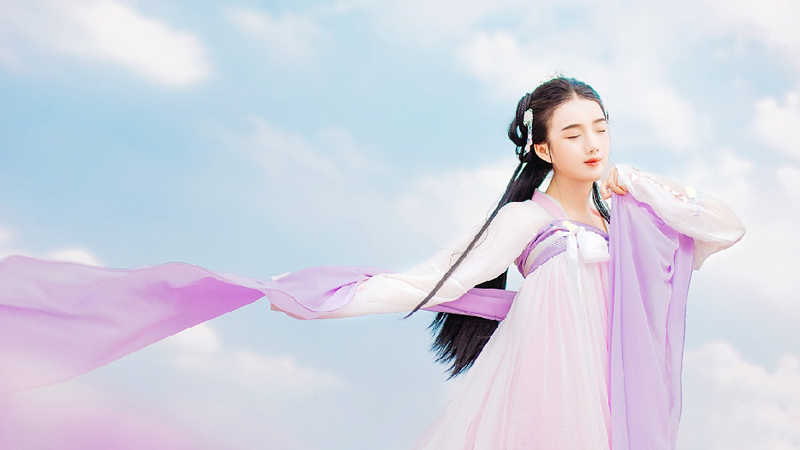
In the historical drama The First Jasmine (莫离), the heroine (played by Bai Lu) and her fellow female characters are almost never seen without a long strip of fabric draped over their forearms. It seems to serve no practical purpose—it is not tied, pinned, or used to carry anything. So why is everyone wearing it?
The answer lies not in modern fashion whims, but in the golden age of the Tang Dynasty (618–907 AD), where this accessory, known as the Pibo (披帛), was an indispensable part of a woman’s wardrobe. More than just a costume choice, it was a tool for visual storytelling, a subtle regulator of posture, and a silent announcement of social status.
The Silk Road Influence
The story of the Pibo begins not in the imperial courts of China, but along the dusty trade routes of Central Asia. During the Wei-Jin period (220–420 AD), Persian cultural influences began filtering into the Central Plains. Among these was a practical garment: a long scarf worn over the shoulders by women in the Western Regions to shield themselves from harsh sandstorms and glaring sunlight. Initially, it was a simple accessory made of wool, but as it migrated eastward, its form and function changed dramatically.
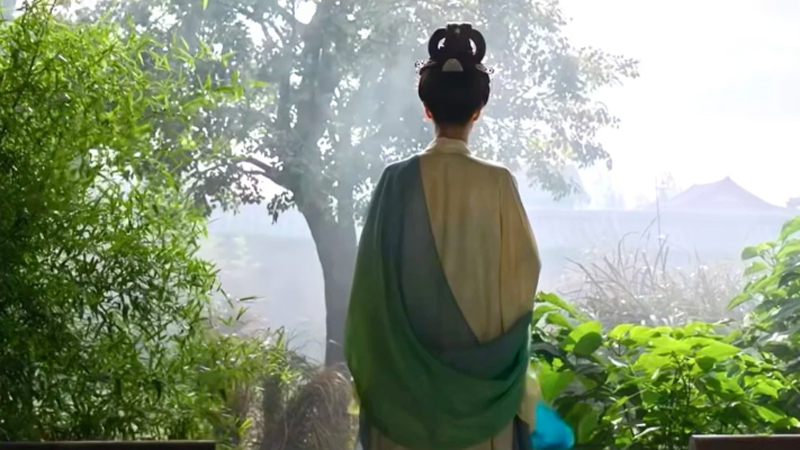
By the time it reached the heart of the Tang Empire, the scarf had shed its practical origins and become a symbol of elegance. The coarse wool was replaced by luxurious silks, and its dimensions expanded significantly. It was no longer just a scarf; it became a flowing ribbon of fabric that could be draped in multiple ways. Historical evidence, such as the murals in the tomb of Xu Xianxiu (徐显秀) in Taiyuan, Shanxi, dating back to the Northern Qi Dynasty, already depict serving women wearing this draped garment. This transition from utility to ornamentation set the stage for its golden era.
The Art of Draping
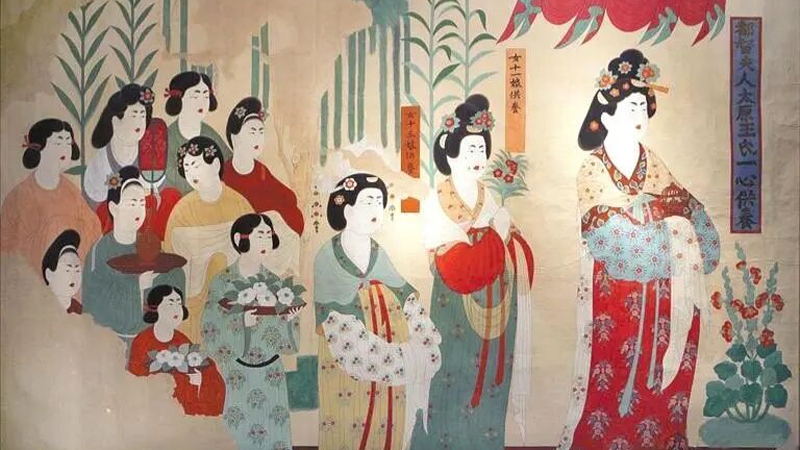
The Tang Dynasty marked the peak of the Pibo’s popularity, but how it was worn was not uniform. It reflected the wearer’s activity and the occasion. One of the most common methods was the “arm-wrapping style”. Here, the Pibo was thrown over the back, passed over the shoulders, and the two ends were brought to the front. Each end was then looped over the outer side of the forearms, finally hanging down beside the waist or skirt. This technique was incredibly practical for everyday movement, as the arms’ natural position kept the fabric securely in place. This specific drape is prominently visible in famous Tang paintings like Beauties Wearing Flowers (花仕女图) and Court Ladies Preparing Newly Woven Silk (捣练图).
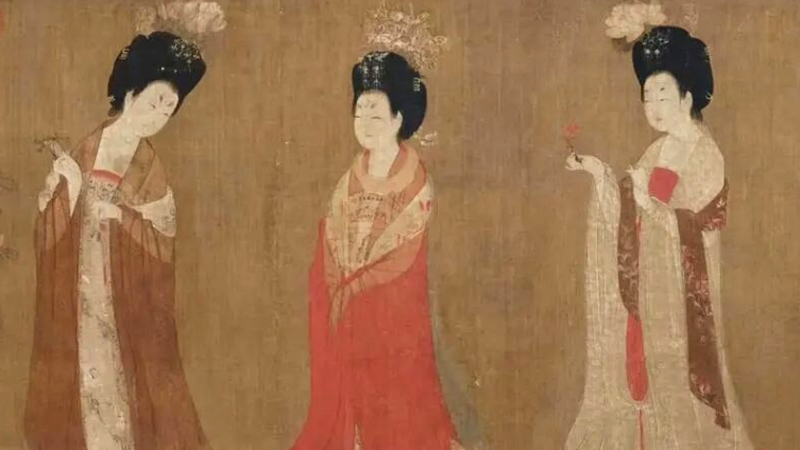
For less formal settings, women often opted for the “single-side hanging style”. This was a more asymmetrical and casual approach. The Pibo would cross the back, drape over one shoulder to hang down the front, while the other end was casually tossed over the opposite arm. This lack of symmetry gave it a relaxed, spontaneous feel, making it a favorite for daily activities. This style is frequently observed on the murals of the tomb of Princess Yongtai (永泰) in Qianling (乾陵), Shanxi, and interestingly, it is also the most replicated style in the drama The First Jasmine, lending the characters a sense of natural grace.
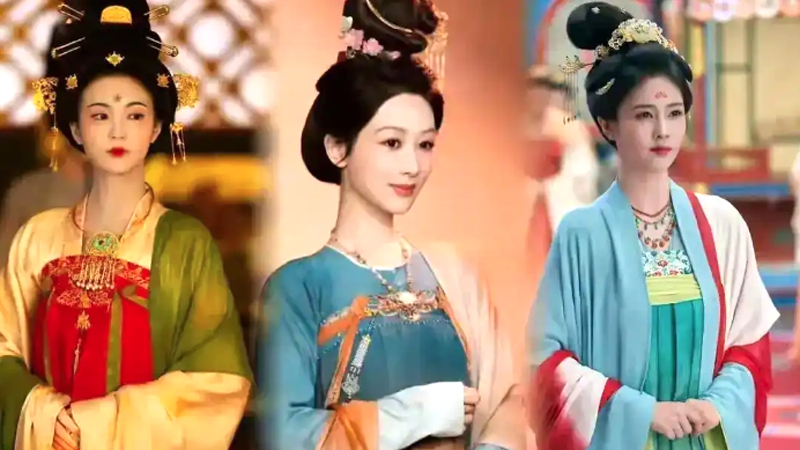
When it came to formal ceremonies, however, the draping required a more stately appearance. The “chest-crossing style”, also known as the “grand Pibo,” involved wrapping the fabric from the back to the front, crossing it over the chest, and then looping it over the arms so the ends hung down past the hem of the skirt, sometimes even trailing on the floor. The extra layer across the chest created a heavier, more dignified silhouette, fit for ritual occasions. Portraits of noble donors from Cave 130 at the Mogao Grottoes (莫高窟) in Dunhuang show high-born ladies adorned in precisely this manner. The most demanding was the “back-dropping style”, where the fabric simply hung straight down the back without any arm support, requiring the wearer to maintain perfect posture or risk the scarf slipping off entirely.
Fashion, Function, and Status
Why was this seemingly fragile piece of fabric so cherished? Firstly, it served to modify the female silhouette. The standard Tang Dynasty court dress featured a narrow, tight top and an extremely voluminous, expansive skirt that began just below the bust. This created a distinct triangular shape. The Pibo’s soft, curved lines, draped across the arms, effectively softened the transition between the tight bodice and the wide skirt, adding a dynamic, horizontal flow to the vertical structure of the outfit. It made the overall look less severe and more ethereal.
Secondly, it was a tool for physical restraint. Because the Pibo had no pins or attachments, it relied entirely on the support of the wearer’s shoulders and arms. This demanded that a woman keep her shoulders back, her spine straight, and her movements fluid and unhurried. It was, in essence, a silent postural coach. If she slouched, it fell; if she moved too quickly, it tangled. The visual impression of weightless freedom was, ironically, achieved through strict bodily control, making it a perfect symbol of cultivated grace in ancient society.
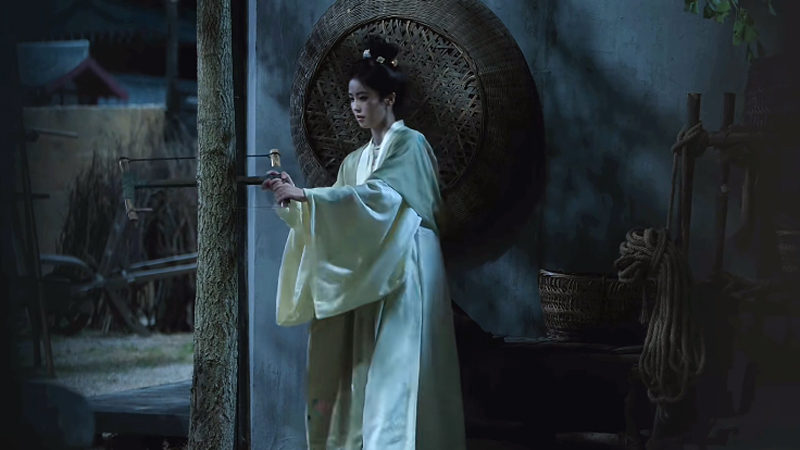
Finally, and perhaps most importantly, the Pibo was a clear marker of social standing. In an era when silk was a precious commodity, a single Pibo could be made from materials as extravagant as light-gauze silk , tie-dyed yarn, or even silk painted with silver and gold. Only those of means could afford such luxurious textiles. Thus, by simply draping a specific Pibo over their arms, a noblewoman was visibly announcing her wealth and rank. This visual code of status has been beautifully translated into The First Jasmine. By donning their various Pibo, the characters do more than merely reference history; they present a vivid, textured visual feast, reminding us that in the Tang Dynasty, even the smallest piece of fabric could speak volumes.