
Hangzhou hosted the Huaxia Yiguan International Hanfu Culture Day on June 17, 2026, a one-day immersive hanfu experience co-organized by Hangzhou’s International Online Communication Center and timed to coincide with the China International Cartoon and Animation Festival. More than 100 Chinese and international students took part in lectures, a hanfu runway showcase, traditional folk-game stations, and a joint visit to the animation festival in hanfu attire.
The event’s working theme, “Wear the Garments of Hua Xia, Keep an Appointment with the World,” sets the framing: the organizers are positioning hanfu not as a domestic-only heritage practice but as a portable, internationally legible cultural vocabulary. The pairing with the China International Cartoon and Animation Festival, one of China’s largest annual pop-culture events, is deliberate. The festival draws international visitors, industry buyers, and content creators, and the organizers wanted the hanfu experience to land inside that existing international audience rather than in a parallel closed-door event.
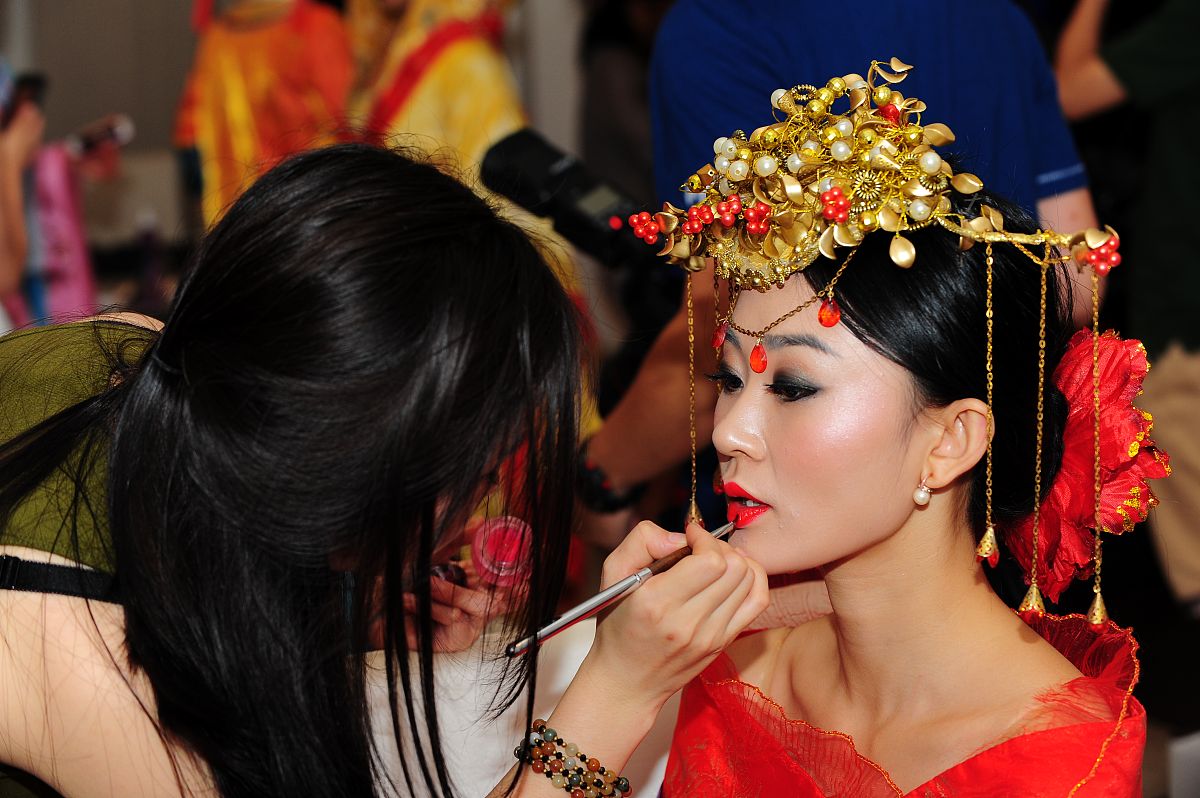
Lecture: Hanfu as a Wearable Civilization History
The day’s content opened with a lecture by Shi Jinjing, a national-level makeup artist, writer, and long-time hanfu practitioner, titled “Hanfu Culture and the Global Circulation of Chinese Aesthetics.” Shi’s talk walked the audience from the legendary origin phrase “the Yellow Emperor hung the robes and the world was ordered” — the canonical origin myth for clothing as a marker of civilization in Chinese tradition — through the rustic silhouette conventions of the Qin and Han dynasties and into the minimalist elegance of the Song-dynasty palette and silhouette. The argument was that hanfu is best understood not as a static costume but as a record of changing Chinese aesthetic philosophies: each dynasty’s clothing is also a statement about how the wearer wanted to be seen.
The talk was delivered in Chinese with simultaneous visual support, and the Q&A after the lecture drew the heaviest engagement from the international students, several of whom said the dynasty-by-dynasty visual breakdown was the first time they had seen Chinese clothing history organized as a connected narrative rather than a set of unrelated costume plates.
The afternoon runway segment, “Hanfu Elegance, Walking Together,” paired Chinese and international students as co-presenters. After a brief runway walk, the students moved into a rotating set of folk-game stations. The touhu (pitch-pot) station taught the arc-and-release mechanics of the pre-Qin era’s classic ceremonial drinking-game. The she-wudu (“shoot the five poisons”) archery station framed the practice as a Duanwu Festival ritual for warding off disease and misfortune. The chuiwan station introduced a stick-and-ball game widely considered a progenitor of golf. The cuju station was a structured football-style kicking game. A puzzle zone featured the Luban lock, the nine-ring puzzle, and the Huarong dao sliding-block puzzle, all of which drew sustained engagement from the international students.
The Animation Festival Crossover
After the on-site hanfu program, the international student cohort walked in hanfu to the China International Cartoon and Animation Festival venue, where they posed for photographs alongside domestic cosplayers, IP mascots, and traditional-style animation characters. The crossover was the event’s most photographed moment: a group of international students in hanfu, walking through a pop-culture venue, produced the kind of cross-audience imagery the organizers were aiming for.
The June 17 program is the second annual edition of the Hangzhou International Hanfu Culture Day, and the explicit pitch is that hanfu can function as a translation tool for Chinese cultural exports. The organizers chose the China International Cartoon and Animation Festival as the host venue because the festival already brings in international visitors who are open to Chinese cultural content but who may not have a structured way to engage with hanfu specifically. The hanfu-day program gives that international cohort a four-hour on-ramp: a lecture, a runway, a folk-game rotation, and a pop-culture crossover. The longer-term goal, according to the organizers, is to convert the event from a one-day showcase into a recurring international exchange format tied to the animation festival calendar.